As an Amazon Associate I earn from qualifying purchases.
The best compact generators for camping in 2026 are not necessarily the biggest or most powerful models. For most campers, the better choice is a portable power source that provides enough electricity for your actual gear while keeping weight, noise, fuel use, and setup manageable.
Some campers only need enough power for phones, lights, cameras, and a laptop. Others need a gasoline inverter generator capable of running a portable refrigerator, CPAP machine, coffee maker, or other higher-draw equipment. RV campers may need considerably more starting and running wattage, especially when an air conditioner is involved.
This guide compares five compact portable power options, including gasoline inverter generators and a small battery power station. The models range from an ultra-light battery unit to 2,500-watt-class inverter generators, giving campers several ways to approach portable power.
Compact Camping Generators at a Glance
| Model | Power Output | Weight | Fuel / Power Type | Best For |
|---|---|---|---|---|
| PowerSmart Gas Portable Generator 1200W | Up to 1,200W class | Lightweight | Gasoline | Basic camping power |
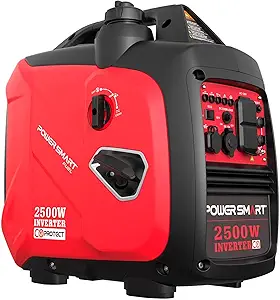
| PowerSmart 2500-Watt Inverter Generator | 1,900W running / 2,500W starting | 39.7 lb | Gasoline | General camping and higher-demand loads |
| MARBERO Portable Power Station 88Wh | Small AC output | 3.2 lb | Battery | Phones, lights and small electronics |
| ERAYAK 2400W Portable Inverter Generator | 1,800W running / 2,400W peak | 42 lb | Gasoline | Longer camping trips and versatile outdoor use |
| GENMAX 1200W Ultra-Quiet Inverter Generator | 1,200W class | About 25 lb | Gasoline | Lightweight camping and tailgating |
The most important difference is between the MARBERO and the gasoline models. The MARBERO is a battery power station, so it produces no engine noise and does not require gasoline. The other four products are fuel-powered inverter generators designed for longer runtime and higher power demands.
PowerSmart Gas Lightweight Generator 1200W
Check Amazon Price: Click Here
The PowerSmart 1200W gasoline generator is designed for campers who need more power than a small battery pack can provide without moving up to a large generator.
Its compact format makes it suitable for basic outdoor power needs such as campsite lighting, charging devices, small appliances, and selected low-wattage tools. Because it is a gasoline-powered generator, however, it should always be operated outdoors and away from tents, RV interiors, doors, windows, and other enclosed areas.
For campers, the biggest advantage of a generator in this class is the ability to refuel and continue operating rather than being limited to the stored energy of a battery.
Why consider the PowerSmart 1200W?
- Compact gasoline-powered design
- Useful for basic campsite electricity
- Suitable for charging electronics and running selected small appliances
- More practical for extended trips than a very small battery station when gasoline is available
- A reasonable option for campers who do not need 2,000 watts or more
This type of generator is best suited to campers who have a relatively modest electrical load. Before buying, add the running watts of the equipment you expect to use and check the starting wattage of appliances with electric motors.
PowerSmart 2500-Watt Inverter Generator
Check Amazon Price: Click Here
The PowerSmart 2500W inverter generator is one of the more versatile options in this group. It produces 2,500 starting watts and 1,900 running watts, weighs approximately 39.7 pounds, and uses inverter technology to provide cleaner electrical output for electronics. The manufacturer and retail listings also specify Eco Mode, low-oil shutdown, overload protection, CO protection on applicable versions, and parallel capability.
Its 1,900 running watts make it substantially more capable than a 1,200-watt compact generator. That gives campers more flexibility when several devices need to operate at the same time.
The generator is also rated for approximately 5.5 hours at 50% load, although actual runtime varies according to the load and operating conditions.
What can a 1,900W running generator handle?
It can be appropriate for a combination of common camping equipment, but you should calculate your total load rather than assuming the generator can power everything simultaneously.
For example, you might use it for:
- Portable refrigerators
- Lights
- Phone and laptop chargers
- Small TVs
- Fans
- Selected cooking appliances
- CPAP machines
- Other modest campsite loads
High-wattage appliances such as electric heaters, large induction cooktops, and RV air conditioners can require substantially more power, especially during startup.
What makes it useful for camping?
The combination of relatively low weight, inverter technology, Eco Mode, and parallel capability gives the PowerSmart a useful balance for campers who need more than a mini generator but do not want a large conventional generator.
Noise specifications vary by load and listing, so campers should check the current product documentation rather than assuming that one dBA number applies under every operating condition.
MARBERO Portable Power Station 88Wh
Check Amazon Price: Click Here
The MARBERO 88Wh is different from the gasoline generators in this guide. It is a compact battery power station designed primarily for small electronics and low-power applications.
At roughly 3.2 pounds, its biggest advantage is portability. You can carry it to a campsite without dealing with gasoline, engine maintenance, exhaust, or engine noise.
That makes it particularly useful for:
- Smartphones
- Small LED lights
- Cameras
- USB devices
- Small electronics
- Short camping trips
- Emergency charging
Battery capacity is measured in watt-hours (Wh) rather than generator output in running watts. The 88Wh rating describes stored energy, not how long every device will run. Actual usable energy at the AC outlet can be lower because of conversion losses.
Who should choose the MARBERO?
This power station makes the most sense when your primary goal is keeping small electronics charged.
If you want to run a refrigerator, coffee maker, heater, microwave, or other high-wattage appliance for extended periods, a larger power station or gasoline inverter generator will generally be more appropriate.
The MARBERO is therefore best viewed as a lightweight camping power station, rather than a replacement for a 2,000-watt-class gasoline generator.
ERAYAK 2400W Portable Inverter Generator
Check Amazon Price: Click Here
The ERAYAK 2400W portable inverter generator offers 2,400 peak watts and 1,800 running watts while weighing approximately 42 pounds. Available specifications also list a noise level around 52.5 dB at 25% load, inverter technology, and multiple AC, USB, and DC outputs.
That combination makes it a practical middle ground for campers who need more power than a 1,200-watt generator but want to avoid moving into a much heavier generator class.
One of its notable features is its Eco Mode. Under light loads, the engine can reduce fuel consumption compared with continuously operating at higher output. Manufacturer and retailer information also cites long runtime figures under light-load conditions, so those numbers should not be interpreted as full-load runtime.
What is the ERAYAK 2400W good for?
The 1,800 running watts give you room for several typical camping loads, although you still need to account for startup surges from motor-driven appliances.
It can be useful for:
- Camping appliances
- Portable refrigerators
- Lights
- Electronics
- Chargers
- Small outdoor equipment
- Selected RV loads
- Emergency backup
At 42 pounds, it is still portable enough for many car-camping setups, although it is considerably heavier than a small battery power station.
GENMAX 1200W Ultra-Quiet Inverter Generator
Check Amazon Price: Click Here
The GENMAX GM1200i is designed for campers who put a high priority on keeping the generator small and easy to transport.
GENMAX lists a 57cc four-stroke OHV engine, a body weight of about 25 pounds, and approximately 58 dB at quarter load. It also uses inverter technology with total harmonic distortion below 1.2%, according to the manufacturer.
Its lightweight design is one of the biggest advantages. Carrying a 25-pound generator from a vehicle to a campsite is considerably easier than moving a 70- to 100-pound conventional unit.
Why choose the GENMAX 1200W?
- Approximately 25 pounds
- Compact design
- Inverter technology
- Low THD specification
- CO detection on the current GM1200i version
- Parallel capability with the appropriate setup
- Useful for smaller camping loads
The tradeoff is power. A 1,200-watt-class generator is not intended to run the same collection of appliances as a 2,000- or 3,000-watt generator.
For tent camping, tailgating, and basic car camping, however, its lower weight can be more valuable than having substantially more power that you never use.
How Much Generator Power Do You Need for Camping?
Choosing a generator by its largest wattage number is one of the easiest ways to end up with the wrong model.
Instead, make a list of everything you expect to run and identify both the running watts and starting watts.
Running watts represent the electricity an appliance needs while operating. Starting watts are the temporary surge required by some motors and compressors when they turn on.
For example, a refrigerator may use substantially more electricity for a brief period when its compressor starts than it uses once it is running.
Basic camping
If you mainly need:
- Phones
- Cameras
- LED lights
- Small fans
- Tablets
- Laptops
A small battery power station may be sufficient.
Car camping with more equipment
If you want to run:
- A portable refrigerator
- Lights
- Fans
- Electronics
- A CPAP
- Small appliances
A generator in the 1,200W to 2,000W running-watt range can provide considerably more flexibility.
Higher-demand camping and RV use
If you need to operate:
- RV air conditioning
- Microwave ovens
- Coffee makers
- Electric cooking appliances
- Multiple appliances simultaneously
You may need a substantially larger generator. RV air conditioners can have significant startup demands, so do not select a generator based only on the appliance’s running wattage.
Gas Generator vs. Battery Power Station for Camping
Both technologies have advantages, and neither is automatically the right choice for every camping trip.
Battery Power Stations
Battery power stations are especially convenient when quiet operation is important.
They have no gasoline engine, produce no exhaust while operating, and can be useful for nighttime loads such as phones, lights and CPAP equipment.
The limitation is stored energy. Once the battery is depleted, you need an appropriate charging source such as AC power, solar panels, or a vehicle charging system.
Gasoline Inverter Generators
Gasoline generators are more suitable when you need higher sustained output or expect to camp for several days without convenient access to electrical charging.
You can carry additional fuel and continue operating as long as the generator is maintained and safely refueled.
The tradeoffs are engine noise, fuel storage, maintenance, exhaust, and carbon monoxide risk.
For many campers, the choice comes down to one simple question:
Do you need stored battery energy for small electronics, or do you need continuous fuel-powered electricity for larger loads?
Features That Matter Most in a Camping Generator
1. Noise Level
Noise can be just as important as wattage at a campground.
A generator that is powerful enough for your equipment but too loud for the campground’s rules is not a practical camping solution.
Inverter generators are generally designed to operate more quietly than traditional open-frame generators. However, noise ratings must be compared carefully because manufacturers may specify different loads and measurement distances.
Always check the campground’s generator hours and noise restrictions before your trip.
2. Weight and Portability
A generator has to be moved.
A 25-pound model can be carried by one person relatively easily, while a much heavier generator may require wheels or two people.
For tent and car camping, weight can therefore be more important than having several thousand watts of unused capacity.
The GENMAX, at about 25 pounds, targets campers who prioritize portability. The PowerSmart and ERAYAK models around 40 to 42 pounds offer considerably more power while remaining manageable for many vehicle-based camping setups.
3. Inverter Technology and Clean Power
Inverter generators are popular for camping because they can provide stable electrical output for electronics.
This can be useful for:
- Laptops
- Phones
- Cameras
- TVs
- Chargers
- CPAP machines
However, “inverter” should not be treated as a substitute for reading the manufacturer’s specifications. Check the generator’s THD specification and the requirements of any sensitive equipment you intend to operate.
4. Carbon Monoxide Protection
Carbon monoxide is one of the most important safety considerations when using a gasoline generator.
Never operate a gasoline generator inside a tent, RV, garage, vehicle, shed, or other enclosed or partially enclosed space.
CO protection can automatically shut down some generators when dangerous carbon monoxide levels are detected, but this is an additional safety feature—not permission to operate the generator in an enclosed area.
5. Runtime
Runtime depends heavily on load.
A generator might operate for many hours at a light load but considerably less time when running close to its maximum output.
For example, the PowerSmart 2500W model is listed at approximately 5.5 hours at 50% load.
When comparing generators, always ask:
At what load was the advertised runtime measured?
A runtime number without a load percentage can be misleading.
6. Fuel Type
Gasoline remains common among compact generators because it is widely available and provides a high amount of stored energy in a relatively small amount of fuel.
Dual-fuel models can provide additional flexibility, but they may also be heavier and more expensive.
For short trips with light electrical demands, a battery power station can eliminate the need to transport fuel altogether.
Best Uses for Compact Camping Generators
Weekend Camping
For a short camping trip, you may not need a large generator.
A compact inverter generator can handle basic appliances and electronics, while a small battery power station can be enough for phones, lights, cameras, and similar devices.
RV Camping
RV users should calculate their electrical requirements before choosing a generator.
Air conditioners, microwaves, refrigerators and other appliances can quickly push power requirements beyond what a 1,200-watt generator can provide.
If you need to power an RV air conditioner, pay particular attention to starting watts and the generator’s continuous running capacity.
Tailgating
Tailgating often requires portable power for speakers, TVs, lights, fans and cooking equipment.
A compact inverter generator can provide more sustained power than a small battery station, while a battery station has the advantage of silent operation.
Emergency Backup
Compact generators can also provide temporary power during an outage.
However, the correct setup depends on what you need to operate. A small generator can charge electronics and power selected appliances, but it is not necessarily capable of supplying an entire home.
Never connect a portable generator directly to household wiring without an appropriate transfer switch or other professionally installed connection method.
Camping Generator Maintenance and Safety Tips
Before taking a gasoline generator camping, inspect it and follow the manufacturer’s maintenance schedule.
- Use the recommended fuel and engine oil.
- Check the oil level before operation.
- Inspect the air filter regularly.
- Keep the generator on a stable, dry outdoor surface.
- Keep the generator away from tents, vehicles, RVs, doors and windows.
- Never operate a gasoline generator indoors or in an enclosed space.
- Allow the generator to cool before refueling.
- Do not refuel while the engine is running or hot.
- Keep fuel containers away from ignition sources.
- Keep electrical connections dry.
- Follow the manufacturer’s instructions for storage.
- Test CO protection features according to the owner’s manual when applicable.
- Follow campground rules regarding generator hours and noise.
For battery power stations, keep the unit dry, avoid excessive heat, and follow the manufacturer’s charging and storage recommendations.
Frequently Asked Questions
What is the best size generator for camping?
For basic tent and car camping, a generator around 1,200 to 2,000 running watts can cover many common electrical needs. If you need an RV air conditioner, microwave, electric cooking appliances, or several high-demand devices at once, you may need considerably more capacity.
Are inverter generators good for camping?
Yes. Inverter generators are popular for camping because they are generally quieter and provide clean electrical output for electronics. They are particularly useful when noise, portability, and stable power are important considerations.
Is a battery power station better than a gas generator for camping?
It depends on your electrical needs. Battery power stations are silent and convenient for smaller loads, while gasoline generators can provide continuous power as long as you have fuel. A battery station is often convenient for electronics, whereas a gas inverter generator is more practical for higher sustained loads.
What is the quietest type of generator for camping?
Battery power stations are effectively silent because they do not use an engine. Among gasoline generators, compact inverter models are generally much quieter than conventional open-frame generators. Always compare the manufacturer’s dBA rating at the same measurement distance and load.
Can I run a CPAP machine with a camping generator?
Many appropriately sized inverter generators and battery power stations can provide power for a CPAP machine. However, you should check the CPAP manufacturer’s power requirements and any humidifier or heated-tube settings because those can significantly increase energy consumption.
Can a 1,200-watt generator run an RV air conditioner?
It depends on the specific air conditioner, but a 1,200-watt generator is generally a poor choice for typical RV air-conditioning loads because startup requirements can be much higher than the unit’s running wattage. Check both the generator’s running and starting capacity and the air conditioner’s specifications.
How far should a gasoline generator be from a tent?
Follow the generator manufacturer’s safety instructions and applicable safety guidance, but never operate a gasoline generator inside or near an enclosed sleeping area. Carbon monoxide can accumulate quickly, so the generator should be positioned outdoors and away from tents, RVs, doors, windows and other openings.
Are compact generators safe for sensitive electronics?
Inverter generators are designed to provide stable electrical output and are commonly used with electronics. Look at the manufacturer’s THD specification rather than relying only on the word “inverter.” For medical equipment, always follow the equipment manufacturer’s power requirements.
Final Thoughts on Compact Generators for Camping in 2026
The best compact generator for camping depends on how you actually use electricity outdoors.
The PowerSmart 1200W is aimed at campers who need a relatively small gasoline generator for basic loads. The GENMAX 1200W places even more emphasis on portability, with a body weight of about 25 pounds and inverter technology designed for electronics.
The PowerSmart 2500W provides substantially more capacity with 1,900 running watts and 2,500 starting watts, making it a more flexible option when your campsite requires several appliances or higher starting loads.
The ERAYAK 2400W offers a similar power class with 1,800 running watts, a 42-pound weight, and a low-load noise rating around 52.5 dB.
For campers who mainly need to keep small electronics charged, the MARBERO 88Wh takes a completely different approach. Its approximately 3.2-pound design makes it much easier to carry than a gasoline generator, although its stored energy and AC output are intended for much smaller loads.
The key is not simply choosing the generator with the highest wattage. Consider the equipment you need to power, starting watts, running watts, noise restrictions, runtime, fuel requirements, portability, and the conditions in which you will use the unit.
For 2026, that approach makes it easier to choose a compact camping power solution that fits your actual trip instead of carrying more generator than you need.