As an Amazon Associate I earn from qualifying purchases.

If you need a portable generator that can handle a substantial portion of your home’s essential circuits while also working for a jobsite, workshop, or outdoor event, the Generac GP7500E Dual Fuel is worth a closer look in 2026.
This open-frame generator produces 7,500 running watts and 9,400 starting watts on gasoline, while propane output is rated at 6,800 running watts and 8,500 starting watts. It uses a 420cc Generac OHV engine, has electric start, supports both gasoline and LP gas, and includes COsense carbon monoxide protection.
The GP7500E DF is not an inverter generator, and that distinction matters. Its main appeal is straightforward: high output, 120/240V capability, dual-fuel flexibility, and a relatively simple conventional-generator design.
Generac GP7500E Dual Fuel: Quick Overview
The current GP7500E Dual Fuel is identified by Generac as Model 80112 / G0080112. It is designed for applications such as emergency home backup, DIY projects, outdoor events, and powering tools and equipment.
| Feature | Generac GP7500E Dual Fuel |
|---|---|
| Model | 80112 / G0080112 |
| Fuel | Gasoline or liquid propane |
| Running Watts – Gasoline | 7,500W |
| Starting Watts – Gasoline | 9,400W |
| Running Watts – LP | 6,800W |
| Starting Watts – LP | 8,500W |
| Engine | 420cc OHV |
| Starting System | Electric start with battery |
| Voltage | 120/240V |
| Gasoline Tank | 7.9 gallons |
| Gas Runtime | Up to about 10 hours at 50% load |
| LP Runtime | About 5 hours at 50% load with a 20-lb tank |
| CO Protection | COsense |
| Outlets | Two 120V 20A GFCI duplex outlets and one 120/240V 30A L14-30R |
| Wheels | Heavy-duty never-flat |
| Hour Meter | Yes |
| Low-Oil Shutdown | Yes |
| Inverter Generator | No |
| Weight | About 204 lb |
Specifications can vary by production version or retailer listing, so the owner’s manual and current Generac documentation should be checked before installation or operation.
How Much Power Does the Generac GP7500E Produce?
The GP7500E’s main selling point is its output.
On gasoline, it provides 7,500 running watts and 9,400 starting watts. When using propane, output drops to 6,800 running watts and 8,500 starting watts.
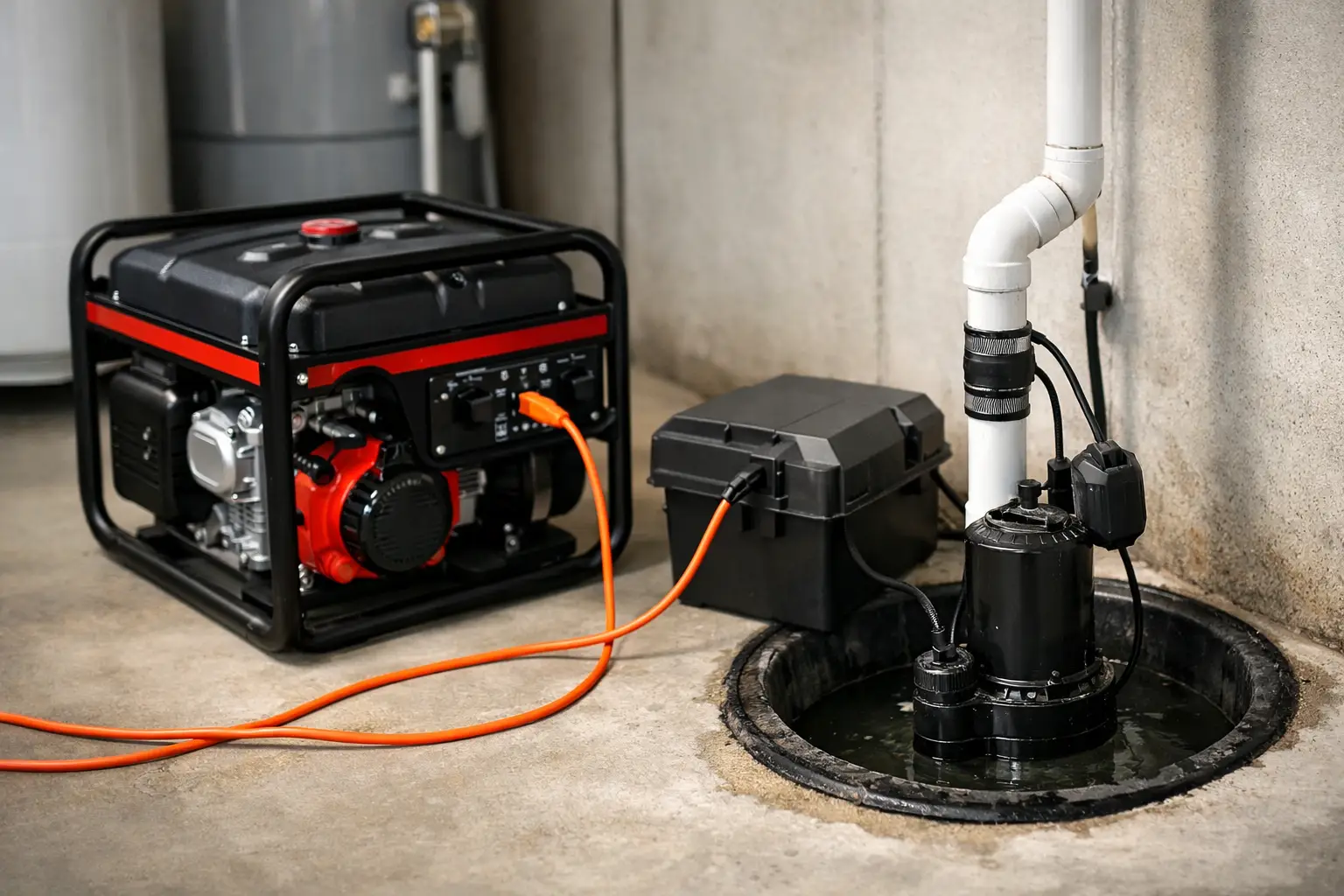
That gives you enough capacity for many common backup-power loads, including refrigerators, freezers, sump pumps, lighting, some power tools, and other essential appliances.
However, 7,500 running watts does not automatically mean you can run everything in a house at once.
Large central air-conditioning systems, electric water heaters, electric ranges, well pumps, dryers, and other high-demand appliances can quickly consume the available capacity. Starting watts also matter because motors can require substantially more power for a few seconds when they start.
A good approach is to add the running wattage of the equipment you expect to operate at the same time and then account for the largest starting load.
What Is PowerRush Technology?
Generac’s PowerRush technology increases the generator’s ability to handle motor-starting loads. For the GP7500E DF, Generac’s documentation describes over 30% more starting capacity, rather than the 40% figure stated in the original article.
That can be useful when starting equipment with electric motors, but PowerRush does not turn the generator into a higher-rated 10,000-watt machine. You still need to stay within the generator’s rated operating limits.
Dual-Fuel Operation: Gasoline or Propane
One of the biggest advantages of the GP7500E DF is its ability to operate on gasoline or liquid propane.
The fuel selector dial lets you choose the fuel source, giving you another option when gasoline is inconvenient or unavailable. Generac specifically designed the model around this fuel flexibility.
Gasoline provides the generator’s higher output, with 7,500 running watts and 9,400 starting watts.
Propane produces less power, but it can be useful for emergency preparedness because propane can be stored for longer periods than gasoline when handled according to applicable safety requirements.
The important point is that the GP7500E is dual-fuel, not tri-fuel. It is designed for gasoline and LP gas; it does not provide a natural-gas option from the factory.
Can You Switch From Gasoline to Propane While the Generator Is Running?
This is one area where the original article needs a significant correction.
The fuel selector makes changing fuel sources convenient, but you should not interpret that feature as permission to switch fuels under load while the generator is running.
Generac’s operating instructions require electrical loads to be disconnected when starting or stopping the generator, and the fuel selection is incorporated into the starting procedure.
For safety and to avoid unnecessary stress on the equipment, follow the current owner’s manual rather than treating the fuel dial as an on-the-fly transfer switch.
Runtime: How Long Will the GP7500E Run?
Runtime depends on the fuel being used and the electrical load.
Generac lists approximately 10 hours of gasoline runtime at 50% load with the generator’s 7.9-gallon fuel tank. With LP gas, runtime is approximately 5 hours at 50% load using a 20-pound propane tank.
Actual runtime will change with the amount of electricity you’re drawing.
For example, a generator running a relatively light load will generally consume less fuel than one operating close to its rated capacity. Conversely, running several high-draw appliances at the same time will reduce runtime.
This is why the advertised runtime should be viewed as a reference point rather than a guarantee for every outage.
120/240V Output for Home Backup
The GP7500E is particularly interesting for homeowners because it provides 120/240V output.
Its control panel includes two 120V 20A GFCI duplex receptacles and a 120/240V 30A L14-30R locking receptacle.
That makes the generator more versatile than a smaller 120V-only portable model.
If you want to connect a portable generator to selected household circuits, the installation should be handled according to local electrical requirements using an appropriate transfer switch or other approved equipment.
Never connect a portable generator directly to a household wall outlet. That can create dangerous backfeeding conditions.
Is the GP7500E an Inverter Generator?
No.
The Generac GP7500E Dual Fuel is a conventional open-frame portable generator, not an inverter generator.
That is an important distinction when comparing it with newer portable inverter models.
An inverter generator is generally designed with a different electrical architecture and is often chosen when low noise, reduced size, fuel efficiency at lighter loads, or cleaner electrical output is a priority.
The GP7500E takes a different approach: it emphasizes relatively high power, 120/240V capability, dual-fuel operation, and a traditional generator design.
If your priority is powering large loads during an outage or running demanding tools, the GP7500E’s capacity is more relevant than its lack of inverter technology.
If your priority is very quiet operation or you specifically need an inverter generator, this is not the type of generator you should be shopping for.
COsense Technology and Generator Safety
The GP7500E includes COsense technology, which monitors carbon monoxide conditions and can alert the user and shut the generator down when hazardous CO conditions are detected. Generac describes the system as providing protection against hazardous carbon monoxide.
This is an important feature, but COsense should never be considered a substitute for proper generator placement.
The CDC’s current guidance says portable generators should be operated outside and at least 20 feet away from windows, doors, and vents.
The CPSC similarly warns that portable generators should never be used inside homes, garages, basements, sheds, or other enclosed areas.
So even though the GP7500E has COsense, the basic rule remains:
Keep the generator outdoors, at least 20 feet from the home, with exhaust directed away from doors, windows, and other openings.
It is also a good idea to have functioning carbon monoxide alarms inside the home.
Electric Start and Portability
The GP7500E comes with an electric-start system and battery, which is useful when you need to start the generator quickly during an outage. The generator also has a recoil-start capability according to the product documentation.
There is, however, an important tradeoff.
At approximately 204 pounds, this is not a lightweight portable generator.
The heavy-duty wheels and fold-down locking handle make it easier to move around a property, but you should not expect to carry the unit around like a compact inverter generator.
For home backup or a workshop where the generator normally stays in one area, this is less of an issue.
For frequent transportation to remote jobsites, the size and weight deserve more consideration.
Maintenance Features
The GP7500E includes several features intended to make routine maintenance easier.
Hour Meter
The built-in hour meter helps track operating time so you can keep up with scheduled maintenance instead of guessing how long the engine has been running.
Low-Oil Shutdown
The generator also has automatic low-oil shutdown protection. If the oil level becomes too low, the system can stop the engine to help prevent damage.
This does not eliminate the need to check the oil before operation. It is a protective feature, not a replacement for regular maintenance.
Steel Fuel Tank
The large steel fuel tank has an integrated fuel gauge, making it easier to see how much gasoline remains without opening the tank. Generac lists the tank capacity at approximately 7.9 gallons.
What Can the Generac GP7500E Power?
The GP7500E’s 7,500 running watts make it suitable for a wide range of residential and worksite applications.
Depending on the actual wattage and starting requirements of your equipment, it can potentially handle combinations such as:
- Refrigerator and freezer
- Sump pump
- Well pump
- Lights
- Fans
- Television and networking equipment
- Microwave
- Selected kitchen appliances
- Power tools
- Workshop equipment
- Some air-conditioning equipment
- Essential circuits through a properly installed transfer setup
The key word is combinations.
You should calculate the actual running and starting wattage of your equipment before deciding which appliances to operate simultaneously.
For large motors and compressors, the starting requirement can be considerably higher than the normal running wattage.
Generac GP7500E Pros and Cons
Pros
- 7,500 running watts on gasoline
- 9,400 starting watts on gasoline
- 6,800 running watts on propane
- Dual-fuel gasoline/LP operation
- Electric start
- 120/240V capability
- 30A L14-30R locking outlet
- GFCI-protected 120V outlets
- COsense carbon monoxide protection
- Low-oil automatic shutdown
- Built-in hour meter
- Large 7.9-gallon gasoline tank
- Heavy-duty wheels and folding handle
Cons
- Heavy at about 204 pounds
- Open-frame design is louder than many inverter generators
- Not an inverter generator
- Only 30A 120/240V output rather than a 50A connection
- Propane output is lower than gasoline output
- LP runtime is substantially shorter with a standard 20-lb tank
- Switching fuels should be performed according to the owner’s manual rather than treated as an instant under-load changeover
Generac GP7500E vs. Other 7,500-Watt Generators
The GP7500E competes in a crowded category.
Current comparison listings place it alongside models such as the Westinghouse WGen7500c, Predator 59206 and other 7,000–8,000-watt portable generators.
The main differences shoppers should look at are not simply peak wattage.
Consider:
- Gasoline-only vs. dual-fuel
- Running watts rather than just starting watts
- 120V vs. 120/240V capability
- 30A vs. 50A connections
- Inverter vs. conventional generator design
- CO shutoff technology
- Electric start
- Fuel-tank capacity
- Weight
- Noise
- Warranty
- Availability of replacement parts and service
This is also where the GP7500E’s purpose becomes clearer. It is designed more around high-output practical backup power than compact size or ultra-quiet operation.
Is the Generac GP7500E Good for Home Backup?
The GP7500E makes sense for homeowners who want a portable generator with enough capacity for multiple essential loads and who value the option to use gasoline or propane.
Its 120/240V output is particularly useful when the generator is being incorporated into a properly designed home-backup setup. Generac itself lists emergency backup as one of the intended applications for the model.
However, it should not be confused with a permanently installed standby generator.
The GP7500E must be manually positioned, started and connected according to the appropriate setup. A permanently installed standby system is a different type of equipment designed for automatic transfer and whole-home applications.
Is the GP7500E Good for a Jobsite?
It can also make sense for jobsites and workshops where portability is needed but the priority is substantial electrical capacity.
The combination of 7,500 running watts, 120/240V output, electric start and a 30A locking connection gives it the ability to support a variety of tools and equipment.
The main drawback is its weight.
At more than 200 pounds, it is better suited to situations where wheels can be used rather than locations where workers need to repeatedly lift and carry the generator.
What I Like About the Generac GP7500E
The strongest part of this generator is the combination of power and fuel flexibility.
You get 7,500 running watts on gasoline without moving into the much larger class of commercial-size portable generators. At the same time, propane gives you another fuel option when preparing for a prolonged outage.
The 120/240V capability is another meaningful advantage for residential backup applications, while electric start eliminates the need to rely exclusively on a recoil starter.
COsense, low-oil shutdown and the hour meter add useful features that are particularly relevant when the generator is being kept for emergency use.
What I Would Consider Before Buying
The biggest question is whether you actually need this much generator.
If your emergency loads are limited to a refrigerator, a few lights, electronics and small appliances, a smaller generator may be easier to move and consume less fuel.
The GP7500E becomes more interesting when you need substantially more capacity, 120/240V output or dual-fuel capability.
I would also consider the generator’s conventional open-frame design. If quiet operation is a major concern, an inverter generator may be a better fit.
Finally, remember that the generator’s 7,500-watt rating does not mean every large appliance in a home can run simultaneously. Calculate your actual loads before purchasing.
Generac GP7500E Dual Fuel: Final Verdict
The Generac GP7500E Dual Fuel remains a substantial portable generator option for 2026, particularly for buyers who want high output without moving to a permanently installed standby system.
Its core specifications are straightforward: 7,500 running watts and 9,400 starting watts on gasoline, 6,800 running watts and 8,500 starting watts on propane, a 420cc OHV engine, electric start, 120/240V output, dual-fuel capability and COsense protection.
The generator’s biggest strengths are its power capacity, fuel flexibility and practical electrical connections.
Its biggest compromises are its 204-pound weight, conventional open-frame design and lack of inverter technology.
For a homeowner preparing for outages, a workshop owner who needs substantial portable power, or someone who wants gasoline and propane flexibility, those tradeoffs may make sense.
Before buying, calculate the running and starting wattage of the equipment you actually intend to use. And regardless of which portable generator you choose, follow the manufacturer’s instructions and keep the unit outdoors and at least 20 feet from doors, windows and vents.