As an Amazon Associate I earn from qualifying purchases.
A basement can go from dry to damaged while the power is still out and the rain is still falling. That is why choosing a generator for sump pump backup is less about buying the biggest machine you can afford and more about matching a generator to a motor that must start reliably under pressure. A unit that runs lights and phone chargers may still fail to start a sump pump when the pit is filling.
The right setup gives the pump enough starting power, a safe way to connect it, and enough fuel to last through a long outage. For many homeowners, a portable generator is the practical answer. Others, especially those with frequent flooding or a finished basement, may be better served by a permanently installed standby system or a battery backup paired with the generator.
Start with the sump pump’s real power demand
Sump pumps are rated in horsepower, but generators are rated in watts. The important number is not only the pump’s running wattage. An electric motor draws a brief, much higher surge of power when it starts. If the generator cannot handle that surge, the pump may hum, trip the generator’s overload protection, or fail to start altogether.
A typical 1/3-horsepower sump pump may use roughly 800 to 1,000 running watts and 1,800 to 2,200 starting watts. A 1/2-horsepower model often needs about 1,000 to 1,500 running watts, with starting demand that can approach 3,000 watts. These are planning ranges, not a substitute for the label on your specific pump. Check the pump’s nameplate for volts and amps, then multiply volts by amps for an approximate wattage figure. If it lists starting amps or locked-rotor amps, use that higher number when sizing the generator.
Pump age, discharge height, a partially clogged line, and cold water can all affect motor load. Give yourself breathing room. A generator rated just above the pump’s published starting watts is not a comfortable choice during a storm. For one conventional residential pump, a generator with at least 3,000 to 4,000 starting watts is often a sensible floor. If you want to run a refrigerator, furnace blower, freezer, lights, or a second pump at the same time, move up from there.
Do not add watts without considering starting loads
Add the running watts of every appliance you intend to operate, then add the highest motor starting load that could occur at the same time. A refrigerator compressor, furnace blower, well pump, and sump pump all create startup surges. You may be able to manage a smaller generator by starting one motor at a time, but that requires someone to be present and paying attention.
For a basement that depends on two pumps, size for the possibility that both run together. A primary pump and a battery-powered backup are often a better flood-prevention combination than two AC pumps dependent on one portable generator.
What size generator for sump pump use makes sense?
Small inverter generators are quiet, fuel-efficient, and easy to store, but they have limits. A 2,000-watt-class inverter generator such as the Honda EU2200i may be enough for a modest 1/3-horsepower sump pump by itself, provided the pump’s actual starting demand is within the generator’s surge rating. It is not the best choice if you also expect to power several household loads or if the pump has a demanding startup.
For many homes, a 3,500- to
5,000-watt portable generator provides a more forgiving range. Models in this class, including inverter options from Champion and conventional portable units from Westinghouse, can usually support a sump pump plus selected essentials. An inverter model supplies cleaner, generally quieter power and can reduce fuel use at lighter loads. A conventional open-frame generator often gives more output per dollar, though it is louder and less convenient around close neighbors.
A 7,000-watt or larger
dual-fuel generator may be appropriate when the sump pump is part of a wider emergency-power plan. It can support more circuits through a transfer switch, but it requires more storage space, more fuel, and more careful load management. Bigger is not automatically better if the generator will sit unused because it is too heavy to move or too complicated for the household to operate.
Dual-fuel capability deserves real consideration. Gasoline is easy to find before an emergency, but it has a limited storage life and should be stabilized and rotated. Propane stores longer and is cleaner for occasional use, although a generator generally produces less power on propane than on gasoline. Confirm the generator’s propane wattage rating before assuming it will start the pump with the same margin.
Choose a safe connection method before the outage
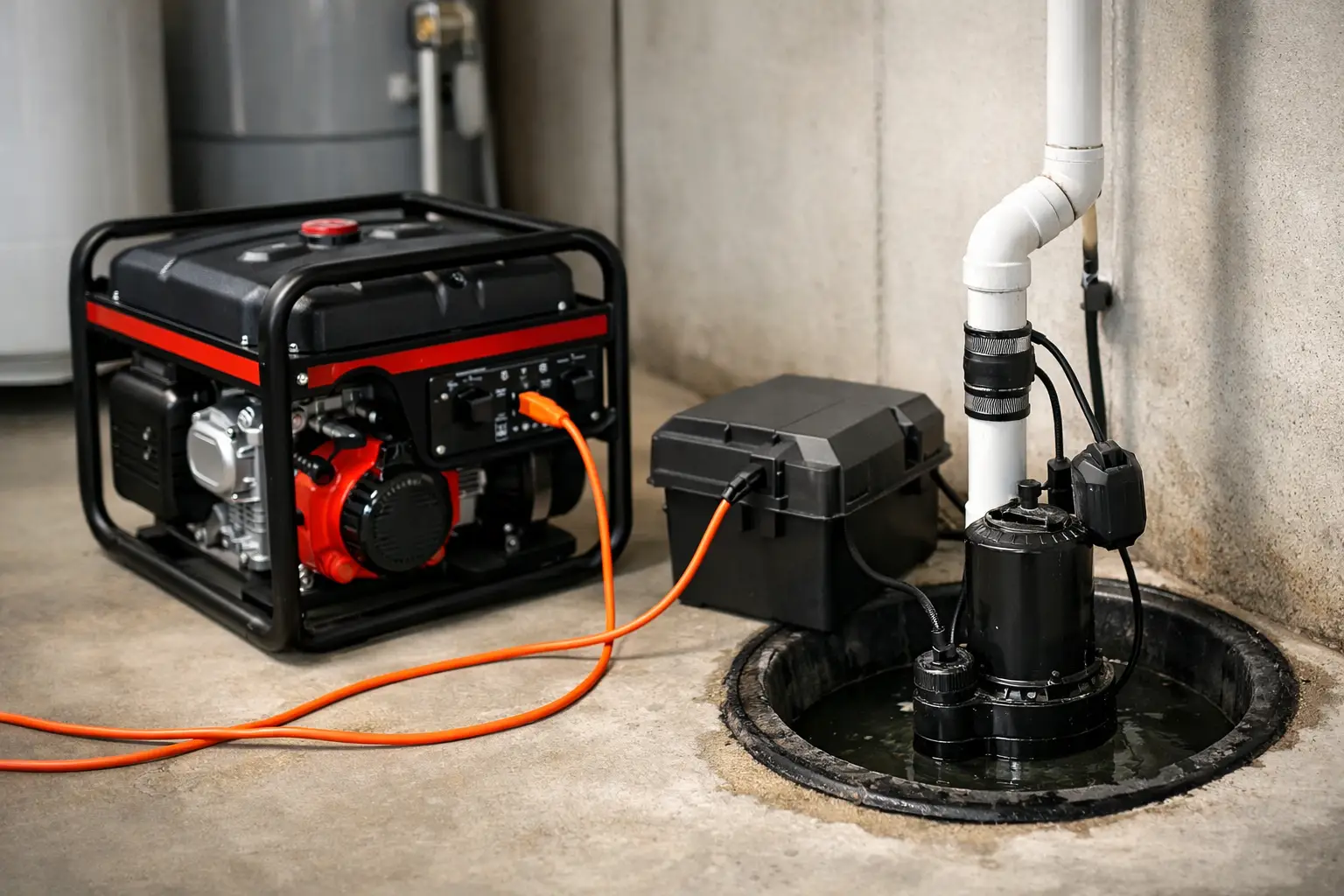
The simplest temporary arrangement is to plug the sump pump directly into the generator with a properly sized outdoor-rated extension cord. Use a heavy-duty cord rated for the load, keep the connection dry, and run the cord where it will not be crushed by doors or create a trip hazard. A 12-gauge cord is a common choice for many portable-generator applications, while longer runs and higher loads may call for 10-gauge wire. The cord and its connectors must be in good condition.
This approach works best when the pump has a normal plug and the generator can be placed safely outdoors. Never run a generator in a garage, basement, crawlspace, or near open doors and windows. Carbon monoxide can build up quickly and can be fatal. Position the unit outside, well away from the home, with exhaust directed away from occupied areas. Carbon monoxide alarms with fresh batteries are essential backup equipment, not an optional accessory.
For a more dependable whole-home arrangement, have a qualified electrician install a
manual transfer switch or an interlock kit with a generator inlet. This lets you power selected circuits, such as the sump pump, refrigerator, and furnace, without running multiple extension cords through the house. It also prevents dangerous backfeeding into utility lines.
Do not connect a generator to a wall outlet or dryer outlet. Backfeeding can energize utility equipment, injure line workers, damage appliances, and create a fire hazard. A transfer switch is the correct method because it isolates the home from the utility supply before generator power is used.
Neutral bonding and GFCI can affect compatibility
Generator connection details matter when you use a transfer switch. Portable generators may have a bonded neutral or a floating neutral, and the correct configuration depends on the transfer equipment and grounding arrangement. Some GFCI-protected generator outlets can also trip in certain setups. These are solvable installation issues, but they should not be guessed at during a flood warning. Review the generator and transfer-switch manuals, and use an electrician when the configuration is unclear.
Plan for runtime, not just peak output
A sump pump does not usually run continuously, which helps a portable generator stretch its fuel. But during severe weather, it can cycle frequently for hours or even days. Consider the generator’s runtime at one-quarter and one-half load, not just the size of its fuel tank. A larger tank reduces refueling trips, while an efficient inverter generator may use less fuel when the pump is cycling lightly.
Keep enough treated gasoline or a properly sized propane supply for the likely outage duration in your area. Store fuel safely and legally, away from ignition sources. Refuel only after shutting down the generator and allowing it to cool. Spilled gasoline on a hot engine is a preventable emergency.
The generator also needs routine exercise. Run it monthly or according to the manufacturer’s schedule, preferably with a meaningful load. Before storm season, test the entire chain: start the generator, connect the pump, verify that the float switch activates it, and make sure water is actually moving through the discharge line. A pump with a failed check valve, blocked outlet, or frozen discharge pipe cannot protect the basement even with perfect backup power.
A practical backup plan is better than one machine
The strongest sump-pump plan uses layers. Keep the primary pump maintained, install a high-water alarm, and consider a battery backup pump for the hours before you can start the generator or when nobody is home. If municipal water pressure is reliable and local rules allow it, a water-powered backup pump is another option, though it can use substantial water and does not fit every property.
A generator remains the flexible tool in that plan because it can power the sump pump and other essentials. Choose it with startup capacity to spare, a connection method you can use safely in bad weather, and a fuel strategy you will actually maintain. The best time to find out whether your generator can start the sump pump is a calm afternoon, not the first ten minutes of a flooded outage.
CHECK OUT THE BEST PORTABLE GENERATORS FOR SUMP PUMP BACKUP AT THE BEST PRICE ON AMAZON 🛒