As an Amazon Associate I earn from qualifying purchases.
If you need portable power for camping, tailgating, RV trips, remote work, or a short power outage, a 2,000-watt-class inverter generator can be a practical middle ground between a small battery power station and a much larger portable generator.
One important detail is easy to miss when comparing these machines: the wattage printed in a product name is not necessarily the amount of power the generator can provide continuously. Many models in this category produce between roughly 1,600 and 1,900 running watts, with a higher starting or surge rating available for a short period.
Best 2000 Watt Inverter Generators
| Model | Starting Watts | Running Watts | Best For |
|---|---|---|---|
| Honda EU2200i | 2,200W | 1,800W | Quiet operation and premium features |
| WEN 56235i | 2,350W | 1,900W | Lightweight portable power |
| Champion 2000W Inverter | 2,000W | 1,600–1,700W | Simple portable backup |
| Westinghouse iGen2200 | 2,200W | 1,800W | Compact everyday use |
| PowerSmart 2500W | 2,500W | 1,900W* | Budget-friendly extra surge capacity |
*Always verify the current specifications for the exact product configuration before purchasing.
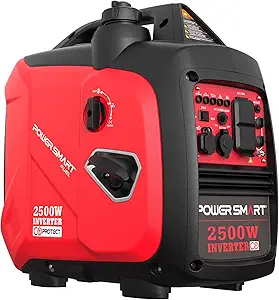
1. PowerSmart 2500-Watt Portable Inverter Generator
The PowerSmart 2500-Watt Portable Inverter Generator is worth considering if you want a little more starting capacity than a traditional 2,000-watt-class unit without moving to a much larger generator.
The model listed for this guide provides 2,500 starting watts and 1,900 running watts, putting it in the same general shopping category as several compact inverter generators with slightly higher peak output.
Its relatively compact design makes it suitable for camping, tailgating, emergency charging, and other situations where portability matters. The main limitation is the 1,900-watt continuous rating. You still need to calculate the running and starting wattage of everything you intend to operate before connecting multiple appliances.
For shoppers comparing budget-friendly inverter generators, PowerSmart is best viewed as an option for light backup and recreational power rather than a replacement for a large home standby generator.
2. Honda EU2200i 2200W Inverter Generator
The Honda EU2200i is one of the most established options in this size class. It produces 2,200 watts of maximum output and 1,800 watts of rated output.
Noise is another important feature. Honda rates the EU2200i at 48 dBA at 1/4 load and 57 dBA at rated load. Its 0.95-gallon fuel tank provides up to 8.1 hours of runtime at 1/4 load, although runtime decreases as the electrical load increases.
The generator also includes CO-MINDER carbon monoxide detection, Eco Throttle load-dependent operation, electronic overload protection, and parallel capability. Honda lists a three-year residential warranty.
At 47.4 pounds, it isn’t the lightest generator in the category, and its price can be considerably higher than budget alternatives. However, its combination of output, noise specifications, safety features, and established design makes it an important model to compare when shopping for a compact inverter generator.
3. WEN 56235i 2350-Watt Inverter Generator
The WEN 56235i is an interesting choice if portability is high on your list. It produces 2,350 surge watts and 1,900 rated watts while weighing 39 pounds. WEN rates the generator at 51 decibels at quarter load.
That combination gives it a useful advantage for camping and portable backup applications. You get slightly more continuous output than many traditional 2,000-watt models without moving into a much heavier generator.
WEN also includes a fuel-shutoff system designed to use the remaining fuel in the carburetor before shutdown. The manufacturer says this can help reduce problems associated with stagnant fuel during storage. The generator includes two 120V receptacles, a 12V DC receptacle, two USB ports, and a two-year warranty.
For buyers who care about weight and running watts rather than simply choosing a generator based on its peak-wattage number, the 56235i is a model worth considering.
4. GENMAX 2000W Ultra Quiet Inverter Generator
The GENMAX 2000W Ultra Quiet Inverter Generator is aimed at buyers who want a compact gasoline generator for basic backup power, camping, and other portable applications.
Its 2,000-watt starting output and 1,600-watt running output put it firmly in the lightweight end of the inverter-generator category.
At roughly 34 pounds, portability is one of its biggest advantages. That makes it easier to move between a vehicle, campsite, garage, or storage area than many larger portable generators.
The trade-off is its relatively modest continuous output. A 1,600-watt running rating is enough for many everyday loads, but it leaves less headroom for appliances with large startup surges.
Runtime also varies with electrical demand, so an advertised maximum runtime should not be interpreted as a guaranteed runtime at high loads.
5. Champion 2000W Inverter Generator
Champion’s compact 2,000-watt inverter-generator class is a much closer match for this guide than a 4,000-watt RV generator.
The current Champion lineup includes compact inverter models around this output range, including units rated at 2,000 starting watts and 1,600 to 1,700 running watts depending on the model.
One Champion 2,000W model, for example, is rated at 2,000 starting watts and 1,700 running watts and weighs about 38.6 pounds.
These smaller Champion units are designed for applications where portability and quieter operation matter more than running several high-demand appliances at once.
They are more appropriate for camping, tailgating, basic emergency loads, and selected power tools than for whole-home backup.
Because Champion sells several generators with similar wattage labels, check the exact model number before purchasing. Fuel type, outlets, runtime, emissions certification, and other specifications can vary.
6. ERAYAK 2400W Portable Inverter Generator
The ERAYAK 2400W Portable Inverter Generator is another option for shoppers who want slightly more surge capacity than a traditional 2,000W-class generator.
Its compact format makes it suitable for camping, tailgating, emergency charging, and light outdoor work.
Its main advantage is the combination of portability and additional peak wattage. However, continuous wattage is more important than the headline peak number when deciding what the generator can actually power for an extended period.
If you choose this model, pay particular attention to the manufacturer’s current specifications for running watts, noise, runtime, outlets, and parallel capability. Those details are more useful for comparing generators than the maximum wattage printed in a product title.
7. Westinghouse iGen2200 Portable Inverter Generator
The Westinghouse iGen2200 is a compact inverter generator designed around the same general power class as the Honda EU2200i.
Its published specifications list 2,200 peak watts and 1,800 running watts, with a 1.2-gallon fuel tank and less than 5% total harmonic distortion.
That combination makes it relevant for camping, tailgating, basic emergency backup, and other situations where you need more capability than a small 1,000-watt generator but don’t want to carry a large open-frame machine.
As with any generator in this class, the 1,800-watt continuous rating is the number to pay closest attention to.
A refrigerator, television, lights, chargers, or other modest loads may fit within the available capacity, but appliances with large startup demands can quickly use the available headroom.
How to Choose a 2000 Watt Inverter Generator
Starting Watts vs. Running Watts
One of the easiest mistakes to make when shopping for an inverter generator is looking only at the largest wattage number in the product title.
Running watts are the amount of power the generator can continuously supply. Starting watts are the temporary surge available when an appliance with a motor or compressor starts.
Refrigerators, freezers, pumps, air conditioners, and some power tools can require significantly more power for a few seconds when they start.
For example, Honda rates the EU2200i at 2,200 maximum watts but 1,800 rated watts.
Before buying, make a list of the appliances you actually intend to use. Add their running wattage and then account for the highest startup demand.
Do not assume that a generator labeled “2,000 watts” can continuously deliver 2,000 watts.
Noise Level
Noise can make a major difference when you’re camping, tailgating, or running a generator near your home.
Inverter generators can reduce engine speed when electrical demand is low, which helps lower noise and fuel consumption.
Compare the manufacturer’s dBA rating carefully because measurements can be taken at different loads and distances.
For example, Honda rates the EU2200i at 48 dBA at 1/4 load and 57 dBA at rated load.
Instead of looking for a “silent” generator, compare published noise levels under similar test conditions.
Fuel Efficiency and Runtime
Runtime figures are only useful when you know the load at which they were measured.
A generator may advertise eight or more hours of runtime at a light load but run for considerably less time when powering a refrigerator, microwave, tools, or other high-demand equipment.
For example, Honda lists up to 8.1 hours for the EU2200i at 1/4 load, while its published runtime at rated load is 3.2 hours.
When comparing models, look for tank capacity, the load percentage used for the runtime claim, and whether an Eco or economy mode is available.
Portability and Weight
Portability is one of the biggest reasons to choose a 2,000W-class inverter generator.
Models in this category can range from very lightweight units around 35–40 pounds to heavier machines approaching 50 pounds.
If you’ll regularly move the generator by yourself, pay attention to dry weight, handle design, dimensions, and whether the manufacturer provides a wheel kit.
Power Quality and Safety
Inverter generators are designed to produce stable AC power with low harmonic distortion, which is one reason they’re commonly used with laptops, televisions, chargers, and other sensitive devices.
Some manufacturers publish specific THD measurements. WEN, for example, states that the 56235i produces under 1.2% THD at full load.
Safety matters just as much as electrical quality.
Look for features such as low-oil shutdown, overload protection, carbon monoxide detection or shutdown, and a spark arrestor when applicable.
Most importantly, never operate a gasoline generator inside a home, garage, basement, shed, RV, or other enclosed or partially enclosed area. Carbon monoxide can build up rapidly.
Always follow the owner’s manual for placement, ventilation, fueling, electrical connections, and maintenance.
What Can a 2000W Inverter Generator Run?
A 2,000W-class inverter generator can handle many everyday electrical loads, but the exact combination depends on the generator’s running and starting wattage.
Typical applications can include:
- Refrigerator or freezer
- Television
- Laptop and phone chargers
- LED lights
- Small fans
- Coffee makers, depending on their wattage
- Small power tools
- CPAP equipment, when compatible with the generator
- Selected microwave ovens, depending on their power requirements
The important limitation is that you cannot simply add appliances together based on their running wattage and ignore startup demand.
A refrigerator, for example, may need additional power when its compressor starts.
A 2,000W-class generator is also not a whole-home backup generator. It generally isn’t intended to power central air conditioning, electric water heaters, electric ranges, or multiple high-wattage appliances simultaneously.
If you need those loads, move up to a larger generator or consider a properly designed home backup system.
Who Should Buy a 2000W Inverter Generator?
Camping and Tailgating
The relatively compact size and lower noise of an inverter generator make it easier to transport and use around other people.
Short Power Outages
A 2,000W-class unit can keep selected essentials operating, such as a refrigerator, lights, chargers, and a television, as long as the combined electrical demand stays within the generator’s limits.
Remote Work
If you’re working from a location without utility power, an inverter generator can provide electricity for a laptop, monitor, router, and other low-wattage equipment.
RV Use
A 2,000W-class generator can be useful for selected RV loads, but you should check the exact requirements of your air conditioner and other appliances before assuming the generator can start them.
When a Larger Generator Makes More Sense
If your goal is to run an entire house or several large appliances simultaneously, this size category is probably too small.
Frequently Asked Questions
Is a 2000 watt inverter generator enough for a home?
A 2,000W-class inverter generator can provide limited emergency power for selected essentials, but it is not designed to power an entire home. A refrigerator, lights, chargers, TV, or other modest loads may be possible if their combined running and starting requirements stay within the generator’s capacity.
Is a 2000W inverter generator enough for an RV?
It depends on the RV appliances. A 2,000W-class generator can handle many smaller RV loads, but an RV air conditioner can require substantial startup power. Check the air conditioner’s running and starting requirements before choosing a generator.
Are inverter generators quieter than conventional generators?
Generally, yes. Inverter generators can reduce engine speed when electrical demand is low, which helps lower noise and fuel consumption. Actual sound levels vary by model and load, so compare manufacturer dBA ratings under similar conditions.
Can a 2000W generator run a refrigerator?
Many 2,000W-class generators can run a typical refrigerator, but the generator must also have enough surge capacity to handle the compressor starting. Avoid judging compatibility by running watts alone.
How long will a 2000W inverter generator run?
Runtime depends on fuel-tank capacity and electrical load. Some compact models can run for many hours at light loads, but runtime can drop substantially at higher loads. Always check the manufacturer’s runtime rating and the load used for that measurement.
Can you run a 2000W generator indoors?
No. Gasoline generators should never be operated indoors or in enclosed or partially enclosed spaces because they produce carbon monoxide. Always operate the generator outdoors and follow the manufacturer’s required clearance and safety instructions.
Final Thoughts
A 2,000W-class inverter generator makes sense when portability, manageable noise, and fuel efficiency matter as much as electrical output.
The most important comparison is not the largest number printed on the box. Look at running watts, starting watts, noise, runtime at a stated load, weight, fuel capacity, outlets, parallel capability, and safety features.
The Honda EU2200i and WEN 56235i illustrate how different manufacturers approach this category: Honda emphasizes a long-established compact platform with 1,800 rated watts, while WEN offers 1,900 rated watts in a 39-pound package.
For budget shoppers, compact Champion, GENMAX, PowerSmart, ERAYAK, and Westinghouse models provide additional options to compare.
Before purchasing, calculate the actual wattage requirements of the appliances you plan to run and check the current manufacturer’s specifications for the exact model. Product names, availability, prices, and configurations can change over time.
Most importantly, treat generator safety as a requirement rather than an optional feature. Use gasoline generators outdoors, keep them away from doors and windows as specified by the manufacturer, and install working carbon monoxide alarms in occupied buildings.