As an Amazon Associate I earn from qualifying purchases.
A generator is only useful in an emergency if it starts when you need it. For gasoline-powered generators, one of the easiest maintenance steps to overlook is fuel care.
Gasoline does not stay fresh indefinitely. As fuel ages, oxidation can lead to gum, varnish, deposits, and other problems that can affect a carburetor or fuel system. Ethanol-blended gasoline can also create additional moisture-related concerns, particularly when equipment sits unused for extended periods.
That is where a good fuel stabilizer or fuel treatment for generators can help.
However, not every fuel additive does the same job. Some products are primarily designed for long-term fuel storage, while others are better suited to regular use, ethanol-related concerns, or fuel-system cleaning.
In this guide, we’ll compare five popular options and explain which type of generator owner each one makes the most sense for.
Important: Most fuel stabilizers discussed here are intended for gasoline. If you have a propane-only generator, gasoline fuel stabilizer is not a substitute for proper propane storage and maintenance. For dual-fuel generators, follow the generator manufacturer’s instructions for each fuel type.
Best Fuel Stabilizers and Treatments for Generators on Amazon US in 2026
| Product | Best For | Size | Original Amazon Link |
|---|---|---|---|
| STA-BIL Fuel Stabilizer | Long-term gasoline storage | 16 oz | Check Amazon |
| STA-BIL In-Season Protection Fuel System Treatment | Generators used regularly | 8 oz | Check Amazon |
| STA-BIL 360 Marine Ethanol Treatment and Fuel Stabilizer | Ethanol and moisture concerns | 8 oz | Check Amazon |
| STAR BRITE Star Tron Enzyme Fuel Treatment | Gasoline treatment and stabilization | 32 oz | Check Amazon |
| STA-BIL 22208 Fuel Stabilizer | Smaller fuel quantities | 8 oz | Check Amazon |
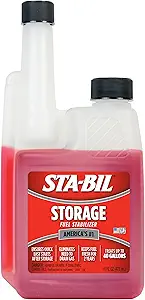
1. STA-BIL Fuel Stabilizer – 16 oz
Best for: Long-term gasoline storage
If your generator spends most of its time sitting in the garage and only comes out during power outages, a traditional storage fuel stabilizer is usually the most straightforward choice.
STA-BIL Fuel Stabilizer is designed to help preserve gasoline during periods of storage and reduce problems associated with fuel degradation.
Key Features
- 16-ounce bottle
- Designed for gasoline fuel
- Helps protect fuel during storage
- Helps prevent gum and varnish formation
- Suitable for many gasoline-powered engines
- Useful for generators, lawn equipment, motorcycles, and other small engines
One important distinction is that a fuel stabilizer is not the same thing as a fuel-system cleaner. Its primary purpose is to help keep stored fuel from deteriorating rather than to repair an already-dirty carburetor.
Why Generator Owners May Want It
Portable generators often sit unused for weeks or months. That makes fuel stability particularly important.
Instead of waiting until a storm is approaching to discover that the generator will not start, treating fresh gasoline before storage can become part of your normal generator maintenance routine.
Always use the dosage printed on the current product label and follow your generator’s owner’s manual.
Best for: Portable gasoline generators that spend long periods in storage.
2. STA-BIL In-Season Protection Fuel System Treatment – 8 oz
Best for: Generators that are used regularly
Not every generator sits unused for an entire season. Some are exercised regularly, used at campsites, taken to worksites, or operated frequently during periods of unreliable power.
For those situations, an in-season fuel treatment can make more sense than relying exclusively on a storage-focused product.
The STA-BIL In-Season Protection Fuel System Treatment is designed for ongoing fuel-system maintenance rather than simply preparing gasoline for extended storage.
Key Features
- 8-ounce bottle
- Designed for active fuel-system maintenance
- Helps keep fuel-system components cleaner
- Intended for gasoline-powered equipment
- Useful for equipment that is operated throughout the year
The advantage of this type of product is that it fits a different maintenance schedule.
If you regularly exercise your generator, you may prefer a treatment designed for ongoing use. If the generator is going to sit unused for months, a storage stabilizer is generally the more appropriate category.
Best for: Generator owners who regularly operate and exercise their gasoline generator.
3. STA-BIL 360 Marine Ethanol Treatment and Fuel Stabilizer – 8 oz
Best for: Ethanol-blended gasoline and moisture concerns
Ethanol-blended gasoline can create additional challenges for equipment that sits for long periods. Ethanol can attract moisture, which is one reason fuel management becomes particularly important in humid environments.
The STA-BIL 360 Marine Ethanol Treatment and Fuel Stabilizer is formulated with ethanol-related fuel concerns in mind and is especially interesting for generator owners who deal with humid conditions, seasonal storage, or equipment that is exposed to challenging environments.
Key Features
- 8-ounce bottle
- Designed for gasoline
- Intended for ethanol-blended fuel
- Helps address moisture-related fuel concerns
- Provides fuel stabilization
- Designed with corrosion protection in mind
Although the product has a marine-oriented name, the underlying fuel-management concerns can also matter to gasoline-powered generators.
That does not mean every generator owner needs a marine formula. If your generator is stored in a dry garage and you simply need basic seasonal fuel stabilization, a standard storage stabilizer may be a more straightforward option.
Best for: Generator owners particularly concerned about ethanol-blended gasoline, humidity, and moisture-related fuel problems.
4. STAR BRITE Star Tron Enzyme Fuel Treatment – 32 oz
Best for: High treatment capacity and ongoing gasoline fuel treatment
The STAR BRITE Star Tron Enzyme Fuel Treatment takes a different approach from a traditional storage-only stabilizer.
Star Tron is designed for gasoline engines and is marketed as a multifunctional fuel treatment that helps address fuel degradation, ethanol-related problems, moisture, gum, and varnish.
The current manufacturer information also lists the product for gasoline engines and states that the formula can stabilize fuel for up to two years when used as directed.
Key Features
- 32-ounce bottle
- Designed for gasoline engines
- Enzyme-based formula
- Helps address fuel degradation
- Helps prevent ethanol-related fuel problems
- Helps maintain fuel-system cleanliness
- High treatment capacity
One of the biggest advantages of the larger bottle is the amount of fuel it can treat when used according to the manufacturer’s specified dosage.
The current Star Tron instructions specify different initial and refill dosing, so it is better to follow the label rather than rely on a generic “one bottle treats X gallons” statement.
When Star Tron Makes Sense
This can be an attractive choice if you have several gasoline-powered machines or regularly treat larger quantities of fuel.
It can also appeal to generator owners who want a product that goes beyond simple fuel stabilization.
Independent long-term testing has also shown that Star Tron can perform well in some aged-fuel applications, although old gasoline should not automatically be considered equivalent to fresh gasoline simply because it contains stabilizer.
Best for: Generator owners who want a versatile gasoline fuel treatment with a high treatment capacity.
5. STA-BIL 22208 Fuel Stabilizer – 8 oz
Best for: Smaller fuel quantities
If you only keep a small amount of gasoline for your generator, a large bottle of fuel stabilizer may be unnecessary.
The STA-BIL 22208 Fuel Stabilizer – 8 oz provides a smaller-format option for generator owners who do not maintain large fuel reserves.
Key Features
- 8-ounce bottle
- Compact and easy to store
- Designed for gasoline fuel
- Helps reduce fuel degradation during storage
- Convenient for smaller fuel quantities
This is particularly practical for someone with a compact portable generator who keeps only a few gallons of gasoline on hand.
The important thing is not the size of the bottle itself but the treatment ratio. Always measure according to the current label instead of assuming that more additive provides better protection.
Best for: Smaller generators and owners who maintain relatively small quantities of gasoline.
Which Fuel Stabilizer Is Best for a Generator?
There is no single additive that is automatically best for every generator.
The right choice depends on how you use and store the machine.
Best Overall for Long-Term Storage: STA-BIL Fuel Stabilizer
For a portable gasoline generator that may sit unused for months, a conventional storage stabilizer is the simplest choice.
Best for Regular Generator Use: STA-BIL In-Season Protection
If you exercise your generator regularly and want an additive intended for ongoing fuel-system maintenance, an in-season treatment is worth considering.
Best for Ethanol and Humidity Concerns: STA-BIL 360 Marine
This option is more appealing when ethanol-blended fuel, moisture, and humid storage conditions are major concerns.
Best High-Capacity Treatment: Star Tron
Star Tron is a strong option when you want a versatile gasoline treatment and regularly maintain multiple pieces of gasoline-powered equipment.
Best Smaller Bottle: STA-BIL 22208
For smaller fuel supplies, an 8-ounce bottle can be more convenient than purchasing a larger container.
Fuel Stabilizer vs. Fuel Treatment: What’s the Difference?
These terms are sometimes used interchangeably, but they do not always describe exactly the same thing.
A fuel stabilizer is primarily intended to slow fuel degradation during storage.
A fuel treatment may have additional functions, such as helping maintain fuel-system cleanliness, addressing moisture, or supporting engine operation.
A fuel-system cleaner is generally focused more heavily on deposits and cleanliness.
That distinction matters when choosing a product for a generator.
If your generator is going into storage, look for a product specifically designed for fuel stabilization.
If the generator is used frequently and you are trying to maintain fuel-system cleanliness, a treatment designed for ongoing use may be more appropriate.
How Long Does Gasoline Last in a Generator?
Gasoline does not have an unlimited storage life.
Generac advises that fuel can begin deteriorating in approximately one month and recommends using a stabilizer from the beginning if fuel will be stored. For portable generators being stored for more than 30 days, Generac also recommends draining the fuel and running the carburetor dry according to its storage guidance.
This is why it is a mistake to assume that adding stabilizer means gasoline can simply remain in a generator indefinitely.
Fuel age, fuel quality, temperature, moisture exposure, the type of gasoline, the generator design, and the manufacturer’s storage procedure can all matter.
A stabilizer helps, but it does not eliminate the need for proper storage.
Should You Put Fuel Stabilizer in a Generator?
If you plan to store gasoline for your generator, using a fuel stabilizer can be a useful part of the maintenance routine.
However, there are two important rules:
- Treat fresh fuel rather than waiting until it has already deteriorated.
- Follow the stabilizer manufacturer’s dosage and the generator manufacturer’s storage instructions.
Do not assume that every generator should be stored with a full tank.
Some manufacturers recommend draining the tank and carburetor for extended storage, while others provide different procedures.
Your generator’s owner’s manual should take priority.
How to Use Fuel Stabilizer in a Generator
The exact procedure varies by product and generator, but the general process is straightforward.
1. Start With Fresh Gasoline
Fuel stabilizer works best as a preventive measure.
Do not expect a stabilizer to completely restore severely degraded gasoline.
2. Measure the Correct Amount
Read the current product label and calculate the dosage according to the amount of gasoline being treated.
More additive is not necessarily better.
3. Add the Stabilizer to the Fuel
Add the recommended amount to the gasoline according to the product instructions.
If treating fuel in a separate approved gasoline container, follow the same dosing instructions.
4. Run the Generator
After adding the stabilizer, allow the treated fuel to circulate through the fuel system.
Some manufacturer storage procedures specify running the engine for approximately 10–15 minutes after adding stabilizer.
Your generator owner’s manual should determine the exact procedure.
5. Follow the Generator’s Storage Procedure
This is where many generic fuel-stabilizer guides fall short.
Depending on the generator, storage instructions may include:
- Draining the fuel tank
- Running the carburetor dry
- Changing the engine oil
- Protecting the engine internally
- Closing or securing fuel-system components
- Storing the generator in a dry, appropriate location
Do not substitute a generic internet storage procedure for the instructions supplied with your generator.
Do Fuel Stabilizers Work With Ethanol Gasoline?
Many modern gasoline engines use ethanol-blended fuel, commonly E10.
Fuel stabilizers and treatments specifically designed for gasoline and ethanol-blended fuel can help address some of the problems associated with storing this type of fuel.
However, no additive eliminates all risks associated with moisture, contamination, or very old gasoline.
For generators that sit for long periods, good fuel management is still important.
Keep fuel containers properly sealed, avoid unnecessary exposure to heat and moisture, and rotate stored gasoline rather than assuming it can remain usable forever.
Can You Use Fuel Stabilizer in a Dual-Fuel Generator?
Yes, but the answer depends on which fuel you are treating.
A dual-fuel generator may operate on gasoline or propane.
A gasoline fuel stabilizer is intended for the gasoline side of the system. It does not stabilize propane in the same way.
If you normally run your generator on propane, gasoline may still remain in the tank or carburetor unless you follow the appropriate procedure for your particular generator.
For dual-fuel models, always check the manufacturer’s instructions for gasoline storage and propane storage separately.
Does Fuel Stabilizer Improve Generator Performance?
This is one area where expectations should be realistic.
A stabilizer’s primary job is fuel preservation.
It is not a replacement for:
- Carburetor cleaning
- Spark-plug replacement
- Air-filter maintenance
- Oil changes
- Fuel-filter replacement
- Proper engine maintenance
If a generator already has a dirty carburetor or severely degraded fuel, adding stabilizer may not solve the underlying problem.
That is why it is better to think of fuel stabilizer as preventive maintenance, not a repair product.
What Happens If You Leave Untreated Gasoline in a Generator?
When gasoline sits for extended periods, it can deteriorate and form deposits.
Those deposits can contribute to:
- Hard starting
- Rough running
- Poor throttle response
- Clogged carburetor passages
- Fuel-system deposits
- Reduced reliability
Ethanol-blended fuel can introduce additional moisture-related concerns.
The exact result depends on the fuel, environment, generator, and length of storage.
The safest approach is to follow the manufacturer’s storage procedure instead of leaving untreated gasoline in the generator and hoping it will still work during the next outage.
Best Fuel Stabilizers and Treatments for Generators: Comparison
| Product | Best For | Main Advantage | Recommended Use |
|---|---|---|---|
| STA-BIL Fuel Stabilizer 16 oz | Long-term storage | Straightforward gasoline stabilization | Seasonal or extended storage |
| STA-BIL In-Season Protection 8 oz | Regular use | Ongoing fuel-system treatment | Frequently operated generators |
| STA-BIL 360 Marine 8 oz | Ethanol and moisture concerns | Ethanol-focused protection | Humid or challenging environments |
| Star Tron 32 oz | High-volume treatment | Versatile gasoline treatment | Multiple machines or larger fuel supplies |
| STA-BIL 22208 8 oz | Small fuel supplies | Compact size | Smaller portable generators |
Fuel Storage Tips for Generator Owners
A fuel stabilizer is only one part of generator fuel maintenance.
Store Gasoline Properly
Use an approved fuel container and keep it sealed according to applicable safety requirements.
Avoid Keeping Fuel for Too Long
Rotate gasoline instead of allowing the same fuel to remain unused indefinitely.
Protect Fuel From Moisture and Heat
Storage conditions can affect fuel quality.
Exercise the Generator
Follow the generator manufacturer’s recommendations for periodic operation and maintenance.
Check the Fuel Before Storm Season
Do not wait until a hurricane, winter storm, or power outage is already underway to discover that your generator has stale fuel.
Follow the Owner’s Manual
Storage recommendations differ between generator models.
Frequently Asked Questions
What is the best fuel stabilizer for a portable generator?
For a gasoline-powered portable generator that spends extended periods in storage, a conventional storage stabilizer such as STA-BIL is a practical choice. The important part is using fresh fuel, following the correct dosage, and following the generator manufacturer’s storage instructions rather than relying on the stabilizer alone.
Can I leave gasoline in my generator with stabilizer?
Sometimes, but it depends on the generator manufacturer’s storage procedure. Some manufacturers recommend draining gasoline and running the carburetor dry for storage beyond a certain period. Always follow the owner’s manual for your specific model.
Does fuel stabilizer work with E10 gasoline?
Many gasoline fuel stabilizers are formulated for use with ethanol-blended gasoline. However, the product label should specifically indicate compatibility. Stabilizer can help with fuel-storage problems, but it does not eliminate all moisture or fuel-quality issues associated with ethanol.
How long can stabilized gasoline last?
Some fuel stabilizers are rated by their manufacturers to keep gasoline fresh for up to two years when used correctly. That should be considered a manufacturer rating, not a guarantee that two-year-old gasoline will perform exactly like fresh gasoline.
Can I use gasoline stabilizer in a propane generator?
No. A gasoline fuel stabilizer is intended for gasoline. Propane is a different fuel and should be stored and handled according to the generator and propane-cylinder manufacturer’s instructions.
Should I use fuel stabilizer every time I fill my generator?
Not necessarily. It depends on the product and how you use the generator. Storage stabilizers are generally used when fuel will be stored, while some fuel treatments are designed for ongoing use. Always follow the product’s current dosing instructions.
Final Verdict
The best fuel stabilizer for a generator depends on how you use the generator.
For a portable gasoline generator that may sit for months, STA-BIL Fuel Stabilizer is a straightforward storage-focused option.
For generators that are regularly operated, STA-BIL In-Season Protection is better suited to ongoing maintenance.
If ethanol-blended gasoline and moisture are major concerns, STA-BIL 360 Marine Ethanol Treatment and Fuel Stabilizer is worth considering.
For users who want a versatile gasoline treatment with a high treatment capacity, STAR BRITE Star Tron is another strong option.
And if you only maintain a small amount of gasoline, the STA-BIL 22208 8-ounce bottle is a convenient alternative.
The bigger lesson is that fuel stabilizer should be viewed as part of a complete generator maintenance routine—not as a substitute for proper storage.
Use fresh gasoline, treat it according to the product instructions, circulate treated fuel when required, follow the generator manufacturer’s storage procedure, and inspect the machine before you actually need backup power.
That combination gives your generator a much better chance of starting when the power goes out.
Quick Picks
- Best for long-term gasoline storage: STA-BIL Fuel Stabilizer
- Best for regular generator use: STA-BIL In-Season Protection
- Best for ethanol and moisture concerns: STA-BIL 360 Marine
- Best high-capacity gasoline treatment: STAR BRITE Star Tron
- Best for smaller fuel quantities: STA-BIL 22208