As an Amazon Associate I earn from qualifying purchases.
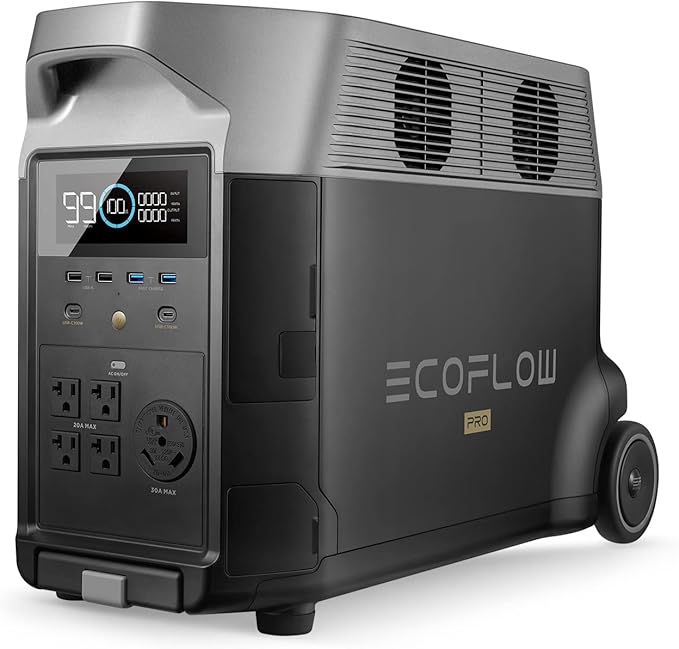
The EcoFlow DELTA Pro EFD500 is a high-capacity portable power station designed for homeowners, RV users, off-grid setups, and anyone who needs more power than a typical 1,000Wh or 2,000Wh battery can provide.
Its 3,600Wh LiFePO4 battery and 3,600W continuous AC output put it firmly in the home-backup class rather than the lightweight camping category. EcoFlow also supports expansion, solar charging, app control, and integration with its home-energy accessories.
One important point for 2026: the EFD500 is the original EcoFlow DELTA Pro, not the newer DELTA Pro 3. The newer model has different specifications, so buyers should make sure they are comparing the correct generation.
Check Amazon Price Click Here!
EcoFlow DELTA Pro EFD500 at a Glance
| Feature | Specification |
|---|---|
| Battery Capacity | 3,600Wh |
| Battery Chemistry | LiFePO4 (LFP) |
| Continuous AC Output | 3,600W |
| X-Boost Output | Up to 4,500W for compatible devices |
| Maximum Surge | Up to 7,200W |
| Expandable Capacity | Up to 10.8kWh with two DELTA Pro Smart Extra Batteries; up to 25kWh in an expanded DELTA Pro system |
| Solar Input | Up to 1,600W |
| AC Charging | Up to 1,800W from 120V or 3,000W from 240V |
| USB-C Output | 2 × 100W |
| USB-A Outputs | 2 standard + 2 fast-charge ports |
| AC Outlets | 5 |
| DC Outputs | 2 × DC5521 + Anderson port |
| Car Output | 12.6V, up to 126W |
| Connectivity | Wi-Fi and Bluetooth |
| Weight | Approximately 99 lb |
| Dimensions | 25 × 11.2 × 16.4 inches |
EcoFlow’s current U.S. specifications list a 3,600Wh LFP battery, 3,600W AC output, up to 4,500W through X-Boost, 1,600W maximum solar input, and approximately 99 lb of weight.
What Is the EcoFlow DELTA Pro EFD500?
The EcoFlow DELTA Pro EFD500 is a large portable battery generator built around a 3.6kWh LFP battery.
Unlike smaller portable power stations intended mainly for phones, laptops, lights, and small appliances, the DELTA Pro is designed to handle significantly larger loads. Its 3,600W continuous inverter gives it enough headroom for many refrigerators, microwaves, power tools, kitchen appliances, and other demanding equipment.
The system can also be expanded with additional EcoFlow batteries and integrated into a larger home-backup setup.
That flexibility is one of the main reasons the original DELTA Pro remains relevant in 2026, even though EcoFlow now sells newer models such as the DELTA Pro 3.
3,600Wh Battery Capacity
The DELTA Pro starts with 3,600Wh of LiFePO4 battery capacity.
In practical terms, the amount of runtime you get depends on the wattage of the devices connected to it and the efficiency losses that occur while converting stored DC energy into AC power.
For example, a device consuming 100W continuously would theoretically use 1,000Wh in about 10 hours before accounting for conversion losses. A 1,000W appliance would consume the same amount of stored energy in roughly one hour.
That is why the DELTA Pro is better suited to larger backup loads than a 1,000Wh-class power station.
EcoFlow also provides example runtimes for common devices, including refrigerators, microwaves, electric ovens, drills, and air conditioners. Actual runtime will vary with appliance power consumption, startup loads, temperature, battery condition, and other factors.
LFP Battery Chemistry and Long-Term Use
The DELTA Pro uses a lithium iron phosphate (LiFePO4 or LFP) battery.
LFP chemistry is commonly used in modern portable power stations because it is designed for a high number of charge and discharge cycles and is well suited to repeated use.
EcoFlow lists the DELTA Pro at approximately 6,500 cycles to 50% capacity and 3,500 cycles to 80% capacity. These figures are based on different depth-of-discharge conditions, so they should not be treated as directly interchangeable with cycle ratings from competing products that use a different test methodology.
For someone using the DELTA Pro only during occasional outages or camping trips, this is more than enough cycling capacity for many years of use.
For daily off-grid operation, battery management and operating conditions become much more important.
3,600W Continuous Output and X-Boost
One of the biggest advantages of the DELTA Pro is its 3,600W continuous AC output.
That puts it well above many conventional portable power stations and makes it suitable for appliances and tools that simply cannot be handled by smaller 1,000W or 2,000W units.
EcoFlow also includes X-Boost, which can support compatible devices up to 4,500W.
However, X-Boost should not be interpreted as turning the DELTA Pro into a 4,500W continuous inverter. It is a feature intended to allow certain compatible appliances to operate at higher power levels under specific conditions.
The unit also has a listed 7,200W surge capability, while two DELTA Pro units can be configured for higher-power 240V applications with the appropriate EcoFlow equipment.
This distinction matters when calculating whether the DELTA Pro can run a particular appliance.
What Can the DELTA Pro Power?
The DELTA Pro is most useful for appliances with substantial power requirements.
Potential applications include:
- Refrigerators and freezers
- Microwaves
- Coffee makers
- Electric kettles
- Power tools
- Portable air conditioners
- Some heating equipment
- Computers and networking equipment
- TVs and entertainment systems
- Lighting
- RV appliances
- Selected medical equipment, provided the equipment’s power requirements and backup specifications are compatible
The important thing is to check both running watts and startup watts.
A refrigerator, pump, compressor, or other motor-driven appliance can briefly require considerably more power when it starts. A power station that looks adequate based only on the appliance’s running wattage may still have difficulty with its startup demand.
15 Output Ports for Multiple Devices
The DELTA Pro provides a broad selection of outputs, allowing multiple devices to run at the same time.
The U.S. version includes:
- 5 AC outlets
- 2 standard USB-A ports
- 2 USB-A fast-charge ports
- 2 USB-C ports rated up to 100W
- 2 DC5521 outputs
- 1 car power outlet
- 1 Anderson port
EcoFlow lists the USB-C ports at up to 100W each and the car output at up to 126W.
For an RV, workshop, emergency-preparedness setup, or home office, this mix of ports is more useful than having only a large inverter.
Fast AC Charging
The DELTA Pro was designed with fast charging as one of its major selling points.
In the United States, EcoFlow lists:
- Up to 1,800W through 120V AC
- Up to 3,000W through 240V AC
EcoFlow’s published figures put a full recharge at approximately 2.7 hours using 1,800W AC or about 1.8 hours using 3,000W at 240V, depending on the charging configuration.
That is particularly useful after an outage or a long day of off-grid use because you do not necessarily have to leave the unit charging overnight.
As always, users should follow EcoFlow’s instructions for the included charging cable and electrical connection rather than assuming any high-power cable or outlet configuration is appropriate.
Solar Charging Up to 1,600W
The DELTA Pro can accept up to 1,600W of solar input, which is a significant advantage for extended outages and off-grid applications.
EcoFlow lists a solar input range of 11–150V with a maximum of 15A.
The original article claimed a fixed 2.8-hour solar recharge time using four 400W panels. That number should be treated as an idealized charging scenario rather than a guaranteed real-world result.
Solar output changes throughout the day because of:
- Cloud cover
- Panel orientation
- Temperature
- Shading
- Season
- Time of day
- Panel efficiency
- Wiring and system losses
A 1,600W-rated solar array can therefore provide excellent recharge capability, but actual daily energy production will vary.
Multiple Ways to Recharge the DELTA Pro
The DELTA Pro supports several charging methods, which is one of its strongest features for emergency preparedness.
Depending on the configuration, you can recharge it using:
- A standard AC wall outlet
- A 240V AC connection
- Solar panels
- A compatible vehicle charging setup
- EcoFlow’s Smart Generator
- Compatible EV charging infrastructure
This gives the DELTA Pro more flexibility than a battery that depends on a single charging method.
For emergency use, that matters because solar may not be practical during several days of bad weather. Conversely, an AC outlet may not be available during a prolonged outage.
EcoFlow App and Smart Controls
The DELTA Pro connects to the EcoFlow app through Wi-Fi and Bluetooth.
The app provides information such as battery level, charging and discharging activity, and other operating information. It can also be used for settings and firmware updates.
For a home-backup system, this is more useful than simply having a display on the front of the battery because you can monitor the system without constantly walking over to the unit.
The app can also help users understand how much power connected equipment is consuming and how quickly the battery is being depleted.
Expandable Battery Capacity
The base DELTA Pro contains 3,600Wh.
With two compatible DELTA Pro Smart Extra Batteries, the battery storage can reach 10.8kWh:
- DELTA Pro: 3.6kWh
- One Extra Battery: 7.2kWh total
- Two Extra Batteries: 10.8kWh total
EcoFlow also advertises system configurations capable of reaching up to 25kWh when the DELTA Pro is combined with additional system components and compatible units.
This is an important distinction.
Buying a DELTA Pro does not mean you automatically receive 25kWh of storage. That capacity requires additional hardware and a substantially larger investment.
For many households, the base 3.6kWh unit or a configuration with one extra battery may be more practical.
Can the DELTA Pro Provide Whole-Home Backup?
The DELTA Pro can be used as part of a home backup system, but it should not be confused with a permanently installed whole-house battery that automatically powers every circuit.
EcoFlow offers accessories such as the Smart Home Panel and other equipment that can integrate DELTA Pro units with a home’s electrical system.
For higher-power 240V applications, EcoFlow states that two DELTA Pro units can be combined with the appropriate equipment to provide up to 7,200W and 240V.
If you want to connect a battery system to a residential electrical panel, installation should follow local electrical requirements and the manufacturer’s instructions. A qualified electrician may be necessary depending on the configuration.
DELTA Pro for RVs and Camping
The DELTA Pro can be an excellent fit for RV users who want substantial battery capacity without relying exclusively on a fuel generator.
Its high output makes it suitable for many RV appliances, while the large battery can support longer periods away from shore power.
The downside is obvious: 99 lb is heavy.
The wheels and telescoping handle make it possible to move the unit across suitable surfaces, but this is not a power station you will casually carry from the car to a remote campsite.
For weekend campers who mainly need to charge phones, cameras, laptops, lights, and a small refrigerator, a smaller power station may make considerably more sense.
DELTA Pro for Emergency Home Backup
This is where the DELTA Pro makes the most sense.
During a power outage, a 3.6kWh battery can provide meaningful backup energy for essential loads such as:
- Refrigeration
- Internet equipment
- Lighting
- Computers
- TVs
- Small kitchen appliances
- Selected medical equipment
- Fans
- Charging personal electronics
Instead of trying to run an entire home indefinitely, most users will get better results by identifying their essential circuits and appliances first.
For example, keeping a refrigerator, router, lights, and several electronics running requires dramatically less energy than attempting to run an electric furnace, central air conditioner, electric water heater, and electric range at the same time.
The 99-Pound Weight Is a Real Trade-Off
There is no way around it: the DELTA Pro is a large machine.
At approximately 99 lb, it is much heavier than typical 500Wh–2,000Wh portable power stations.
The wheels help when moving it across a smooth floor, driveway, or other suitable surface. But stairs, gravel, uneven terrain, and vehicle loading are different situations.
This is one of the biggest considerations buyers should make before purchasing.
The DELTA Pro is better thought of as a wheeled portable battery than a lightweight portable power bank.
Noise and High-Power Loads
A large inverter and fast charging system generate heat, so the cooling fans can become noticeable when the DELTA Pro is operating under heavy loads or charging at high power.
This is not necessarily a problem for garage or outdoor use, but it can matter if you plan to place the unit beside a bed, desk, or inside a quiet living space.
Users who need near-silent operation for light loads should consider whether a smaller power station would better fit their needs.
DELTA Pro vs. DELTA Pro 3 in 2026
This distinction is particularly important in 2026.
The original DELTA Pro EFD500 has:
- 3,600Wh capacity
- 3,600W continuous AC output
- Up to 4,500W with X-Boost
- Up to 1,600W solar input
- Approximately 99 lb weight
The newer DELTA Pro 3 is a separate generation with a 4,096Wh battery and 4,000W continuous output, along with newer hardware and faster charging characteristics.
That does not make the original DELTA Pro irrelevant.
The EFD500 can still make sense when its price is substantially lower or when its established ecosystem and specifications already meet your requirements.
However, buyers should not assume that an article about “DELTA Pro” is automatically describing the same product as an article about “DELTA Pro 3.”
What I Like About the EcoFlow DELTA Pro EFD500
1. Large 3,600Wh Battery
The capacity is large enough for serious home-backup and RV applications without immediately requiring additional batteries.
2. Strong 3,600W Continuous Output
The inverter provides considerably more power than most smaller portable power stations.
3. Excellent Expansion Potential
The system can grow from 3.6kWh to 10.8kWh with two compatible extra batteries and can be expanded further as part of a larger EcoFlow configuration.
4. Fast AC Charging
The ability to accept up to 3,000W through a compatible 240V connection makes the DELTA Pro particularly useful when rapid recharge matters.
5. 1,600W Solar Input
A large solar input is valuable during extended outages and off-grid trips because it reduces dependence on the electrical grid or fuel.
6. Useful App
Wi-Fi and Bluetooth connectivity make it easier to monitor the station and adjust settings.
7. LFP Battery
The LiFePO4 battery chemistry is well suited to users who expect repeated charging and discharging over an extended period.
Where the DELTA Pro Falls Short
1. It Is Heavy
At approximately 99 lb, portability is limited compared with smaller stations.
2. Expansion Gets Expensive
The ability to reach 10.8kWh or more is useful, but every additional battery and home-integration accessory increases the total system cost.
3. It Is Overkill for Many Campers
If your primary needs are phones, laptops, lights, and a small cooler, a 3.6kWh station may be considerably more than you need.
4. It Is Not a Complete Whole-Home Installation by Itself
A DELTA Pro can become part of a home backup system, but connecting it to household circuits requires appropriate equipment and installation.
5. The Original Model Is No Longer EcoFlow’s Newest DELTA Pro
The DELTA Pro 3 now occupies a newer position in EcoFlow’s lineup, so buyers should compare the actual street prices and specifications of both models before purchasing.
Who Should Buy the EcoFlow DELTA Pro EFD500?
The DELTA Pro makes the most sense for someone who needs more than a conventional camping power station.
It is particularly suited to:
- Homeowners preparing for extended outages
- RV owners with high electrical demands
- Off-grid users
- Workshop users running power tools
- People who want a large solar-rechargeable battery
- Buyers planning to expand their backup system over time
- Users who need substantial inverter output without using gasoline for every outage
It is less compelling for someone who only wants to charge small electronics during occasional camping trips.
EcoFlow DELTA Pro EFD500: Is It Worth Buying in 2026?
The answer depends heavily on the price and your power requirements.
The DELTA Pro remains a capable 3,600Wh, 3,600W portable power station, and its expandable architecture gives it considerably more potential than a basic battery generator. EcoFlow still lists the original DELTA Pro in its product lineup, while newer models such as the DELTA Pro 3 now offer updated hardware.
If you need substantial backup capacity and find the original DELTA Pro at a significantly lower price than newer alternatives, it can still be an interesting option in 2026.
On the other hand, someone buying at full price should compare it carefully with newer 3–4kWh power stations before making a decision.
The 99 lb weight is also something you should take seriously. This is a system designed to provide a lot of power, not a lightweight battery for casual trips.
Important Note About the 30% Residential Clean Energy Credit
The original version of this article mentioned a potential 30% Residential Clean Energy Credit.
That information should not be carried over into a 2026 buying guide as if a new purchase automatically qualifies.
The IRS states that the Residential Clean Energy Credit under Section 25D was terminated for expenditures made after December 31, 2025, following changes enacted in 2025.
Therefore, buyers considering a new DELTA Pro purchase in 2026 should not assume that the 30% federal credit will reduce the cost of the system.
Tax rules can be complicated, and state or local incentives may differ, so consult a qualified tax professional for advice about your particular situation.
Final Verdict
The EcoFlow DELTA Pro EFD500 remains a powerful portable power station in 2026.
Its combination of 3,600Wh LFP storage, 3,600W continuous AC output, 4,500W X-Boost capability, 1,600W solar input, fast AC charging, multiple output ports, app control, and expandable battery capacity makes it much more than a conventional camping battery.
Its biggest compromises are equally clear: the unit weighs approximately 99 lb, expansion can become expensive, and the original DELTA Pro is now an older generation compared with the newer DELTA Pro 3.
For serious home backup, RV use, off-grid applications, and buyers who value a scalable power system, the DELTA Pro still deserves consideration in 2026. For casual camping or basic electronics, a smaller and lighter power station may be a better fit.
The most important thing is to buy the model that matches your actual electrical loads rather than choosing solely by battery capacity or maximum wattage.
Check Amazon Price Click Here!
Frequently Asked Questions
Is the EcoFlow DELTA Pro EFD500 still worth buying in 2026?
The original DELTA Pro remains relevant because it offers 3,600Wh of LFP storage, 3,600W continuous output, expandable capacity, and strong solar input. However, it is no longer EcoFlow’s newest DELTA Pro model. Compare its current price and features with the newer DELTA Pro 3 before buying.
How much power does the EcoFlow DELTA Pro produce?
The DELTA Pro provides 3,600W of continuous AC output. EcoFlow lists support for compatible devices up to 4,500W with X-Boost, while its specifications also list 7,200W surge capability. Two DELTA Pro units can be configured for higher-power 240V operation using the appropriate EcoFlow equipment.
How long will the EcoFlow DELTA Pro run a refrigerator?
Runtime depends on the refrigerator’s actual energy consumption and compressor cycling. EcoFlow gives an example of approximately 1–2 days for a refrigerator under its stated test assumptions. Real-world runtime can be shorter or longer depending on the refrigerator, temperature, door openings, battery condition, and other loads.
Can the DELTA Pro be charged with solar panels?
Yes. The DELTA Pro supports up to 1,600W of solar input with an 11–150V input range. Actual charging speed depends on available sunlight, panel orientation, shading, temperature, and the solar array’s output.
Can the DELTA Pro power an entire house?
The DELTA Pro can be integrated into a larger home-backup system, but the base unit should not be treated as a plug-and-play replacement for a permanently installed whole-home battery. Appropriate EcoFlow equipment and electrical installation may be required for connecting backup power to household circuits.
How heavy is the EcoFlow DELTA Pro?
The DELTA Pro weighs approximately 99 lb. Its wheels and telescoping handle make it easier to move across suitable surfaces, but it is still a large and heavy power station compared with smaller portable models.
What is the difference between the DELTA Pro and DELTA Pro 3?
The original DELTA Pro EFD500 has a 3,600Wh battery and 3,600W continuous output. The DELTA Pro 3 is a newer model with a 4,096Wh battery and 4,000W continuous output, along with newer charging and system features. They are separate generations and should be compared as different products.
Does the DELTA Pro qualify for the 30% federal tax credit in 2026?
A new 2026 purchase should not be assumed to qualify for the former 30% Residential Clean Energy Credit. The IRS states that the Section 25D credit was terminated for expenditures made after December 31, 2025. State and local incentives can have different rules.