Introduction
Dual fuel portable generators give homeowners, RV users, campers, and contractors another way to manage backup power by allowing the same generator to run on gasoline or propane. That flexibility can be useful during a power outage, at a campsite, or on a job site where fuel availability and runtime matter.
The main advantage is fuel flexibility rather than identical performance on both fuels. In many dual fuel models, gasoline provides the higher wattage output, while propane offers a convenient alternative that can be stored for longer periods when properly handled. The actual power and runtime available on each fuel vary by generator, so both ratings should be checked before buying.
What to Look for in a Dual Fuel Portable Generator
Before comparing individual generators, it helps to understand the specifications that matter most.
Running watts indicate how much power the generator can continuously provide. Peak or starting watts provide additional short-term capacity for equipment with electric motors, such as refrigerators, sump pumps, well pumps, air conditioners, and some power tools.
Fuel type also matters. A dual fuel generator does not necessarily produce the same output on gasoline and propane. Gasoline commonly provides the higher rated wattage, while propane gives you another fuel option when gasoline is unavailable or when long-term storage is a priority.
Other factors worth comparing include:
- Running and peak watts on both fuels
- Gasoline tank capacity
- Propane compatibility
- 120/240V operation
- Electric or remote start
- Outlet configuration
- Noise level
- Generator weight
- Wheel and handle design
- Carbon monoxide protection
- Intended use
Top Dual Fuel Portable Generators for 2026
| Generator | Gasoline Output | Propane Output | Best For |
|---|---|---|---|
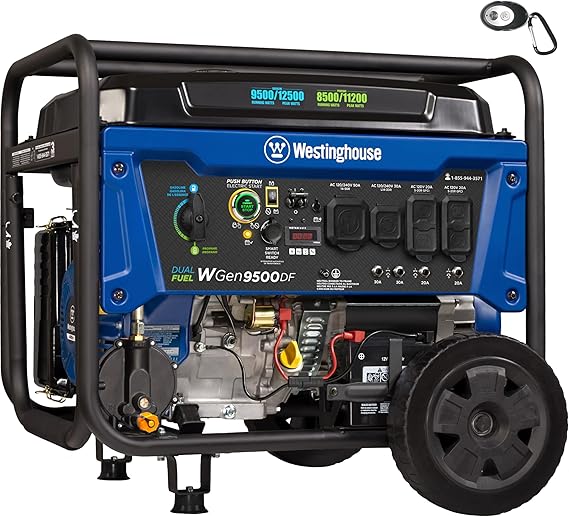
| Westinghouse 12500 Watt Dual Fuel | 12,500 peak / 9,500 running W | 11,200 peak / 8,500 running W | Home backup |
| DuroMax XP13000EH 13,000-Watt | 13,000 peak / 10,500 running W | 12,350 peak / 9,975 running W | High-load backup |
| Westinghouse 13500 Peak Watt Dual Fuel | 13,500 peak / 10,500 running W | 12,500 peak / 9,500 running W | Larger backup loads |
| WEN 11000-Watt Dual Fuel Portable Generator | 11,000 peak / 8,300 running W | 9,500 peak / 7,500 running W | Home backup and job sites |
| Westinghouse 4000 Peak Watt Super Quiet | Check current model specification | Check current model specification | RV and outdoor use |
Check Current Prices
- Westinghouse 12500 Watt Dual Fuel: Check Amazon Price
- DuroMax XP13000EH 13,000-Watt: Check Amazon Price
- Westinghouse 13500 Peak Watt Dual Fuel: Check Amazon Price
- WEN 11000-Watt Dual Fuel Portable Generator: Check Amazon Price
- Westinghouse 4000 Peak Watt Super Quiet: Check Amazon Price
How these generators are compared: This guide focuses on published specifications such as running watts, peak watts, fuel options, starting system, voltage, portability, and intended use. Specifications can vary by model revision and seller listing, so check the manufacturer’s current documentation before purchasing.
Understanding Key Features of Dual Fuel Portable Generators
Power Output
Running watts are the number to pay attention to when estimating the continuous load a generator can handle. Peak watts, sometimes called starting watts, provide additional short-term capacity for appliances and equipment with electric motors.
For example, the Westinghouse 12500 Watt Dual Fuel generator is rated at 9,500 running watts and 12,500 peak watts on gasoline. Its propane output is lower at 8,500 running watts and 11,200 peak watts.
The same principle applies to other dual fuel generators. Before buying, add up the running wattage of the equipment you expect to operate and allow additional capacity for motor-starting loads such as refrigerators, sump pumps, well pumps, air conditioners, and power tools.
A generator’s maximum peak wattage should not be treated as its continuous operating capacity.
Fuel Flexibility and Tank Capacity
Dual fuel generators typically use gasoline and propane, but the two fuels do not necessarily provide the same power output or runtime. Gasoline generally delivers the higher rated output on many models, while propane can be useful when long-term fuel storage is a priority.
The Westinghouse 13500 Peak Watt Dual Fuel model, for example, is rated at 13,500 peak watts and 10,500 running watts on gasoline, compared with 12,500 peak watts and 9,500 running watts on propane. Its 9.5-gallon gasoline tank is designed for extended operation.
When comparing generators, look at fuel capacity, rated output on each fuel, expected runtime, and the propane tank size recommended by the manufacturer rather than comparing peak wattage alone.
Starting Mechanisms
Starting systems vary considerably between portable generators. Common options include recoil start, electric start, and remote electric start.
Electric start is useful for larger generators because it eliminates the need to pull a recoil starter. Remote start can be particularly convenient when the generator is being used for emergency backup, although the feature is not included on every model.
The Westinghouse 12500 Watt Dual Fuel includes remote starting, while the DuroMax XP13000EH uses electric and recoil starting.
Buyers should also consider whether the generator’s starting battery requires periodic maintenance and whether the manufacturer provides a manual-start option as a backup.
Weight and Portability
Portability becomes increasingly important as generator size increases. Smaller inverter models are generally easier to move and are better suited to RVs, camping, and tailgating, while high-output open-frame generators can weigh well over 200 pounds.
Wheels and folding handles make large generators easier to position, but they do not make them lightweight. If you expect to move a generator without assistance, check the listed dry weight and overall dimensions before purchasing.
For home backup, it is usually more practical to position a large generator in advance rather than choosing a model based solely on its wheel kit.
Noise Levels
Noise can be a major consideration for camping, RV use, residential neighborhoods, and overnight operation. Inverter generators generally have an advantage in this area because many use variable engine speeds at lighter loads, although actual noise levels vary by model and load.
Do not assume that every dual fuel generator is quiet simply because it offers propane operation. Large open-frame generators can produce substantially more noise than compact inverter models.
When noise matters, look for a manufacturer-published decibel rating and check whether the measurement was taken at a specified distance and load. A lower number is useful only when the testing conditions are comparable.
Why Choose a Dual Fuel Portable Generator?
The main reason to choose a dual fuel generator is flexibility. Having two fuel options can be useful when one fuel is unavailable, inconvenient, or less suitable for the situation.
- Fuel flexibility: You can use gasoline or propane depending on availability and your planned use.
- Emergency preparedness: Propane can be stored for extended periods when handled according to applicable safety requirements, while gasoline requires more careful fuel-storage management.
- Different operating characteristics: Gasoline and propane may produce different wattage and runtime figures, so you can choose the fuel based on the load and situation.
- Multiple applications: A dual fuel generator can serve as home backup power while also being useful for RVs, camping, or job-site equipment.
The trade-off is that dual fuel does not mean unlimited runtime or identical performance on both fuels. Always use the manufacturer’s fuel-specific wattage ratings when planning your loads.
Practical Applications of Dual Fuel Portable Generators
Emergency Home Backup Power
High-output dual fuel generators can be useful for temporary residential backup during a power outage. Depending on the generator’s rated output and the home’s electrical setup, a large portable unit may support essential circuits such as a refrigerator, freezer, sump pump, lights, internet equipment, and selected heating or cooling equipment.
The actual load must be calculated before connecting appliances. Large loads such as central air conditioners, electric water heaters, dryers, ovens, and well pumps can require substantial starting and running power.
For connection to household circuits, use an appropriately installed transfer switch or other code-compliant connection method. Never connect a portable generator directly to a household wall outlet.
Outdoor and Recreational Use
Campers, RV owners, and tailgaters may prefer smaller dual fuel generators because they are easier to transport and can provide an alternative to carrying gasoline.
For recreational use, pay particular attention to noise, weight, running watts, RV outlet compatibility, and whether the generator is an inverter model. A high-wattage open-frame generator may provide plenty of power but can be impractical for a campground where noise and portability matter.
Job Sites and Remote Work
Contractors and other professionals can benefit from dual fuel generators when grid power is unavailable. Higher-output models can operate tools, lights, compressors, pumps, and other equipment, provided the combined load remains within the generator’s running and starting limits.
For portable work applications, consider wheel design, outlet configuration, fuel capacity, weather protection, and the generator’s rated output on both fuels. If sensitive electronics will be connected, check whether the specific generator uses an inverter design and review its published electrical specifications.
Maintenance and Safety Tips for Dual Fuel Generators
Proper operation is just as important as choosing the right generator. Follow the owner’s manual for the specific model and observe local electrical and fuel-storage requirements.
- Operate it outdoors: Never operate a portable generator inside a home, garage, basement, shed, or other enclosed or partially enclosed space.
- Keep it at least 20 feet from the house: Portable generators should be placed outdoors and at least 20 feet from windows, doors, and vents. Position the exhaust so it points away from the building.
- Use carbon monoxide protection: Keep working CO detectors inside the home. A built-in generator CO shutoff can provide another layer of protection, but it does not replace proper placement.
- Refuel carefully: Turn the generator off and allow it to cool before adding gasoline. Store gasoline only in approved containers and follow local requirements.
- Inspect propane connections: Check hoses, fittings, and tanks for damage or leaks before operation. Follow the generator and propane-cylinder manufacturer’s instructions.
- Check the oil: Follow the manufacturer’s recommended oil type and maintenance intervals.
- Protect the generator from moisture: Use the generator only under conditions and with protection permitted by the manufacturer. Keep electrical connections dry.
- Avoid overloads: Do not exceed the generator’s running-watt rating, and account for the starting wattage of motor-driven equipment.
- Use proper electrical connections: For household backup, have the generator connected through a properly installed transfer switch or another code-compliant method.
- Test before an emergency: Periodically inspect and run the generator according to the manufacturer’s recommendations so you know the starting system, battery, fuel system, and outlets are functioning.
Conclusion
Dual fuel portable generators can provide a practical combination of power and fuel flexibility for home backup, outdoor recreation, RV use, and job sites. The most important differences between models are not simply their advertised peak wattage, but their running watts on each fuel, starting system, fuel capacity, outlet configuration, noise level, size, and safety features.
A high-output model may make more sense for residential backup, while a smaller inverter generator can be easier to transport for camping or RV use. Before buying, compare the gasoline and propane specifications separately and calculate the loads you actually expect to run.
Finally, treat generator placement and electrical connection as part of the purchase decision. Portable generators produce carbon monoxide and must be operated outdoors, at least 20 feet from doors, windows, and vents. Proper placement, working CO detectors, and a code-compliant electrical connection are essential parts of safe generator use.