As an Amazon Associate I earn from qualifying purchases.
A generator inlet box provides a dedicated connection between a portable generator and your home’s electrical system. However, installing one involves more than mounting a weatherproof box outside and connecting a power cord. NEC generator inlet requirements address transfer equipment, electrical ratings, wiring, grounding, identification, and protection against dangerous utility backfeeding.
If you are planning to connect a portable generator to your home’s electrical panel, the inlet must work as part of a properly designed standby power system. The generator, inlet box, connecting cord, circuit breaker, transfer equipment, and grounding arrangement all need to be compatible.
The National Electrical Code (NEC) provides the framework for these installations, but the edition adopted by your state or local jurisdiction determines which requirements apply. The local Authority Having Jurisdiction (AHJ) also determines how the code is enforced.
This guide explains the main electrical requirements homeowners should understand before purchasing a generator inlet box or arranging an installation. You can research the equipment yourself, but a qualified electrician should handle the electrical work connected to your home’s panel.
What Is a Generator Inlet and How Does It Work?
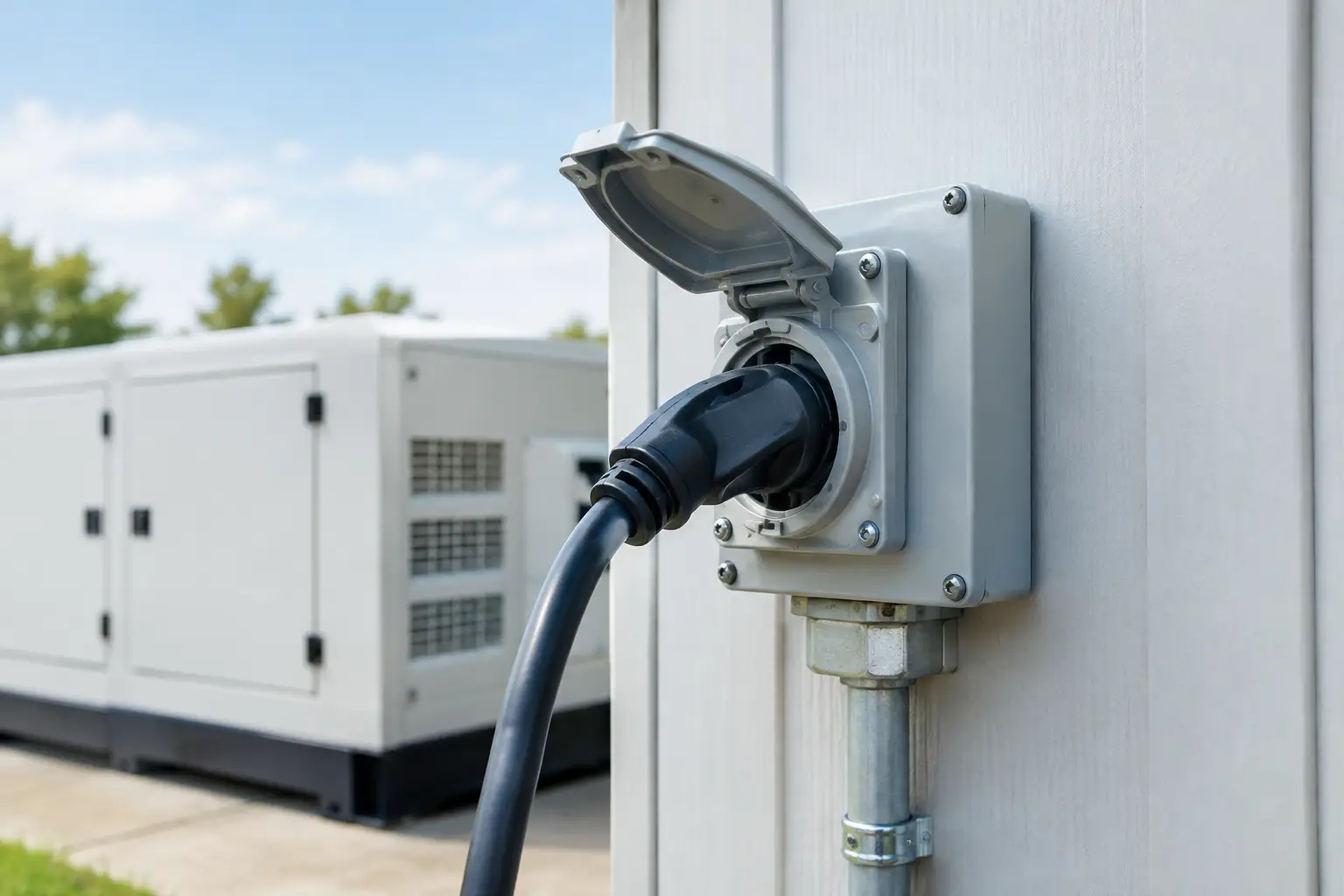
A generator inlet is a power connection installed on the outside of a home or another approved location. It receives electricity from a portable generator through a properly rated generator power cord.
Unlike a standard household outlet, which supplies electricity to an appliance, an inlet receives electricity from an external power source.
A typical installation works like this:
- The portable generator produces electricity through its output receptacle.
- A properly rated generator cord connects the generator to the exterior inlet.
- Conductors carry the generator power from the inlet to the transfer equipment.
- A manual transfer switch or compatible panel interlock allows the selected circuits to receive generator power.
- The home’s electrical circuits receive power from the generator instead of the utility supply.
The inlet box is therefore only the connection point. It does not independently disconnect your home from the utility grid.
This distinction is important because connecting a generator directly to a household receptacle using a homemade male-to-male cord can energize wiring that was never designed for that purpose. This dangerous practice is known as backfeeding.
Backfeeding can expose utility workers to unexpected electrical power while they are repairing supposedly de-energized lines. It can also create serious fire and electrocution hazards.
A properly designed transfer system prevents the generator from unintentionally energizing the utility supply.
NEC Generator Inlet Requirements: Transfer Equipment Comes First
One of the most important requirements for a residential portable generator installation concerns transfer equipment.
NEC Article 702 covers optional standby systems. Section 702.5 addresses interconnection and transfer equipment. In general, the equipment must be suitable for its intended use and listed, designed, and installed to prevent the unintended interconnection of power sources.
In practical terms, the utility supply and generator supply must not be connected together through an improper switching arrangement.
Homeowners commonly use three types of transfer equipment.
1. Manual Transfer Switch
A manual transfer switch allows you to select generator power for specific household circuits.
For example, you might choose circuits serving:
- Refrigerator and freezer
- Well pump
- Sump pump
- Furnace blower
- Selected lighting
- Internet equipment
- Essential household receptacles
A manual transfer switch is often a practical choice when you have a portable generator and do not need to power the entire home.
2. Panel Interlock Kit
A panel interlock is a mechanical device designed for a compatible electrical panel.
It prevents the main breaker and generator breaker from being switched on simultaneously. This helps prevent the utility supply and generator from energizing the panel at the same time.
However, not every interlock kit fits every electrical panel.
The interlock must be specifically listed or approved for the panel model and installed according to its listing, manufacturer’s instructions, and applicable local requirements.
A generic interlock that happens to fit physically is not necessarily an acceptable substitute.
3. Automatic Transfer Switch
An automatic transfer switch monitors the normal power supply and transfers the electrical load to an available backup source when utility power fails.
This equipment is commonly used with permanently installed standby generators.
When utility power returns, the transfer equipment can switch the load back to the normal supply according to its operating sequence.
The correct transfer equipment depends on the generator, electrical panel, system configuration, and loads you intend to operate.
30-Amp vs. 50-Amp Generator Inlets: Understanding the Difference
The two most common amperage ratings homeowners encounter when shopping for portable generator inlet boxes are 30 amps and 50 amps.
Both can be used in residential backup power systems, but they do not provide the same theoretical electrical capacity.
For a 120/240-volt split-phase connection, the calculations are:
| Inlet rating | Voltage | Theoretical maximum | |—|—:|—:| | 30 amps | 120/240V | 7,200 watts | | 50 amps | 120/240V | 12,000 watts |
These figures are calculated using voltage multiplied by current. They are not guarantees of continuous generator output.
The actual available power depends on the generator’s rated output, circuit protection, transfer equipment, wiring, and the loads connected to the system.
A 50-amp inlet does not increase the output of a generator rated for less power.
For example, connecting a smaller generator to a higher-rated inlet does not turn it into a larger generator. The generator’s own output limitations still apply.
Likewise, a 30-amp system should not be overloaded simply because the generator advertises a high starting-watt rating.
Does Your Generator Provide 120V or 120/240V Power?
Many residential generator inlet installations use 120/240-volt single-phase power.
This configuration provides two 120-volt legs and can supply both standard 120-volt household circuits and compatible 240-volt equipment.
Some appliances that may require 240 volts include:
- Certain well pumps
- Electric ranges
- Some central air-conditioning equipment
- Electric water heaters
- Other large household appliances
However, not every portable generator provides 120/240-volt output.
Some inverter generators supply only 120 volts, even when their advertised wattage appears sufficient for a particular application.
Before purchasing an inlet box, check the generator’s nameplate and actual output receptacles. Confirm the voltage configuration rather than relying on the wattage advertised on the product packaging.
Generator Inlet Plug Types and Compatibility
Amperage alone does not determine whether a generator inlet will work with your generator.
The connector configuration must also match.
One common 30-amp configuration is the NEMA L14-30, which provides 120/240-volt service through a four-wire connection.
Larger portable generators may use a 50-amp, 120/240-volt NEMA 14-50 receptacle or another compatible 50-amp connector, depending on the equipment.
Before buying a generator inlet box, verify:
- Generator outlet configuration
- Voltage rating
- Amperage rating
- Number of conductors
- Connector compatibility
- Generator continuous output
- Transfer equipment rating
An adapter does not increase generator capacity or change the underlying electrical characteristics of the equipment.
If your generator has a 30-amp L14-30 outlet, a properly matched 30-amp inlet and cord are generally a straightforward option, provided the complete installation is designed for that configuration.
You can compare compatible options in our 50-amp generator inlet box category.
Choose a Listed, Weather-Rated Generator Inlet Box
A generator inlet installed outdoors must be suitable for its location and exposure to weather.
Look for an inlet assembly that is listed for its intended electrical application and has an enclosure appropriate for the installation environment.
Common enclosure considerations include:
NEMA Type 3R: Commonly used for outdoor electrical equipment exposed to rain, sleet, and external ice formation. It is a frequent choice for residential generator inlet installations.
NEMA Type 4: Designed for protection against windblown dust and rain, splashing water, and hose-directed water.
NEMA Type 4X: Provides Type 4 protection with additional corrosion resistance.
The appropriate enclosure depends on the location, exposure, product listing, and manufacturer’s specifications. A particular NEMA rating should not be treated as a universal NEC requirement for every generator inlet.
Material is another consideration.
Metal enclosures can provide good mechanical durability, while nonmetallic enclosures may offer additional resistance to corrosion in certain environments.
Regardless of the material, the inlet must be installed according to its listing and instructions.
Location matters, too. The inlet should be accessible for connecting the generator but positioned so the generator can operate outdoors in a location that keeps exhaust away from doors, windows, and other building openings.
Cord and Wiring Requirements for a Generator Inlet
The generator power cord and the permanent wiring between the inlet and transfer equipment serve different purposes.
Both must be appropriately rated for the electrical system.
Generator Power Cord
The flexible cord connects the portable generator to the inlet box.
For a typical 30-amp, 120/240-volt setup, the cord generally has four conductors:
- Hot conductor L1
- Hot conductor L2
- Neutral conductor
- Equipment grounding conductor
A 50-amp, 120/240-volt arrangement also requires the appropriate four-wire connection.
The cord must have compatible connectors and be rated for the intended amperage, voltage, outdoor use, and operating conditions.
Cord length also matters.
Longer cords can experience greater voltage drop, especially when supplying substantial electrical loads. Using an appropriately sized cord and avoiding unnecessarily long runs helps maintain acceptable electrical performance.
You can compare available 30-amp four-prong generator cords when selecting a compatible connection.
For larger generators, review these 50-amp generator extension cords.
Permanent Wiring Between the Inlet and Transfer Equipment
The conductors installed between the inlet box and transfer equipment must be sized according to the applicable electrical requirements.
The electrician must consider:
- Circuit rating and overcurrent protection
- Conductor material
- Insulation type
- Terminal temperature ratings
- Installation method
- Ambient temperature
- Number of current-carrying conductors
- Raceway conditions
- Applicable voltage-drop considerations
NEC requirements, including conductor ampacity and overcurrent protection rules, must be considered together.
For example, a 50-amp inlet does not automatically mean that every conductor in the installation can be selected using a single generic wire-size recommendation.
The installation conditions and equipment specifications matter.
Never assume that the flexible generator cord and permanent building conductors can use the same sizing rules.
Generator Inlet Identification and NEC 702.7(C)
An important detail that homeowners may overlook is the identification requirement associated with power inlets for temporary portable generator connections.
NEC 702.7(C) addresses power inlet identification.
Under the 2023 NEC provision, a warning sign must be placed near the power inlet to indicate the type of generator permitted to be connected.
This matters because an existing inlet and transfer system may have been designed around a particular generator configuration.
For example, the neutral arrangement of the generator and the transfer equipment must be compatible.
Connecting a generator with an incompatible neutral configuration can create problems with the intended grounding and bonding arrangement.
The warning identification helps prevent someone from connecting an unsuitable generator to an existing installation.
The applicable adopted NEC edition and local amendments should be checked with the AHJ. The electrician should determine the exact labeling required for the installation.
Grounding and Neutral Bonding: Why the Generator Configuration Matters
Grounding and neutral bonding are among the most confusing parts of portable generator installations.
The reason is simple: not all portable generators have the same electrical configuration.
Some generators have a bonded neutral, meaning the neutral conductor is electrically connected to the generator frame.
Others have a floating neutral, meaning the neutral is not bonded to the frame at the generator.
The correct arrangement depends on the generator design and how the transfer equipment handles the neutral conductor.
What Is a Bonded Neutral Generator?
In a bonded-neutral generator, the neutral-to-frame connection is established inside the generator.
This configuration must be considered when designing the transfer system.
If the generator is connected to a system that already has the appropriate neutral-to-ground bonding point, an incompatible arrangement can create parallel paths for neutral current.
That can result in unwanted current flowing through equipment grounding conductors or metal components.
What Is a Floating Neutral Generator?
A floating-neutral generator does not have the same neutral-to-frame connection at the generator.
Depending on the transfer equipment and system design, this arrangement may be appropriate for certain installations.
However, simply removing a neutral bonding jumper or modifying the generator without understanding the complete system is not a safe solution.
Does a Portable Generator Need a Grounding Rod?
Not necessarily.
NEC 250.34 addresses grounding requirements for portable generators under specific conditions, while NEC 250.30 covers grounding and bonding for separately derived alternating-current systems.
Whether a grounding electrode connection is required depends on the generator’s use and the electrical system configuration.
For example, a generator supplying only equipment connected directly to its own receptacles under the conditions described in NEC 250.34 is treated differently from a generator supplying a building’s premises wiring system.
The transfer equipment, neutral switching arrangement, generator bonding, and grounding electrode system must be evaluated together.
Installing an additional ground rod without understanding the system does not automatically make a generator installation safer or code-compliant.
Have the electrician verify the generator’s neutral configuration, transfer equipment, equipment grounding conductor, and grounding method as one complete system.
Load Planning: Match the Generator to Your Essential Circuits
Even a correctly installed generator inlet cannot compensate for an undersized generator.
Before selecting a 30-amp or 50-amp inlet, determine which household appliances and circuits you actually want to operate during an outage.
Start with essential equipment:
- Refrigerator
- Freezer
- Well pump
- Sump pump
- Furnace blower
- Selected lighting
- Internet equipment
- Essential receptacles
Then calculate the expected running wattage and starting wattage.
Motors, compressors, and pumps can require substantially more power during startup than during normal operation.
A well pump is a good example. Its starting demand may be considerably higher than its running demand, so the generator must have enough surge capacity to start the pump without exceeding its limits.
If motor startup is a problem, a properly selected soft-start device may help with compatible equipment.
However, it should not be used as a substitute for correctly sizing the generator and evaluating the electrical load.
A 50-amp inlet may offer greater capacity than a 30-amp inlet, but the generator must actually be capable of supplying the additional power.
Generator Inlets and RV Connections: 30 Amps Does Not Always Mean the Same Thing
Another common source of confusion involves recreational vehicle electrical connections.
A typical 30-amp RV connection supplies 120-volt power.
A residential 30-amp generator inlet using an L14-30 configuration typically provides 120/240-volt power.
Although both systems are rated at 30 amps, their voltage arrangements and connector configurations are different.
They should not be treated as interchangeable.
Using an adapter without understanding the electrical configuration can create a dangerous situation.
Always verify the generator outlet, inlet, cord, and transfer equipment specifications before connecting them.
Permits, Electrical Inspections, and Local NEC Adoption
Installing a permanent generator inlet and connecting it to a home’s electrical panel may require an electrical permit and inspection.
The exact requirements depend on the local jurisdiction.
Some authorities enforce the 2020 NEC, others the 2023 NEC, and jurisdictions may adopt newer editions or local amendments on different schedules.
The 2026 NEC publication does not automatically mean that every state or municipality has adopted that edition.
Before starting an installation, contact your local building department or electrical inspection authority.
An inspection may address:
- Compatibility of the inlet and transfer equipment
- Panel and breaker requirements
- Conductor sizing
- Overcurrent protection
- Grounding and bonding
- Equipment listing and installation instructions
- Required identification and warning labels
- Working clearances and accessibility
The goal is not simply to install an inlet that works. It is to install a complete backup-power connection that meets the requirements applicable to your home.
Generator Inlet Buying Checklist
Before purchasing a generator inlet box, compare the generator specifications with the rest of the electrical system.
Use this checklist to avoid common compatibility mistakes.
| What to check | Why it matters | |—|—| | Generator voltage | Confirms whether you need 120V or 120/240V | | Generator outlet | Determines the required connector | | Generator running watts | Establishes available continuous power | | Inlet amperage | Must match the system design | | Transfer equipment | Prevents unintended utility interconnection | | Power cord | Must match the inlet and generator | | Enclosure rating | Must suit the outdoor environment | | Permanent wiring | Must meet applicable ampacity and installation requirements | | Neutral configuration | Must be compatible with the transfer system | | Identification | Must meet the applicable NEC and local requirements | | Permit and inspection | Confirms local installation requirements |
Avoid buying equipment based only on the highest amperage rating advertised on the packaging.
A properly matched 30-amp system can be a better solution than an unnecessarily large 50-amp installation if your generator and essential household loads do not require the additional capacity.
Frequently Asked Questions About NEC Generator Inlet Requirements
Does the NEC require a transfer switch for a portable generator?
NEC Article 702, Section 702.5, addresses transfer and interconnection equipment for optional standby systems. The equipment must prevent unintended interconnection between power sources.
A properly designed manual transfer switch or compatible panel interlock is commonly used in residential installations.
The applicable code edition and any permitted exceptions must be evaluated by the local authority.
Can I install a generator inlet without a transfer switch?
An inlet box alone does not prevent a generator from backfeeding the utility supply.
A properly designed transfer arrangement is necessary when connecting a portable generator to premises wiring, subject to the applicable NEC provisions and exceptions.
Never rely on a homemade connection or an improvised switching arrangement.
Is a 30-amp generator inlet enough for a house?
It can be enough to operate selected essential circuits, depending on the generator’s actual output and the loads connected.
A 30-amp, 120/240-volt inlet has a theoretical maximum capacity of 7,200 watts.
However, running and starting loads must remain within the limits of the generator and every component in the system.
Is a 50-amp generator inlet better than a 30-amp inlet?
Not automatically.
A 50-amp inlet offers greater theoretical capacity, but your generator, transfer equipment, wiring, and circuit protection must support the system design.
If your portable generator supplies only 30 amps, installing a 50-amp inlet does not increase its available output.
Does a generator inlet box need to be weatherproof?
An outdoor inlet must be suitable for its installation location and exposure to environmental conditions.
Choose an appropriately listed enclosure with a rating suitable for the intended location and follow the manufacturer’s installation instructions.
Does a portable generator need a ground rod when connected to a house?
Not in every configuration.
Grounding requirements depend on the generator’s electrical design, whether it is separately derived, the transfer equipment, and the applicable NEC requirements.
The electrician should evaluate the complete grounding and bonding arrangement rather than automatically adding a ground rod.
What is the difference between a generator inlet and a generator outlet?
A generator outlet supplies electricity from the generator.
A generator inlet receives electricity from the generator and transfers it to the home’s properly configured electrical system.
They serve opposite functions and have different connection requirements.
Does a generator inlet need a warning label?
NEC 702.7(C) addresses identification near a power inlet used for temporary portable generator connections.
The identification must indicate the type of generator permitted under the applicable provision. Confirm the exact requirements with the electrician and local AHJ.
Final Thoughts: Choose a Generator Inlet That Meets Your Electrical System’s Requirements
A generator inlet box is a relatively small component, but its role in a residential backup-power system is important.
The right installation depends on more than choosing between 30 amps and 50 amps. Generator output, voltage, connector type, transfer equipment, conductor sizing, grounding, neutral bonding, and local electrical requirements all need to work together.
For most homeowners, the smartest approach is to select the generator and essential circuits first, then have a qualified electrician design the inlet and transfer equipment around those requirements.
A properly installed system provides a safer and more dependable way to use portable generator power when utility service is unavailable.