As an Amazon Associate I earn from qualifying purchases.
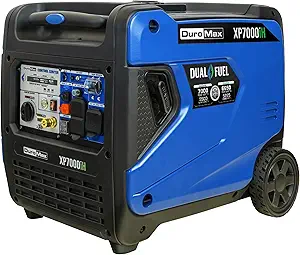
A 7000 watt inverter generator is a popular choice for homeowners, RV owners, and anyone who wants substantially more portable power than a small 2,000- or 3,000-watt inverter can provide.
The important detail is that “7000 watts” does not always mean 7,000 watts of continuous power. Generator manufacturers normally list both starting watts and running watts, and the difference can be significant. A generator in the 7,000-watt class may deliver somewhere around 5,000 to 7,000 watts continuously, depending on the model and fuel.
For home backup, an inverter generator in this range can handle many essential loads such as refrigerators, freezers, sump pumps, lights, televisions, computers, and selected heating or cooling equipment. For RV use, the right model can also provide enough output for a large air conditioner and other appliances, provided the generator has the appropriate 30A or 50A RV connection.
Below, you’ll find several 7000-watt-class options, including dual-fuel and higher-output alternatives. I have also included the key specifications that actually matter when choosing a generator for emergency power.
Best 7000 Watt Inverter Generators on Amazon US in 2026
| Generator Model | Fuel | Starting Watts | Running Watts | Best For |
|---|---|---|---|---|
| DuroMax XP7000iH | Gas/Propane | 7,000 | 5,500 | Home backup and RV |
| WEN DF680iX | Gas/Propane | 6,800 | 5,100 | RV and home backup |
| A-iPower SUA7600iED | Gas/Propane | 7,600 | 6,100 | Value and home backup |
| Champion 8750W Open Frame Inverter | Gasoline | 8,750 | 7,000 | Higher continuous output |
| Westinghouse iGen11000DFc | Gas/Propane | 11,000 | 9,000 | Large-load backup |
1. DuroMax XP7000iH Dual Fuel Inverter Generator
Check Amazon Price Click Here!
The DuroMax XP7000iH is one of the closest matches to what most people mean when they search for a 7000 watt inverter generator.
It combines inverter technology, dual-fuel operation, 120/240V output, electric start, remote start, and CO protection in a relatively compact package. DuroMax currently lists 7,000 starting watts and 5,500 running watts on gasoline, with 6,650 starting watts and 5,225 running watts on propane.
DuroMax XP7000iH Specifications
- Starting watts: 7,000W gasoline
- Running watts: 5,500W gasoline
- Starting watts on propane: 6,650W
- Running watts on propane: 5,225W
- Fuel: Gasoline and propane
- Voltage: 120/240V
- Engine: 320cc 4-stroke OHV
- THD: Less than 3%
- Fuel tank: 3 gallons
- Weight: 147 lb
- Noise: 62 dB at 25% load
- Starting: Electric, recoil and remote
- CO protection: CO sensor shutdown
- RV ready: Yes
- Home backup ready: Yes
One of the biggest advantages here is fuel flexibility. During a prolonged outage, having both gasoline and propane available gives you more options than a gasoline-only generator.
The 120/240V output also makes the XP7000iH more useful for home backup applications than many smaller portable inverter generators.
Best for: Homeowners who want a true 7000-watt-class inverter with dual-fuel capability.
2. WEN DF680iX Dual Fuel Inverter Generator
Check Amazon Price Click Here!
The WEN DF680iX is slightly below the 7,000-watt mark but belongs in this comparison because it is one of the more relevant 7000-watt-class inverter generators.
Unlike the specifications shown in many older articles, the current WEN specifications list 6,800 surge watts and 5,100 rated watts on gasoline, or 6,000 surge watts and 4,500 rated watts when operating on propane.
The DF680iX is particularly interesting for RV owners because it includes a TT-30R RV receptacle along with 120/240V capability.
WEN DF680iX Specifications
- Starting watts: 6,800W gasoline
- Running watts: 5,100W gasoline
- Starting watts on propane: 6,000W
- Running watts on propane: 4,500W
- Fuel: Gasoline and propane
- Engine: 224cc
- Voltage: 120/240V
- Fuel tank: 2.9 gallons
- Noise: Approximately 64 dB at 25% load
- Starting: Electric and recoil
- CO protection: WEN Watchdog CO shutdown
- RV outlet: TT-30R
- Warranty: 3 years
WEN also includes a fuel-shutoff system designed to run remaining fuel from the carburetor before shutdown. That can be useful for people who don’t operate their generator frequently and want to reduce stale-fuel issues.
Another unusual feature is its bonded-neutral 240V configuration, which WEN says can support low-power Level 2 EV charging.
For sensitive electronics, WEN states that the generator produces less than 0.3% THD at no load and less than 1.2% at full load.
Best for: RV owners and homeowners who want a quieter dual-fuel inverter at a lower output level.
3. A-iPower SUA7600iED Dual Fuel Inverter Generator
Check Amazon Price Click Here!
The A-iPower SUA7600iED is another strong option for shoppers searching for a generator around 7,000 watts.
Its 7,600 starting watts and 6,100 running watts on gasoline put it slightly above the nominal 7,000-watt class, while propane output is rated at 6,900 starting watts and 5,500 running watts.
A-iPower SUA7600iED Specifications
- Starting watts: 7,600W gasoline
- Running watts: 6,100W gasoline
- Starting watts on propane: 6,900W
- Running watts on propane: 5,500W
- Fuel: Gasoline and propane
- Voltage: 120/240V
- Engine: 322cc 4-stroke OHV
- Fuel tank: 3.6 gallons
- Starting system: Electric and recoil
- Inverter: Digital inverter
- THD: Less than 3%
- CO protection: CO Watch-Guard
- Certifications: EPA/CARB/PGMA compliant
The SUA7600iED makes sense when your priority is having a little more continuous capacity than the DuroMax XP7000iH without moving into a much larger generator.
The dual-fuel design is also useful for emergency preparedness because propane can be stored for long periods compared with gasoline.
Best for: Buyers looking for strong output and dual-fuel flexibility without moving to a much larger generator.
4. Champion 8750W Open Frame Inverter Generator
Check Amazon Price Click Here!
The Champion 8750W Open Frame Inverter deserves a slightly different explanation.
It is not a 7,000-watt generator in terms of starting output. Instead, it produces 8,750 starting watts and 7,000 running watts, which makes it particularly interesting if you need approximately 7,000 watts of continuous power.
Its open-frame design also separates it from the enclosed inverter generators above.
Champion 8750W Specifications
- Starting watts: 8,750W
- Running watts: 7,000W
- Fuel: Gasoline
- Voltage: 120/240V
- Design: Open-frame inverter
- RV capability: Yes
- Starting: Electric/recoil
- CO protection: CO safety technology
- Application: Home backup, RVs and job sites
The advantage is straightforward: if your actual requirement is 7,000 running watts, this type of generator makes more sense than choosing a unit advertised as 7,000 watts that only delivers 5,500 watts continuously.
The trade-off is that open-frame generators generally don’t have the same enclosed, compact design associated with premium inverter models.
Because this Champion model has been on the market for several years, availability and current pricing can vary, so check the Amazon listing before purchasing.
Best for: Users who specifically need approximately 7,000 watts of continuous output.
5. Westinghouse iGen11000DFc Dual Fuel Inverter Generator
Check Amazon Price Click Here!
The Westinghouse iGen11000DFc is included as a higher-output alternative rather than a direct 7,000-watt competitor.
That’s an important distinction.
This generator is rated for 11,000 peak watts and 9,000 running watts on gasoline, with 10,000 peak and 8,100 running watts on propane.
Westinghouse iGen11000DFc Specifications
- Starting watts: 11,000W gasoline
- Running watts: 9,000W gasoline
- Starting watts on propane: 10,000W
- Running watts on propane: 8,100W
- Fuel: Gasoline and propane
- Voltage: 120/240V
- Fuel tank: 7.92 gallons
- Engine: 459cc
- Starting: Electric/remote
- Inverter: Yes
- CO protection: CO sensor
- Application: Large homes and high-demand backup
If your home’s load calculation shows that 5,000 to 6,000 running watts isn’t enough, stepping up to a larger inverter generator can make more sense than trying to operate a 7,000-watt-class machine at its limit.
However, this generator is significantly larger than the other models in this guide, so it shouldn’t be purchased simply because the number “11,000” sounds better.
Best for: Homeowners with substantially higher electrical loads who need more capacity than a typical 7,000-watt-class generator can provide.
7000 Watt Inverter Generator Comparison
| Model | Fuel | Starting Watts | Running Watts | Voltage | Best Use |
|---|---|---|---|---|---|
| DuroMax XP7000iH | Dual fuel | 7,000 | 5,500 | 120/240V | Home/RV |
| WEN DF680iX | Dual fuel | 6,800 | 5,100 | 120/240V | RV/Home |
| A-iPower SUA7600iED | Dual fuel | 7,600 | 6,100 | 120/240V | Home/RV |
| Champion 8750W | Gasoline | 8,750 | 7,000 | 120/240V | High-load backup |
| Westinghouse iGen11000DFc | Dual fuel | 11,000 | 9,000 | 120/240V | Large-load backup |
The table shows why you should never choose a generator based only on the large number printed in its product name.
For example, the DuroMax XP7000iH is a 7,000-starting-watt generator but provides 5,500 running watts. The Champion 8750W, on the other hand, delivers 7,000 running watts.
That distinction can completely change which model is appropriate for your home.
What Can a 7000 Watt Inverter Generator Run?
A generator producing roughly 5,000 to 7,000 running watts can handle a substantial collection of household appliances, but the exact combination depends on their starting and running wattage.
A typical emergency load might include:
- Refrigerator
- Freezer
- Sump pump
- Several lights
- Wi-Fi router
- Television
- Computers
- Microwave
- Small kitchen appliances
- Battery chargers
- Selected heating equipment
- Some air-conditioning systems
Large central air conditioners, electric water heaters, electric dryers, electric ranges and other high-draw appliances can quickly consume most of the available capacity.
The safest approach is to calculate your actual running watts and then account for startup surges from motors and compressors.
Do not assume that a “7000 watt” label means you can continuously draw 7,000 watts from every generator in this category.
Starting Watts vs. Running Watts
This is one of the most important things to understand before buying a portable generator.
Running watts are the continuous power the generator can supply.
Starting watts, sometimes called surge watts, are the additional short-term power available to start appliances with electric motors or compressors.
For example, a refrigerator may use considerably more electricity for a brief moment when its compressor starts than it uses once it is running.
The same applies to:
- Sump pumps
- Well pumps
- Air conditioners
- Refrigerators
- Freezers
- Some power tools
If you only compare starting watts, you may accidentally buy a generator that cannot handle your continuous load.
For home backup, running watts should be one of your primary selection criteria.
Why Choose an Inverter Generator?
Traditional portable generators and inverter generators work differently.
A conventional generator produces AC electricity directly from the engine-driven alternator.
An inverter generator first produces electrical power and then uses electronic circuitry to create a highly regulated AC output.
This design provides several advantages.
Cleaner electrical output
Inverter generators are designed to provide stable power with low harmonic distortion. That can be useful for modern electronics such as computers, televisions, chargers and networking equipment.
Better fuel efficiency at lighter loads
Many inverter generators automatically reduce engine speed when electrical demand falls.
That can reduce fuel consumption and noise when you’re not using the generator near its maximum capacity.
Lower noise
Enclosed inverter generators are generally designed to reduce operating noise compared with many traditional open-frame generators.
Noise ratings still vary considerably by model and load, so don’t assume every inverter generator is equally quiet.
Portable power for different situations
A 7000-watt-class inverter can be useful for emergency home backup, RV camping, outdoor events and selected job-site applications.
Dual Fuel vs. Gasoline
Several generators in this guide are dual-fuel models, meaning they can operate on gasoline or propane.
There are advantages to having both options.
Gasoline
Gasoline generally provides higher output on many dual-fuel generators.
It is also widely available during normal conditions.
Propane
Propane can be convenient for emergency preparedness because properly stored propane has a long shelf life.
It can also give you another fuel option when gasoline is difficult to obtain.
The trade-off is that many dual-fuel generators produce somewhat less power when operating on propane.
If you are buying primarily for emergency home backup, dual fuel can be particularly useful because fuel availability can become a problem during extended outages.
120V vs. 240V: Why It Matters
A generator that provides both 120V and 240V can be considerably more useful for home backup.
Many standard household appliances use 120V electricity, while larger equipment and some home electrical systems require 240V.
A 120/240V generator can also be compatible with certain transfer-switch or interlock configurations, depending on the generator and electrical system.
However, connecting a portable generator to a home’s electrical panel is not something you should improvise.
A properly installed transfer switch or approved interlock arrangement should be installed according to local electrical requirements and the generator manufacturer’s instructions.
Never attempt to energize household wiring by plugging a generator into a standard wall outlet.
Can a 7000 Watt Inverter Generator Power an RV?
Yes, depending on the RV and the generator’s outlets.
For RV owners, pay particular attention to whether the generator has a 30A TT-30R or 50A 14-50R connection.
A generator with enough wattage may run a large RV air conditioner, refrigerator, lighting, microwave and other equipment, but the exact load still matters.
The WEN DF680iX, for example, includes a TT-30R RV receptacle, while other generators in this class offer different combinations of RV and household outlets.
Before buying, check your RV’s electrical service and the generator’s actual receptacles rather than relying only on the wattage rating.
Are 7000 Watt Inverter Generators Good for Home Backup?
They can be an excellent solution for essential-circuit backup, but a portable 7,000-watt-class generator is not automatically a whole-house generator.
For many homes, this amount of power is enough to keep essential appliances operating during an outage.
However, the answer depends on the electrical loads in your house.
A home with gas heating, a gas water heater and efficient appliances may require considerably less backup power than a home with electric heating, electric water heating, a large central AC system and an electric range.
Before purchasing, make a list of the appliances you want to operate simultaneously and calculate their running and starting requirements.
Generator Safety: What You Need to Know
This is more important than any wattage specification.
Never operate a fuel-powered portable generator inside your home, garage, basement, shed, crawlspace or another enclosed or partially enclosed area.
Carbon monoxide is colorless and odorless and can become deadly quickly.
The CDC recommends operating a portable generator outside and more than 20 feet from doors, windows and vents, with the exhaust directed away from the building.
A CO sensor or automatic shutdown feature is an additional safety feature. It is not permission to operate a generator indoors or closer to the house.
Also:
- Keep the generator dry.
- Do not operate it in standing water.
- Allow the engine to cool before refueling.
- Store gasoline safely and according to local requirements.
- Use properly rated outdoor extension cords when appropriate.
- Follow the owner’s manual.
- Install functioning CO alarms inside your home.
- Keep the generator away from doors, windows and ventilation openings.
Safety features should complement safe placement and operation, not replace them.
How to Choose the Best 7000 Watt Inverter Generator
Before buying, compare these factors.
1. Running wattage
This is more important than the headline starting-watt number.
2. Starting wattage
Make sure the generator can handle the startup surge from pumps, refrigerators, compressors and other motor-driven equipment.
3. Fuel type
Gasoline-only generators can be simpler, while dual-fuel models provide additional flexibility.
4. 120/240V capability
If you plan to use the generator for home backup, 120/240V capability can be important.
5. RV outlet
RV owners should verify whether the generator has the correct TT-30R or 14-50R connection.
6. Noise
Look at the manufacturer’s dB rating and the load at which it was measured.
7. CO protection
Look for a generator equipped with an appropriate carbon monoxide detection and shutdown system.
8. Electric or remote start
Electric start is convenient during emergencies. Remote start can be especially useful when the generator is positioned outside and you don’t want to walk outside in severe weather.
9. Fuel tank size and runtime
A larger tank can reduce the number of refueling stops, but it can also increase the generator’s size and weight.
10. Weight and mobility
A generator weighing more than 100 pounds is not something most people want to carry by hand. Wheels and folding handles can make a major difference.
Which 7000 Watt Inverter Generator Should You Buy?
There isn’t one model that makes sense for everyone.
The DuroMax XP7000iH is a particularly relevant option if you want a true 7,000-starting-watt inverter with dual-fuel capability, 120/240V output, remote start and home-backup features.
The WEN DF680iX makes sense if your requirements are slightly lower and you want a dual-fuel inverter with an RV outlet and several useful convenience features.
The A-iPower SUA7600iED offers more starting and running capacity than the DuroMax on gasoline while retaining dual-fuel flexibility.
The Champion 8750W is worth considering when your priority is approximately 7,000 watts of continuous output rather than simply a 7,000-watt starting rating.
The Westinghouse iGen11000DFc belongs in a different power class and makes more sense when your electrical load is substantially higher than what a typical 7,000-watt-class generator can handle.
Frequently Asked Questions
Is 7000 watts enough to run a house?
It can be enough for essential household loads, but it depends on the appliances you want to run simultaneously. A 7,000-starting-watt generator may provide only around 5,000 to 6,000 running watts, so calculate your actual load before buying.
Can a 7000 watt generator run central air conditioning?
Possibly, but it depends on the size and startup requirements of the air-conditioning system. Check the AC unit’s rated and locked-rotor/startup requirements before assuming a portable generator can handle it.
What is better, a 7000 watt generator or a 5000 watt generator?
A 7000-watt-class generator provides more available power and more flexibility for multiple appliances. However, it is usually heavier, more expensive and consumes more fuel than a smaller generator. Choose based on your actual electrical load rather than buying the largest model automatically.
Is an inverter generator better than a regular generator?
An inverter generator can offer cleaner electrical output, quieter operation and better fuel efficiency at lighter loads. A conventional generator can still make sense when maximum output, lower initial cost or a particular application is more important.
Can I run a 7000 watt generator all night?
Some models are designed for extended operation, but runtime depends on the load, fuel tank size, fuel type and operating conditions. Always follow the manufacturer’s operating instructions and never operate a fuel-powered generator indoors or near openings into the home.
Can a 7000 watt inverter generator power a 50 amp RV?
It depends on the generator’s available receptacle and actual output. A generator must have the appropriate RV connection and enough running and starting wattage for the RV’s electrical loads.
Can I connect a 7000 watt generator directly to my house?
Do not connect a portable generator to household wiring through a wall outlet. For home backup, use a properly installed transfer switch or an approved interlock setup that complies with local electrical requirements and the generator manufacturer’s instructions.
Are dual-fuel generators worth it?
For many emergency-preparedness applications, dual fuel is useful because it gives you two fuel options. Gasoline often provides more output, while propane can be convenient for longer-term storage and fuel flexibility.
Final Thoughts
A 7000 watt inverter generator can be a practical middle ground between a small portable generator and a much larger whole-house backup system.
The key is to look beyond the wattage printed in the product name.
Compare running watts, starting watts, fuel type, 120/240V capability, RV connections, noise, CO protection, runtime and starting options before making a decision.
For many buyers, the DuroMax XP7000iH is one of the closest matches to the 7000-watt inverter-generator category, while the WEN DF680iX and A-iPower SUA7600iED provide alternatives with slightly different output and feature combinations.
If your home requires approximately 7,000 watts of continuous power, the Champion 8750W deserves attention because its 7,000-watt figure refers to running output rather than starting output.
And if your calculated electrical load is significantly higher, moving into a larger inverter such as the Westinghouse iGen11000DFc may make more sense than operating a smaller generator near its maximum capacity.
The best generator is ultimately the one that matches your actual electrical load, fuel preferences, installation setup and intended use—not simply the one with the biggest wattage number on the box.