As an Amazon Associate I earn from qualifying purchases.
Affordable solar generators have become much more useful for camping, road trips, emergency preparedness, remote work, and short power outages. But finding a good value in 2026 is not simply about buying the cheapest power station you can find.
The better approach is to compare battery capacity, continuous output, battery chemistry, solar charging capability, portability, and the type of devices you actually need to run.
The five solar generator options below cover different needs, from lightweight emergency charging to higher-capacity backup power. Prices can change frequently, so use the Amazon links to check the current configuration and availability before buying.
Affordable Solar Generators for 2026
| Solar Generator | Battery Capacity | AC Output | Solar Panel | Best For |
|---|---|---|---|---|
| MARBERO 237Wh Solar Generator Set | 237Wh | Up to 250W peak | 30W included | Emergency kits and light portable use |
| Jackery Explorer 1000 v2 + 200W Panel | 1,070Wh | 1,500W | 200W | Emergency backup and RV use |
| Apowking 200W Solar Generator Set | 146Wh | Up to 200W peak | 30W included | Basic device charging |
| Jackery Explorer 300 | 293Wh | 300W | Optional | Camping and electronics |
| DaranEner NEO300 | 268Wh | 600W | Optional | Higher-power compact applications |
The most important thing to remember is that these are not five versions of the same product. A 146Wh station and a 1,070Wh station serve very different purposes.
1. MARBERO 237Wh Solar Generator Set – Compact and Lightweight
Check Amazon Price Click Here!
Brand: MARBERO
Battery Capacity: 237Wh
Peak Output: Up to 250W
Weight: Approximately 4.6 lbs
Solar Panel: 30W foldable panel included
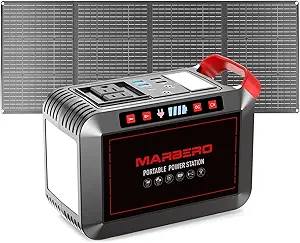
The MARBERO 237Wh Solar Generator Set is designed for people who value portability and simplicity more than high power output.
With a 237Wh battery and a compact design, it makes sense for keeping phones, lights, small fans, cameras, and other low-power electronics running during camping trips, road trips, or short outages.
The included 30W folding solar panel is also an advantage for buyers who want a complete starter kit rather than purchasing a power station and panel separately.
However, this is still a small power station. It should not be treated like a replacement for a large home backup battery. The 250W peak rating puts it firmly in the lightweight category, so check the power requirements of any AC appliance before connecting it.
Key Features
- 237Wh battery capacity
- Up to 250W peak output
- Foldable 30W solar panel included
- AC, USB, and DC outputs
- LCD battery display
- Multiple charging methods
- Compact design for travel and emergency kits
Best For
Campers, travelers, students, emergency kits, and anyone who mainly needs portable power for small electronics.
Check the current MARBERO price and package on Amazon:
View MARBERO Solar Generator
2. Jackery Explorer 1000 v2 with 200W Solar Panel – Best for Higher-Power Backup
Check Amazon Price Click Here!
Brand: Jackery
Battery Capacity: 1,070Wh
Continuous AC Output: 1,500W
Surge Output: 3,000W
Weight: Approximately 23.8 lbs
Battery Chemistry: LiFePO4
Solar Panel: 200W option
The Jackery Explorer 1000 v2 belongs to a completely different class from the small 200Wh power stations on this list.
Jackery’s current specifications list a 1,070Wh LiFePO4 battery, 1,500W rated AC output, and 3,000W surge capability. The unit weighs about 23.8 pounds and supports solar charging through its DC inputs.
That extra capacity makes it much more practical for emergency backup, RV trips, off-grid use, and situations where you need to run more than phones and USB devices.
A 1,070Wh battery also gives you considerably more energy to work with than a 200Wh-class station. Actual runtime will depend on the power consumption of the connected equipment and conversion losses, so watt-hours should be treated as a starting point rather than a guarantee of runtime.
The LiFePO4 battery chemistry is another important advantage for buyers who plan to use their power station regularly. Jackery rates the battery for up to 4,000 cycles before retaining at least 70% of its original capacity.
Key Features
- 1,070Wh LiFePO4 battery
- 1,500W continuous AC output
- 3,000W surge capacity
- Three AC outlets
- USB-C and USB-A charging
- 12V car port
- Solar charging capability
- Approximately 23.8 lbs
- Long-cycle-life LiFePO4 battery
Best For
Home emergency backup, RV owners, van life, camping, remote work, and buyers who need substantially more power than a compact 200Wh-class station can provide.
Check the current Jackery Explorer 1000 v2 configuration on Amazon:
View Jackery Explorer 1000 v2
3. Apowking 200W Solar Generator Set – Basic Emergency Power on a Small Budget
Check Amazon Price Click Here!
Brand: Apowking
Battery Capacity: 146Wh
Peak Output: Up to 200W
Solar Panel: 30W foldable panel included
Weight: Approximately 3.3 lbs
The Apowking 200W Solar Generator Set is aimed at buyers who want a very small and inexpensive backup power solution.
At 146Wh, it has substantially less stored energy than the larger stations on this list. That limitation is important, but it is also what makes the unit attractive for basic emergency charging.
It can be useful for smartphones, cameras, tablets, LED lights, small fans, and other low-power devices. Its compact size also makes it easy to keep in an emergency bag, vehicle, or camping kit.
The included solar panel means you can recharge the station away from an electrical outlet, although a 30W panel is best viewed as a slow charging solution rather than a high-speed way to refill the battery.
Key Features
- 146Wh battery capacity
- Up to 200W peak output
- 30W folding solar panel
- USB charging
- DC output
- AC outlet
- LED emergency light
- Solar, wall, and vehicle charging options
Best For
Emergency kits, hiking, camping, travel, and buyers who mainly need to keep small electronics charged.
If your goal is to operate larger appliances, this is not the type of solar generator you should choose. Look at a 500Wh-to-1,000Wh-class station instead.
Check the current Apowking package on Amazon:
View Apowking Solar Generator
4. Jackery Explorer 300 Portable Power Station – Compact Power for Electronics
Check Amazon Price Click Here!
Brand: Jackery
Battery Capacity: 293Wh
AC Output: 300W
Surge Output: 500W
Weight: Approximately 7.1 lbs
Solar Panel: Sold separately
The Jackery Explorer 300 remains a compact option for people who need more capacity than a small emergency power bank but don’t want to carry a 20-plus-pound power station.
Jackery currently lists the Explorer 300 at 293Wh with a 300W inverter and 500W surge output. It also uses a pure sine wave inverter and supports multiple devices at the same time.
This makes it particularly useful for laptops, phones, cameras, drones, lights, small fans, and other electronics.
One important consideration in 2026 is that this is an older model using NCM lithium-ion battery chemistry, rather than the LiFePO4 chemistry now common in many newer budget power stations. Jackery’s current information lists an approximately 800-cycle life to 80% capacity.
That does not automatically make the Explorer 300 a bad choice. It simply means buyers should consider whether the older model’s portability and price make more sense than choosing a newer LiFePO4 alternative.
Key Features
- 293Wh capacity
- 300W continuous output
- 500W surge output
- Pure sine wave inverter
- Two AC outlets
- USB-C PD charging
- USB-A ports
- Car charging outlet
- Compact portable design
Best For
Campers, photographers, travelers, digital nomads, and people who primarily need to charge electronics rather than operate high-wattage appliances.
Check the current Explorer 300 price on Amazon:
View Jackery Explorer 300
5. DaranEner NEO300 – Compact Station with 600W Output
Check Amazon Price Click Here!
Brand: DaranEner
Battery Capacity: 268Wh
Continuous Output: 600W
Peak Output: Up to 1,000W
Solar Panel: Sold separately
The DaranEner NEO300 takes a different approach from the smaller 200W-class stations.
Its 268Wh battery is still compact, but the 600W inverter gives it considerably more output capability than the MARBERO and Apowking units.
That can be useful when your equipment has a higher power requirement but you still want a relatively small portable power station.
The important distinction is that output power and battery capacity are not the same thing. A 600W inverter does not mean the station can deliver 600W for a long period. At a 600W load, a 268Wh battery would be depleted quickly after accounting for inverter losses.
This is why the NEO300 makes more sense for short-duration higher-power loads than for extended high-wattage backup.
Key Features
- 268Wh battery capacity
- 600W continuous AC output
- Up to 1,000W peak output
- Multiple AC, USB, and DC outputs
- Solar charging capability
- Compact portable design
- Higher inverter output than many small power stations
Best For
Users who need more inverter power in a compact package, including portable work, camping, small tools, and short-duration higher-power loads.
Check the current DaranEner listing and configuration on Amazon:
View DaranEner NEO300
How to Choose an Affordable Solar Generator in 2026
Buying a budget solar generator is easier when you focus on the specifications that actually affect your use.
1. Battery Capacity: Look at Watt-Hours
Battery capacity is normally listed in watt-hours (Wh).
A 1,000Wh power station stores considerably more energy than a 200Wh station. However, that does not mean a 1,000Wh station will always run an appliance for exactly twice as long.
For example, a device drawing 100W theoretically uses about 100Wh per hour. Real-world runtime will be lower because power stations have conversion losses and some devices do not draw a constant amount of power.
This is why Wh is generally more useful than mAh when comparing different portable power stations.
2. Continuous Wattage Matters More Than Peak Wattage
The continuous output rating tells you approximately how much power the inverter can deliver during normal operation.
The surge rating refers to short bursts of additional power that some appliances require when starting.
For example, a motor-driven appliance may briefly need more power during startup than it needs while running.
Don’t choose a power station based only on its peak number. Compare the continuous rating with the actual wattage requirements of your equipment.
3. Battery Chemistry Is More Important in 2026
One of the biggest changes in the affordable power station market is the availability of LiFePO4 batteries in smaller and less expensive models.
Current 2026 budget comparisons heavily emphasize LiFePO4 because these batteries generally offer substantially longer cycle life than older NMC lithium-ion batteries.
That doesn’t mean every NMC power station is a poor purchase. An older model can still make sense when portability, price, or a particular feature matters more than maximum cycle life.
But if two similarly priced stations offer similar capacity and output, battery chemistry deserves serious consideration.
4. Check Solar Input, Not Just the Panel Size
A solar panel’s advertised wattage does not mean it will continuously produce that amount of power.
A 100W panel might produce substantially less under clouds, shade, poor orientation, high temperatures, or other real-world conditions.
Also check the power station’s maximum solar input. A very large solar array does not help if the station’s solar input is limited.
For occasional camping, slower solar charging may be perfectly acceptable. For emergency preparedness, faster solar input becomes more valuable because you want to restore usable battery capacity during limited daylight hours.
5. Don’t Ignore Weight
Portability is one of the biggest advantages of a solar generator.
A 150Wh-to-300Wh unit can be convenient for camping, travel, and vehicle emergency kits. Larger 1,000Wh-class systems provide much more stored energy but are significantly heavier.
The Jackery Explorer 1000 v2, for example, weighs approximately 23.8 pounds, while the Explorer 300 is around 7.1 pounds.
Think about where you will actually use the power station before choosing capacity.
6. Count the Ports You Actually Need
Check the number and type of outputs before buying.
Common connections include:
- 120V AC outlets
- USB-C
- USB-A
- 12V DC
- Car charging ports
USB-C Power Delivery can be particularly useful for modern laptops, tablets, phones, cameras, and other electronics.
More ports aren’t automatically better. The important question is whether the station has the connections and output ratings your devices require.
7. Consider Whether You Need a Solar Panel Included
A “solar generator” can refer to a portable power station sold with a solar panel, while a power station by itself may require you to purchase the panel separately.
An included panel can make a kit more convenient and may provide better value for someone starting from scratch.
On the other hand, buying the power station separately can give you more flexibility when choosing panel size and configuration.
What Can an Affordable Solar Generator Actually Power?
A small power station can be extremely useful, but expectations matter.
Small 100Wh–300Wh Class
These are generally best suited to:
- Smartphones
- Tablets
- Cameras
- LED lights
- Small fans
- Portable electronics
- Some laptops
- Small DC equipment
300Wh–600Wh Class
These provide more flexibility for:
- Laptops
- Multiple phones
- Cameras and drones
- Small TVs
- Portable refrigerators
- Lights
- Small fans
- Other moderate loads
Around 1,000Wh and Above
These are more appropriate for:
- Longer emergency backup
- RV use
- Multiple electronic devices
- Refrigerators for limited periods
- Larger collections of essential electronics
- Higher-power appliances within the inverter’s limits
Always check the actual wattage of the appliance before connecting it.
A power station’s battery capacity tells you how much energy it stores. Its inverter rating tells you how much power it can deliver at one time. You need both numbers to determine whether a particular station fits your needs.
How Long Will a Solar Generator Run My Device?
A simple starting calculation is:
Estimated runtime = Battery capacity (Wh) ÷ Device power consumption (W)
For example, a 268Wh power station connected to a 50W device gives a theoretical runtime of:
268Wh ÷ 50W = 5.36 hours
Real runtime will be shorter because of inverter losses, battery management, temperature, and the device’s changing power consumption.
This simple calculation is still useful when comparing stations because it helps prevent one of the most common mistakes: buying a power station based solely on its advertised wattage.
Are Cheap Solar Generators Worth Buying in 2026?
They can be, but the cheapest price is not necessarily the best value.
The budget portable power station market has improved significantly, with LiFePO4 batteries, faster charging, and higher inverter output becoming available at lower price points. Current 2026 comparisons include models such as the BLUETTI EB3A, Anker SOLIX C300, EcoFlow RIVER 3, and Jackery Explorer 300 Plus in the sub-$300 segment.
That creates more competition for older NMC-based models.
For a buyer, the better question is not:
“What is the cheapest solar generator?”
Instead, ask:
“What is the least expensive power station that has the capacity, output, battery chemistry, and charging options I actually need?”
That small change in thinking can prevent a lot of wasted money.
Final Verdict: Which Affordable Solar Generator Should You Choose?
There is no single best solar generator for every situation.
Your choice should depend on the size of your loads, how long you need backup power, how portable the system needs to be, and whether you want a solar panel included.
Best for Higher-Power Emergency Backup
Jackery Explorer 1000 v2 + 200W Panel
Its 1,070Wh LiFePO4 battery and 1,500W continuous output make it the most capable system among the five options listed here.
Best for Lightweight Emergency Kits
MARBERO 237Wh Solar Generator Set
The compact design and included solar panel make it practical for small electronics, camping, and emergency kits.
Best for the Smallest Budget
Apowking 200W Solar Generator Set
Its 146Wh capacity keeps the system compact and inexpensive, making it better suited to basic device charging than appliance backup.
Best Compact Jackery Option
Jackery Explorer 300
Its 293Wh capacity and 300W inverter make it a useful middle ground for camping, travel, and electronics.
Best When You Need More Inverter Output in a Compact Size
DaranEner NEO300
Its 600W continuous inverter gives it more output capability than many compact stations, although its 268Wh battery means it is better for shorter-duration higher-power loads.
Frequently Asked Questions
What is the best affordable solar generator in 2026?
The best affordable solar generator depends on how much power you need. Small 200Wh-class stations are convenient for phones and lights, while a 1,000Wh-class model is more appropriate for extended emergency backup. Battery chemistry, inverter output, solar input, and weight should all be considered alongside price.
Is a 200Wh solar generator enough for emergencies?
A 200Wh-class power station can be useful for short emergencies, especially for charging phones, lights, cameras, and other electronics. It is not a substitute for a large home backup system. If you need to operate appliances for longer periods, consider a substantially larger battery capacity.
Are LiFePO4 solar generators better?
For many buyers, LiFePO4 is attractive because it generally offers a much longer cycle life than traditional NMC lithium-ion batteries. Many 2026 budget power stations now use LiFePO4, making it an important specification to compare before purchasing.
Can a solar generator run a refrigerator?
Some larger solar generators can run a refrigerator, but the result depends on the refrigerator’s running wattage, startup surge, battery capacity, inverter rating, and how frequently the compressor cycles. A small 150Wh or 200Wh station should not be assumed to provide long-term refrigerator backup.
Can I use a solar generator while it is charging?
Some power stations support pass-through charging, but the exact behavior varies by model. Check the manufacturer’s specifications before relying on this feature for sensitive equipment or continuous backup applications.
How many solar panels do I need?
The answer depends on the power station’s maximum solar input and the amount of energy you need to replace each day. More panel wattage can reduce charging time, but only up to the station’s supported input limit. Actual solar production will also vary with weather, shade, orientation, and temperature.
Is a solar generator the same as a portable power station?
The terms are often used interchangeably in the consumer market. A portable power station is the battery and inverter system, while a “solar generator” is commonly used to describe a power station used with solar panels or sold as a solar charging package.
Bottom Line
Affordable solar generators are considerably more capable in 2026 than many older budget models were a few years ago. The key is to stop judging them by price alone.
Look at watt-hours, continuous watts, surge capacity, battery chemistry, solar input, charging speed, weight, and the devices you actually need to power.
A small station can be an excellent companion for camping and emergency charging. A 1,000Wh-class system can provide a much more useful layer of backup during an outage. The right choice is the one that matches your actual power requirements without paying for capacity you will never use.
Before purchasing, check the current Amazon listing because configurations, bundle contents, and prices can change over time.