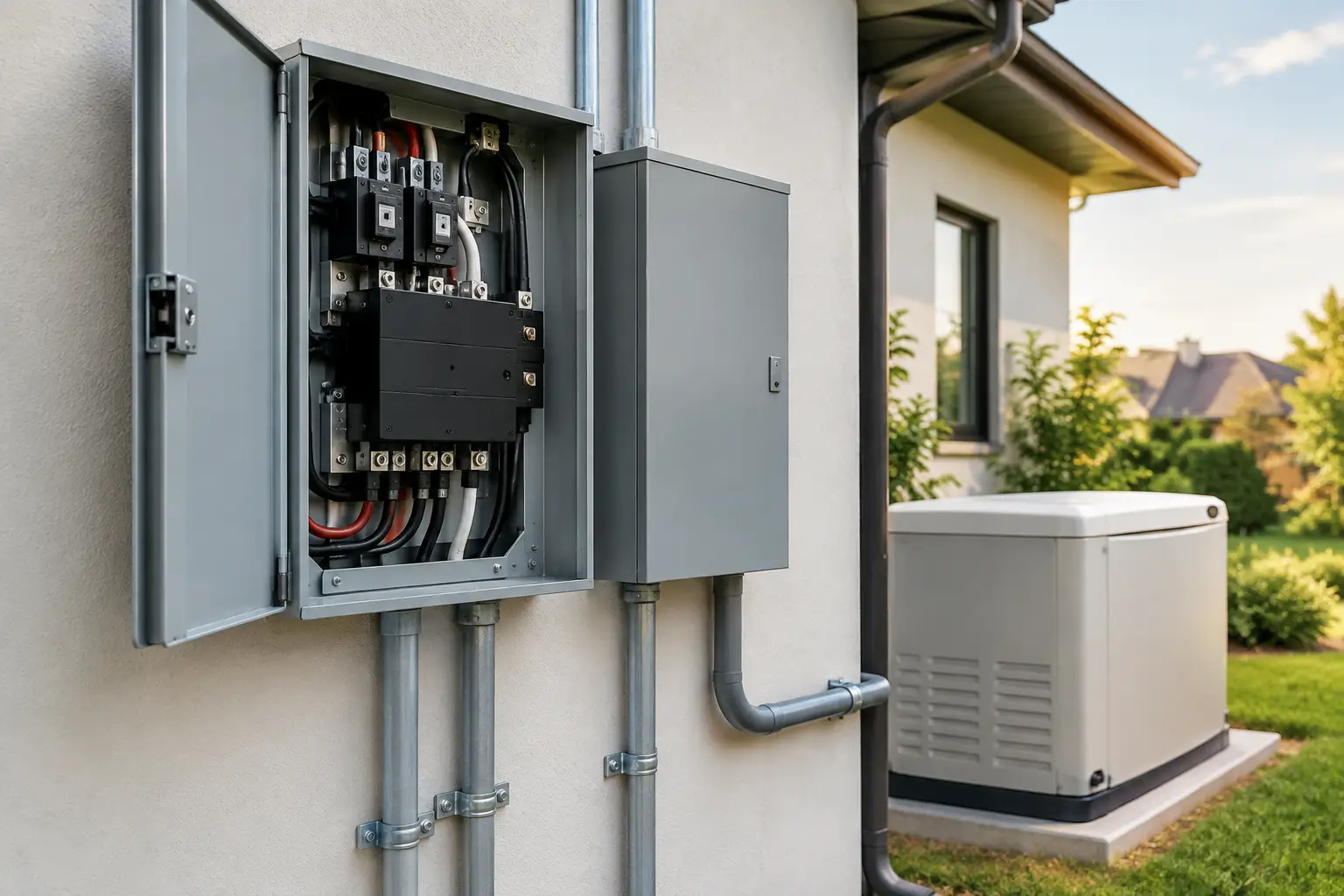
How Transfer Switches Protect Your Home Power
A portable generator can keep your refrigerator running, power essential lights, and help prevent a sump pump from failing during a storm. But connecting a generator to your home’s electrical system requires more than a heavy-duty cord. You need a safe, properly designed connection that keeps generator power separate from utility power.
A generator transfer switch provides that controlled connection. It allows selected household circuits, or an appropriately designed electrical service, to receive backup power while preventing the generator from feeding electricity back into utility lines. That protection helps safeguard utility workers, your home’s electrical equipment, and the generator itself.
The right setup also makes backup power easier to use. Instead of running extension cords through windows and doorways, you can power essential circuits through a compatible outdoor generator inlet and transfer equipment.
Whether you’re planning to use a portable generator or install a permanent standby system, understanding how transfer switches work will help you choose equipment that fits your home, electrical panel, and backup power needs.
What Transfer Switches Actually Do
A transfer switch is a device that selects one power source at a time. In normal conditions, your circuits receive utility power. When an outage occurs, you move those circuits to generator power manually or the system transfers automatically, depending on the equipment.
The key function is isolation. A correctly installed switch prevents the utility and generator from energizing the same circuits at the same time. Without that separation, generator power can travel backward through the service lines, a dangerous condition called backfeeding. Never connect a generator to a wall outlet with a homemade double-male cord. It is unsafe, illegal in many jurisdictions, and not a substitute for a listed transfer switch or approved panel interlock.
Most homeowners use one of three approaches:
- A manual transfer switch feeds a dedicated group of essential circuits.
- An automatic transfer switch senses a utility outage and starts and transfers a compatible standby generator.
- A panel interlock kit uses a mechanical lockout at the main electrical panel so the main breaker and generator breaker cannot be on together.
Each approach can be safe when it is correctly matched to the panel, generator, and local electrical code. The right choice depends less on the brand name and more on how you expect to use backup power.
Manual vs. Automatic Transfer Switches
Manual transfer switches for portable generators
A manual transfer switch is often the practical choice for homeowners using a portable generator. When the power goes out, you roll out the generator, start it outdoors, connect the generator cord to an inlet box, and move the selected circuits from utility to generator power.
This setup works well with conventional portable generators and inverter generators, including models used for emergency power, RV trips, or a jobsite. It gives you direct control over what runs, which can help prevent overloads. You might choose the refrigerator, furnace blower, sump pump, well pump, a few lights, and internet equipment, then leave the electric range and central air off.
The trade-off is that someone must be home and able to operate it. A manual setup also requires fuel management. If your generator runs on gasoline, propane, or dual fuel, you still need to refuel or switch fuel sources according to the manufacturer’s instructions.
Automatic transfer switches for standby systems
An automatic transfer switch, often called an ATS, is built for hands-off backup power. It monitors incoming utility power. When it detects an outage, it signals a compatible standby generator to start, then shifts the home load to generator power after a brief delay. When utility power returns and stabilizes, it transfers the load back and allows the generator to cool down before shutting off.
This is the better fit for homes where outages may happen while the owner is away, or where continuous power is especially valuable. Homes with sump pumps, refrigerated medications, security systems, well pumps, or frequent storm-related outages are common candidates.
Automatic systems cost more because the generator, transfer equipment, fuel supply, electrical work, and often concrete pad or permitting requirements are more involved. They are not generally paired with a typical portable generator. For many households, a portable generator with a manual transfer switch delivers a better balance of cost and capability.
Size the Switch Around the Load, Not Just the Generator
Transfer-switch ratings are commonly expressed in amps, such as 30, 50, 100, or 200 amps. The correct rating must work with both the generator output and the circuits or service being transferred.
A 30-amp, 120/240-volt inlet and transfer setup is common for smaller portable generators. It can support selected essentials, but it has a maximum output ceiling of roughly 7,200 running watts at 240 volts. A 50-amp setup can carry up to roughly 12,000 watts and is a better match for many larger portable units. Those figures describe capacity, not a promise that every appliance can run at once.
Start with the loads you truly need. A refrigerator may use modest running wattage but needs more power briefly when its compressor starts. A well pump, sump pump, furnace blower, microwave, and window air conditioner all have their own starting and running demands. Central air conditioning, electric water heaters, clothes dryers, electric ovens, and large shop tools can consume capacity quickly.
For a home with a private well, the pump deserves special attention. Confirm whether it is a 120-volt or 240-volt load, its breaker size, and its starting requirements. A generator that appears large enough on paper can still struggle if it cannot handle motor starting surge. In some cases, a soft-start device or load-management strategy may help, but those decisions should be made with qualified electrical guidance.
Whole-Home Backup Is Not Always the Best Value
“Whole-home” sounds reassuring, but it can mean different things. A 200-amp automatic transfer switch may allow a standby generator to support the entire service panel, yet the generator still has a finite capacity. If several high-draw appliances start at once, the system may need load management to shed nonessential circuits.
An essential-circuit transfer switch is more focused. It powers only the circuits selected during installation. That can be limiting if you later decide you need a different room or appliance, but it also makes generator capacity easier to manage and can reduce installation cost.
A panel interlock can be another sensible option for experienced homeowners working with a licensed electrician. It often provides access to more circuits because you choose which breakers to turn on during an outage. However, it requires disciplined load management. You must know which breakers to leave off, and it is not compatible with every electrical panel. The interlock must be listed for that exact panel model.
The Inlet Box, Cord, and Plug Must Match
A transfer switch is only one part of the backup-power path. The inlet box mounted outside the home receives power from the generator cord. The cord connects to the generator receptacle. Every component must match the voltage, amperage, and connector type your generator supports.
A common mistake is buying a 50-amp inlet box because it seems more future-proof, then discovering the generator only has a 30-amp outlet. Adapters can be useful for certain applications, but they do not increase the generator’s available output or change the rating of a smaller circuit. Use only properly rated cords and adapters, and avoid light-duty household extension cords for generator-to-inlet connections.
For 120/240-volt home backup, look for a four-wire connection that includes two hot legs, a neutral, and a ground. The exact plug configuration matters. L14-30, SS2-50, and 14-50 connections are common examples, but they are not interchangeable. Check the generator’s outlet label, the inlet-box specification, and the transfer equipment requirements before ordering anything.
Cord length matters too. Buy enough length to keep the generator outdoors, well away from doors, windows, vents, and attached structures, while avoiding excessive slack. A generator must never run in a garage, basement, shed, or enclosed porch because carbon monoxide can build up rapidly.
→ Compare Generator Inlet Boxes and Transfer Switch Accessories
Installation Details That Deserve Professional Help
Installing a transfer switch or panel interlock involves work inside the electrical panel. That is not a casual DIY task. A licensed electrician can verify service capacity, panel compatibility, correct neutral and grounding arrangements, wire sizing, breaker selection, inlet-box location, and local permit requirements.
This is especially relevant with portable generators because neutral bonding can affect how the equipment should be configured. Some generators have a bonded neutral, while others have a floating neutral. The correct arrangement depends on the transfer equipment and whether the generator is treated as a separately derived system. Do not guess based on forum advice or modify generator wiring without understanding the manufacturer’s instructions and the applicable electrical code.
Ask the installer to label every backed-up circuit clearly. Then test the system before the next storm. Practice starting the generator, connecting the cord, transferring power, checking loads, and returning to utility power. Store the process near the panel, along with the generator manual and a fuel plan.
Buying With the Next Outage in Mind
Choose transfer equipment after you have identified your essential loads and confirmed your generator’s voltage, output, and outlet type. A small inverter generator may be ideal for camping or sensitive electronics, but it may not support a well pump or 240-volt furnace circuit. A larger dual-fuel portable generator can provide more home backup flexibility, though it needs a compatible inlet, heavier cord, and a realistic fuel-storage plan.
The strongest backup setup is not necessarily the largest one. It is the one you understand, can operate safely, and have tested before the weather turns. When the lights go out, clear labels, compatible equipment, and a practiced routine are worth far more than extra wattage you cannot use.
→ Explore Generator Transfer Switches for Home Backup Power
Frequently Asked Questions
Do I need a transfer switch for a portable generator?
If you want to supply power through your home’s electrical panel, you need an appropriate, code-compliant transfer arrangement that prevents unsafe backfeeding. Depending on the installation, this may be a manual transfer switch or an approved panel interlock. Never feed a home circuit through an ordinary wall outlet using a double-male cord. Have a qualified electrician determine the correct arrangement for your panel and generator.
What is the difference between a transfer switch and an interlock kit?
A transfer switch uses switching equipment to select between utility and generator power for the circuits or electrical service it controls. A panel interlock is a mechanical device that prevents the main breaker and generator breaker from being on simultaneously. An interlock can provide access to circuits throughout a compatible panel, but the operator must manage the electrical load. Both arrangements require appropriate equipment and installation.
Can a 30-amp transfer switch power an entire house?
A 30-amp, 120/240-volt connection has a theoretical apparent-power capacity of 7,200 volt-amperes, but the actual usable output depends on the generator and the complete installation. It may support several essential household circuits when loads are managed carefully. It will not necessarily run every appliance in the home, particularly high-demand equipment such as central air conditioning or electric water heaters.
Can I install a generator transfer switch myself?
Transfer-switch installation involves electrical-panel work, source isolation, conductor sizing, grounding and bonding, and compliance with local electrical requirements. Mistakes can create serious hazards. The safest approach is to have a qualified, appropriately licensed electrician select and install the equipment and verify the completed system. Always follow the manufacturer’s instructions and local permit requirements.
Does an automatic transfer switch start any generator?
No. An automatic transfer switch must be compatible with the generator and its controls. Residential ATS systems are commonly designed for permanently installed standby generators that support automatic startup and transfer. Most conventional portable generators require manual startup and a compatible manual transfer arrangement. Verify the exact equipment specifications before assuming a generator can operate automatically.
Does a transfer switch increase generator wattage?
No. A transfer switch controls how electrical power is connected to the home; it does not generate electricity or increase the generator’s output. The generator’s running capacity, starting capability, voltage, and available outlets still determine which appliances can operate. A larger-rated transfer switch cannot compensate for an undersized generator.
Final Thoughts
A properly selected generator transfer switch makes home backup power safer, more organized, and easier to manage. It helps isolate utility power from generator power while providing a controlled way to supply essential household circuits during an outage.
For many homeowners with portable generators, a manual transfer switch or compatible panel interlock is a practical solution. Those who want backup power to start and transfer automatically may prefer a permanently installed standby generator with a compatible automatic transfer switch.
Before buying, identify your essential loads, verify the generator’s actual electrical capabilities, and confirm compatibility with the panel, inlet, cord, and transfer equipment. Have the installation evaluated by a qualified electrician, and test the system before you need it.
When an outage arrives, a well-planned backup system can make a difficult situation much easier to manage.