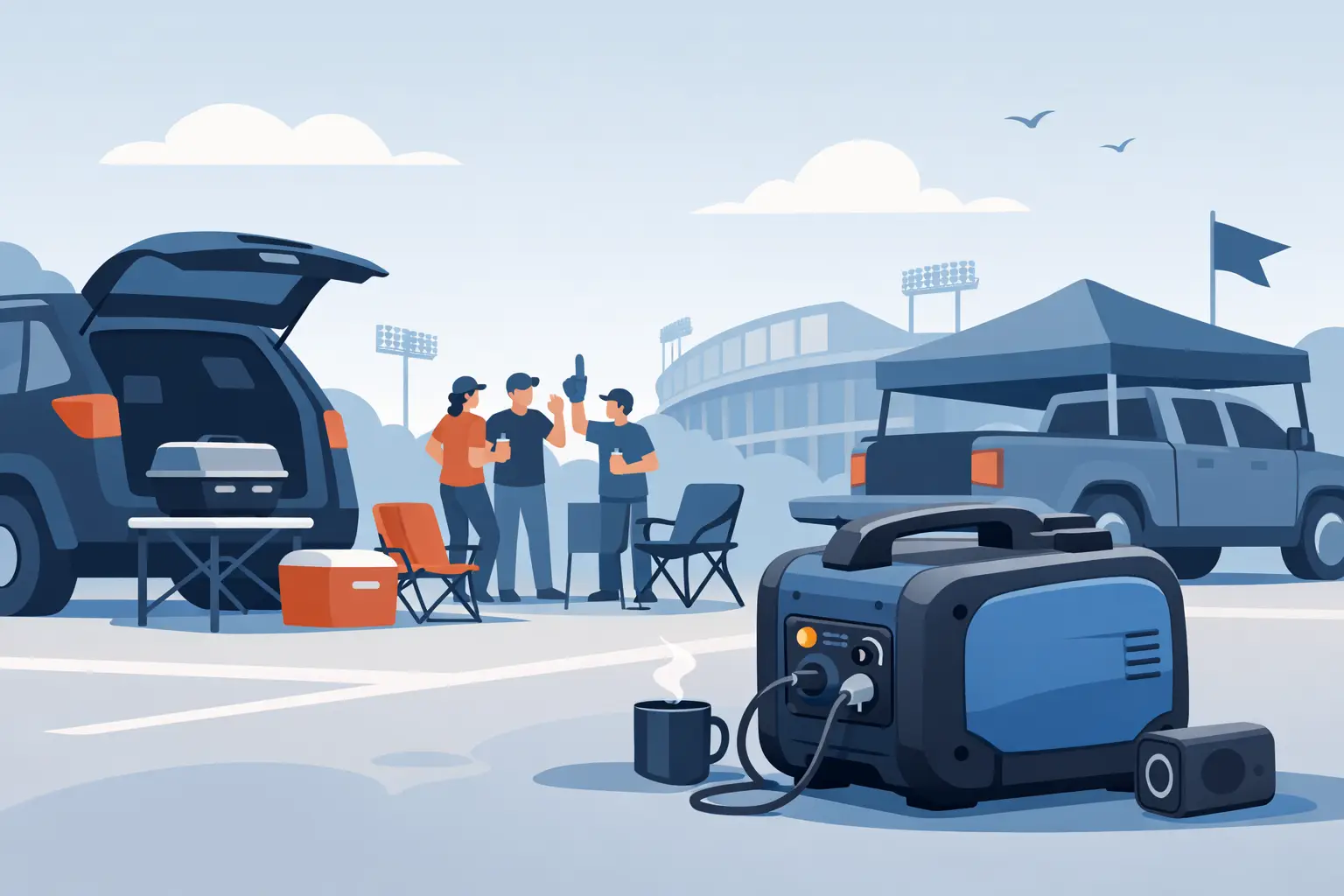
The wrong generator can ruin a tailgate before the grill even gets hot. If your power source is too loud, too weak, or constantly running out of fuel, it stops being helpful and starts being the thing everyone complains about. That is why choosing the right quiet inverter generator for tailgating matters more than many buyers expect.
Tailgating power needs are usually simple on paper but messy in real life. You may want to run a TV, a small electric grill or slow cooker, a speaker, phone chargers, a coffee maker, and maybe a fan or space heater depending on the season. The trick is not just finding enough wattage. It is finding clean, portable, low-noise power that works in a crowded parking lot without dominating the whole setup.
What makes a quiet inverter generator for tailgating different?
A standard open-frame generator can produce plenty of power, but it is rarely a good fit for game day. Tailgating puts you close to other people, cars, tents, and conversation. In that setting, noise is not a minor inconvenience. It is a buying factor.
An inverter generator is designed to produce cleaner power and typically runs much quieter than traditional portable models. That cleaner output matters if you are powering a TV, laptop, tablet, or newer sound system. It also helps that inverter models can throttle down when demand is low, which improves fuel efficiency and keeps noise in check.
For tailgating, that combination matters more than raw power. Most people do not need a construction-grade machine with huge output. They need a compact unit that starts easily, runs for several hours, and does not force everyone nearby to talk over it.
How much wattage do you actually need?
This is where many shoppers either overspend or buy too small. A quiet inverter generator for tailgating should match what you will really run, not every appliance you own.
If your setup is light, such as a TV, streaming device, phone chargers, and a speaker, you may only need 1000 to 2000 running watts. If you are adding a coffee maker, electric griddle, blender, or portable cooler, your needs go up quickly. Heating elements are usually the biggest issue. A coffee maker or hot plate can pull far more power than a TV and speakers combined.
For many tailgaters, the practical sweet spot is around 2000 to 2500 running watts. That range is often enough for entertainment gear plus a few food-prep appliances, while still keeping size and weight manageable. If you want to run multiple cooking appliances at once, or if several people are plugging into one unit, moving into the 3000-watt class may make sense. The trade-off is more weight, more fuel use, and often a bit more noise.
A simple way to think about it is this: if your generator is mostly for screens, chargers, lights, and light kitchen duty, smaller is usually better. If your tailgate is built around electric cooking, you need more headroom.
Noise level matters more than the spec sheet suggests
Most buyers look at wattage first, but at a tailgate, decibel rating deserves equal attention. A generator that sounds acceptable in your driveway can feel much louder in a crowded parking lot.
Many inverter generators marketed for recreation fall somewhere in the low-50 to low-60 decibel range under lighter loads. That is generally the zone you want. Once you start getting noticeably above that, the generator becomes more intrusive, especially if it is running nonstop for hours.
There is a catch, though. Manufacturers often publish noise ratings measured at partial load and from a specific distance. Real-world noise changes based on what you are powering, where you place the generator, and how reflective the surrounding surfaces are. Concrete, vehicle rows, and stadium lots can bounce sound around more than expected.
So treat the decibel number as a comparison tool, not a promise. If two otherwise similar models are close in power and runtime, the quieter one is usually the better tailgating pick.
Fuel efficiency and runtime can make or break game day
Nobody wants to shut everything down in the middle of pregame because the tank ran dry. Runtime is one of the most practical buying factors, especially for all-day events.
A good tailgating generator should comfortably cover your arrival, setup, pregame, and some buffer time. For many buyers, that means looking for a unit that can run at least 6 to 8 hours at moderate load. More is always helpful, but it depends on how heavily you plan to use it.
A smaller inverter generator can sometimes deliver surprisingly long runtime because it is efficient at lower demand. That is another reason not to oversize without a clear reason. A giant unit loafing along may still burn more fuel and take up more space than you need.
Dual-fuel models can also be worth considering. Propane is convenient for some tailgaters because it stores cleanly and can be easier to manage than carrying gasoline in the car. On the other hand, gasoline often provides stronger overall output and is simpler if you already keep fuel on hand. There is no universal winner here. It depends on your storage habits, travel setup, and how often you plan to use the generator beyond tailgating.
Features that are actually useful at a tailgate
Some generator features sound impressive but add little value in a parking lot. Others make ownership much easier.
Electric start is convenient, especially in cold weather or when multiple people may use the unit. Parallel capability is useful if you want the option to connect two smaller inverter generators later instead of buying one larger machine now. That approach can work well for buyers who want flexibility, though it does add complexity and cost.
Outlet selection matters more than people expect. You should have enough standard household outlets for your core gear, plus USB ports if you plan to charge phones directly. If you use a travel trailer, powered cooler, or specialty equipment, check outlet compatibility before buying instead of assuming adapters will solve everything.
Weight also matters. A generator that looks portable online can feel much less portable when you are lifting it in and out of an SUV early in the morning. Wheels help on larger models, but compact size is still a major advantage for tailgating.
Tailgating setup mistakes to avoid
Even the best generator can be frustrating or unsafe if it is used poorly. Placement is the first issue. A generator should never run inside a vehicle, under an enclosed canopy, or too close to occupied areas because of carbon monoxide risk. Outdoor use with proper distance and ventilation is not optional.
Extension cord planning is another common miss. Buyers often focus on the generator and forget that cord length, cord gauge, and outlet count affect the whole setup. If your cords are too light or too short, you create unnecessary hassle and may limit what the generator can do.
It is also smart to think about startup loads. Appliances like coffee makers, blenders, and small cooking devices can spike demand when they first turn on. If your wattage estimate is too tight, the generator may overload even if the running numbers looked fine on paper.
One more mistake is ignoring parking lot etiquette. A quieter machine helps, but so does thoughtful placement. Point the exhaust away from people, keep the unit out of walkways, and avoid forcing neighboring tailgates to listen to your engine all morning.
Should you buy small, midsize, or large?
For most buyers, small to midsize inverter generators are the best fit. A compact 1000 to 2000-watt unit works well for simple entertainment-focused setups and is often the easiest to carry and store. A midsize 2000 to 3000-watt model is the best all-around choice for people who want room for cooking appliances and longer runtimes without moving into bulky territory.
Larger models have a place, especially for group tailgates with multiple TVs, electric cooking, and heavier accessory use. But bigger is not automatically better. Large units cost more, weigh more, and may create more noise than the average buyer needs to deal with.
This is where honest use planning matters. If you tailgate a few times each season and mainly want to power convenience items, keep it simple. If your setup is elaborate and power-heavy, buy for that reality instead of hoping a small unit will stretch.
How to choose with confidence
If you are comparing options, start with three filters: realistic wattage, real-world noise expectations, and runtime at moderate load. After that, look at portability, fuel type, outlet layout, and starting method.
That order matters because it keeps you focused on how the generator will actually perform during a tailgate, not just how good the product page sounds. At TopGeneratorsOnline, that is usually the difference between a satisfying purchase and one that gets returned after the first weekend.
The best quiet inverter generator for tailgating is usually not the one with the biggest number attached to it. It is the one that fits your gear, keeps the atmosphere comfortable, and gives you dependable power without becoming the center of attention. If your generator does its job so well that nobody talks about it all day, you picked the right one.