A campsite gets a lot less relaxing when your cooler warms up, your CPAP battery runs low, or your coffee setup quits before sunrise. Choosing the right portable generator for camping is really about matching power to the way you camp – not buying the biggest unit you can afford and hoping for the best.
That matters because camping generators live in a world of trade-offs. More wattage usually means more weight. Lower price can mean more noise. Longer runtime may come with a larger fuel tank, which adds bulk when you are loading the truck. If you want dependable power without turning your campsite into a construction zone, it helps to know which specs actually affect your trip.
What a portable generator for camping needs to do
For most campers, a generator is there to cover a few practical jobs. It might keep a small RV air conditioner running, recharge phones and camera batteries, support lights after dark, or power a medical device overnight. Some people need backup for cooking equipment or an electric cooler. Others just want a quiet power source for occasional charging.
That is why there is no single best size or type. A tent camper charging small electronics has a very different power profile from an RV owner trying to run an air conditioner, microwave, and battery charger. The best portable generator for camping is the one that covers your real load with some breathing room, without becoming too heavy, too loud, or too expensive to justify.
Start with wattage, not marketing
The first number to look at is running wattage. This tells you how much power the generator can supply continuously. Starting wattage matters too, especially for anything with a motor or compressor, because startup demand can spike well above normal use.
If you are only charging phones, laptops, battery packs, and LED lights, your power needs are modest. A compact inverter generator in the lower wattage range may be more than enough. If you want to run an RV air conditioner, coffee maker, or electric skillet, your needs jump quickly. In that case, a generator that seems fine on paper can end up overloaded in real use.
A common buying mistake is adding up only the devices you expect to use, then choosing a generator with almost no headroom. That can lead to overload shutdowns, unstable performance, and frustration when one extra appliance tips the system over the edge. A better approach is to calculate your likely simultaneous load, then add a buffer so the generator is not working at its limit all day.
Typical camping loads to think through
Small electronics and chargers draw relatively little power, but heating appliances and cooling equipment change the equation fast. A coffee maker, hot plate, or space heater can consume far more power than many first-time buyers expect. RV air conditioners are especially demanding because they need both strong startup capacity and steady output.
If your camping style changes from trip to trip, buy for your most common use case, not the once-a-year edge case. Otherwise you may end up carrying around excess generator weight on every trip for power you rarely use.
Why inverter generators usually make more sense
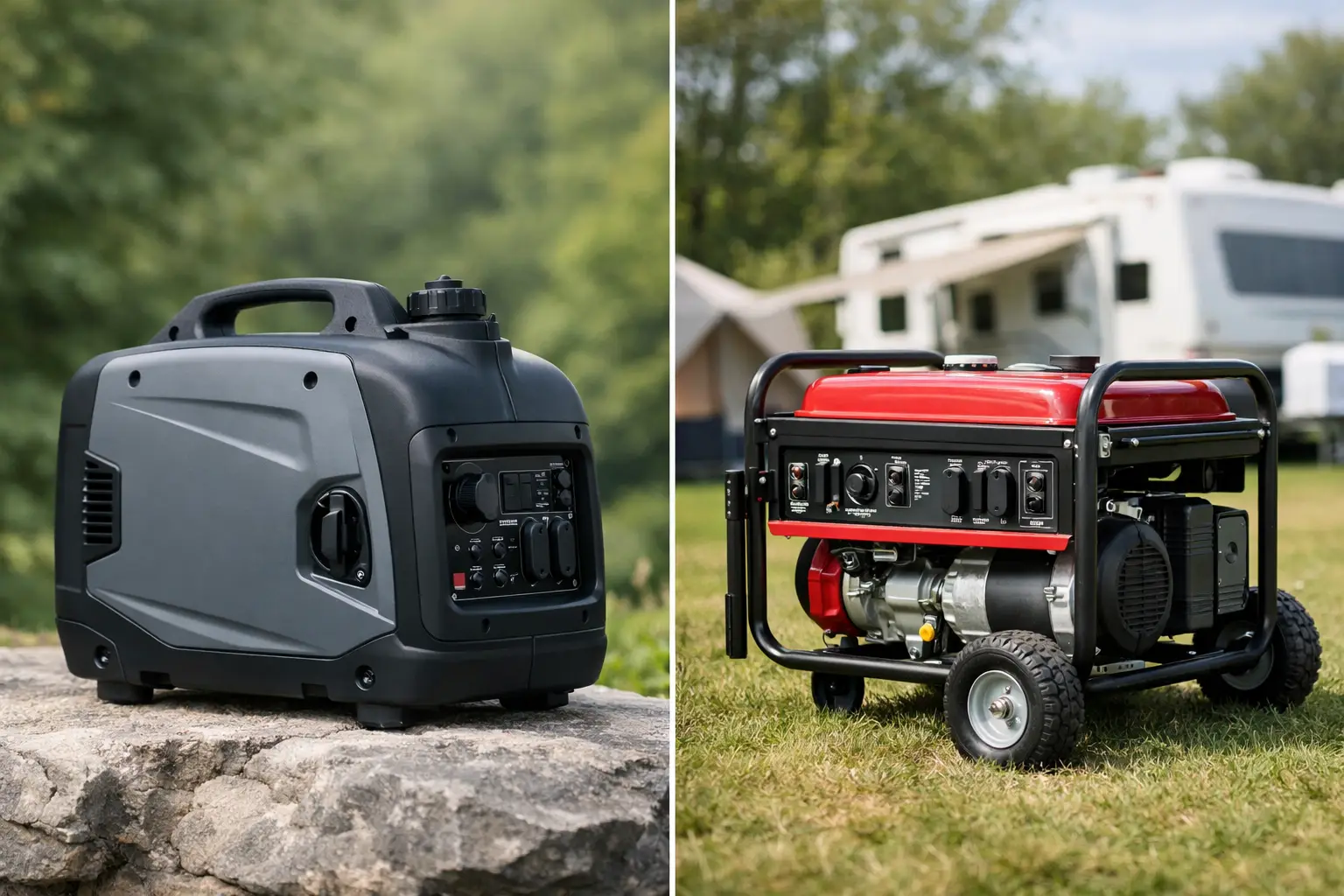
For camping, inverter generators are usually the better fit. They are typically quieter, more fuel-efficient at partial loads, and better suited for sensitive electronics like laptops, battery chargers, and CPAP machines. That combination lines up well with how most people use power outdoors.
Conventional generators can still make sense if you need more wattage for less money, but they are often louder and less refined. At a busy worksite, that may be acceptable. At a campground, noise can become the deciding factor.
This is one area where spending more up front often improves the ownership experience. A quieter generator with stable output and eco mode is easier to live with, especially on multi-day trips where fuel use and campsite comfort matter.
Noise is not a small detail
Generator noise is one of the fastest ways to regret a purchase. A model that sounds acceptable in a product description can feel much louder when it is running 20 feet from your tent or parked next to another family in a campground.
Look beyond general terms like quiet or whisper-like. Decibel ratings are not perfect because testing conditions vary, but they still give you a better comparison point than marketing language. Inverter models usually have the advantage here, particularly at lower loads when they can throttle down.
Also think about where you camp. Dispersed camping may give you more flexibility. Established campgrounds often have generator hour restrictions, and some campers simply will not tolerate loud equipment nearby. If quiet operation is high on your list, it should be treated as a core buying criterion, not a nice extra.
Fuel type, runtime, and the weight problem
Most camping generators in this category run on gasoline, though some are dual-fuel and can use propane as well. Gasoline models are common and easy to understand, but fuel storage and spill management take a little more planning. Propane burns cleaner and can be convenient for campers already carrying tanks, though power output may be slightly lower depending on the unit.
Runtime figures also need a reality check. Manufacturers often quote runtime at 25 percent load, which may not reflect how you actually use the generator. If your setup includes an RV air conditioner or cooking appliances, your real-world runtime may be much shorter than the number on the box suggests.
Then there is portability. A generator can be technically portable and still be a pain to move. Before buying, look at dry weight, handle design, wheel kit availability, and overall shape. A 30-pound difference may not sound dramatic until you are lifting the unit in and out of a truck bed every weekend.
Outlets and features that matter in real use
Outlet selection is easy to overlook until you need to plug in several devices at once. Think about whether you need standard household outlets, RV-ready connections, USB ports, or 12V charging options. If you are powering an RV, the right outlet can save you from dealing with awkward adapters.
Parallel capability is another feature worth considering. Some inverter generators can be paired with a second matching unit to increase output. That can be a smart option for campers who want compact portability most of the time but the ability to scale up later.
Low-oil shutdown, fuel shutoff, overload protection, and a clear control panel also make ownership easier. These are not flashy features, but they improve safety and reduce troubleshooting when you are far from home.
Safety matters more at camp than many buyers realize
A generator should never run inside a tent, RV, enclosed trailer, vehicle, or garage-like shelter. Carbon monoxide is the biggest risk, and it can become deadly fast. Even when camping in open areas, placement matters. Keep the generator well away from sleeping areas, doors, windows, and neighboring campsites.
You also need to account for weather. Generators and rain are a bad combination unless the unit is protected properly and operated according to the manufacturer instructions. Do not improvise unsafe covers or run extension cords in ways that create trip hazards or exposed connections.
Ground conditions matter too. Place the generator on a stable surface where it can ventilate properly and stay level. That helps with both safe operation and fuel management.
How to choose the right size for your camping style
If your trip is centered on light charging, lights, and small electronics, a compact inverter generator will usually be the sweet spot. It is easier to move, quieter in operation, and more efficient for small loads. For many tent campers and weekend users, that is the most practical place to start.
If you camp with a travel trailer or small RV and want to run more than one meaningful appliance, move up to a unit with stronger continuous output and enough starting wattage for motor-driven equipment. Air conditioning is often the tipping point. Once that enters the picture, undersizing becomes a much more expensive mistake.
If you are torn between two sizes, ask yourself how often you really need the extra capacity. Buying larger for peace of mind can make sense, but only if you are willing to accept the extra weight, fuel use, and cost. A smaller inverter model with parallel capability sometimes offers a better long-term balance.
At TopGeneratorsOnline, the most useful buying advice is usually the least dramatic: buy for your actual use, leave room for startup surges, and do not treat noise or safety as afterthoughts. A camping generator should make the trip easier, not become the thing you have to work around.
The right choice is the one that disappears into the background – starts when you need it, powers what matters, and lets the campsite stay a campsite.
CHECK THE BEST GENERATORS FOR CAMPING AT THE BEST PRICE ON AMAZON 🛒