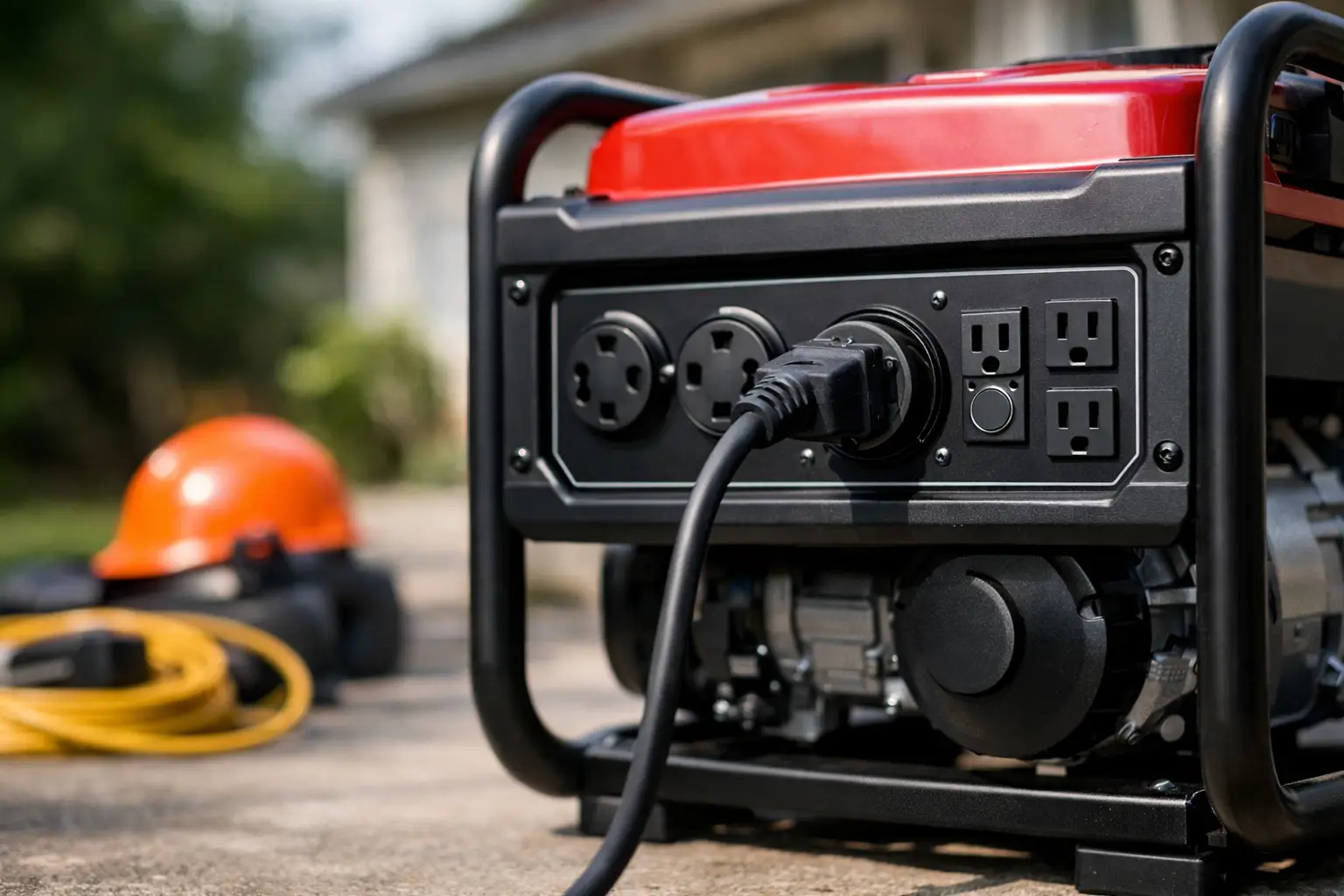
A generator can have plenty of wattage and still be the wrong fit if its outlets do not match the equipment you need to run. That is why generator outlet types explained clearly is more useful than simply comparing running watts. The receptacles on the control panel determine which cords, adapters, RV connections, and home power inlet boxes you can use safely.
A standard household plug may cover a lamp, refrigerator, or battery charger. It will not connect directly to a 240-volt well pump, a generator-ready home inlet, or many RV shore-power systems. Before buying a generator or a power cord, identify the outlet type, voltage, amperage, and whether the receptacle is straight-blade or locking.
Generator Outlet Types Explained: Start With Voltage and Amperage
Every outlet is rated for a specific voltage and maximum current. Voltage is the electrical pressure supplied to the appliance. Amperage is the amount of current the outlet and wiring can safely carry. Multiply volts by amps to estimate the maximum available wattage. For example, a 120V, 20A receptacle can supply up to 2,400 watts in theory, although the generator’s total output and circuit limits still apply.
Most portable generators use 120V outlets for ordinary appliances. Larger open-frame generators and some inverter generators also provide 120/240V output for heavier equipment and home backup connections. The outlet face, slot pattern, and labeling tell you what it is designed to power. Never assume a higher-watt generator automatically includes a 30A or 50A connection.
120V Household Outlets: 5-15R and 5-20R
The familiar household-style outlet on a generator is usually a NEMA 5-15R receptacle. It supplies 120V and accepts standard three-prong appliance plugs. On many generators, these outlets are protected by a 15A or 20A circuit breaker and may be paired together on one circuit.
They are practical for extension cords running to refrigerators, lights, fans, chargers, TVs, sump pumps, and small power tools. A
compact inverter generator such as the Honda EU2200i or a comparable 2,000-watt class model often relies primarily on 5-15R outlets because it is intended for lighter, portable loads.
A NEMA 5-20R outlet looks similar but has a T-shaped neutral slot. It can accept either a 15A plug or a 20A plug, provided the appliance uses the matching configuration. This outlet is common on mid-size generators intended for worksite tools or heavier 120V loads.
Do not confuse the receptacle rating with the generator’s total rating. Two 20A outlets do not always mean you can pull 40A from them at once. Check the generator manual and panel breaker arrangement. The outlets may share one 20A circuit, or the generator may limit output based on its overall wattage capacity.
120V Locking Outlets: L5-30R
A NEMA L5-30R is a 120V, 30A locking receptacle. Instead of pushing a plug straight in and pulling it out, you insert the matching plug and twist it to lock. This reduces the chance of an accidental disconnect when a cord is moved, tugged, or exposed to vibration.
The L5-30R is useful when a single 120V circuit needs more capacity than a standard household outlet. You may see it on generators used for food trucks, jobsite equipment, small transfer panels, or long runs to a distribution box. Its maximum capacity is 3,600 watts at 120V, but again, the generator must be capable of delivering that power.
An L5-30R is not an RV 30-amp outlet. RV 30A service commonly uses a TT-30R receptacle, which has a different blade pattern. Both are 120V and 30A, but their plugs are not interchangeable without a properly rated adapter. Using the correct dedicated outlet is usually the cleaner choice.
RV Generator Outlets: TT-30R and 14-50R
For a travel trailer or smaller motorhome with 30-amp service, look for a TT-30R outlet. It supplies 120V at up to 30A, or 3,600 watts. This is the standard 30-amp RV connection used throughout the United States. A generator with a TT-30R outlet lets you connect a compatible RV cord directly, avoiding unnecessary adapters.
Larger RVs often use 50-amp shore power, which is typically a 120/240V split-phase service through a 14-50R receptacle. This four-prong outlet provides two 120V hot legs, a neutral, and a ground. It can support significantly more power than 30A RV service, including multiple air conditioners on a properly sized generator.
The 14-50R is also used for some EV charging applications, but a generator is rarely an ideal EV charging source. Charging can demand sustained high output for hours, consume substantial fuel, and may exceed what a portable generator can comfortably provide. If this is your intended use, verify the generator’s continuous 240V rating and the charger settings before relying on it.
120/240V Locking Outlets: L14-30R and L14-50R
The L14-30R is one of the most common outlets on home-backup-capable portable generators. It is a four-prong, 120/240V, 30A locking receptacle. At 240V, it can provide up to 7,200 watts. At 120V, it can supply power across two separate hot legs, depending on the generator’s design and load balance.
This outlet is commonly used with a generator inlet box and a manual transfer switch or breaker interlock. A generator-rated cord connects the L14-30R outlet to the home inlet, while approved switching equipment isolates the house from the utility supply. That isolation is non-negotiable. Never connect a generator to a wall outlet with a homemade double-male cord, sometimes called backfeeding. It can energize utility lines, injure lineworkers, damage equipment, and create a fire hazard.
The L14-50R serves the same general purpose at 50A. It is more common on larger portable units, including higher-output models from brands such as DuroMax, Westinghouse, and Champion. A 50A connection can support up to 12,000 watts at 240V, but only if the generator’s running output, breaker, power cord, inlet box, and transfer equipment are all rated for that capacity.
For many homes, a 30A setup is enough to manage selected essentials such as refrigeration, lighting, a gas furnace blower, internet equipment, a sump pump, and a few kitchen circuits. A 50A setup makes sense when you need more circuits, larger well pumps, central equipment, or greater flexibility. The right choice depends on the loads you plan to manage, not simply the largest outlet available.
14-30R and Other Straight-Blade 240V Outlets
Some generators include a 14-30R receptacle, a non-locking four-prong 120/240V, 30A outlet. It provides the same basic electrical configuration as an L14-30R but does not twist-lock. It may work well for stationary equipment or a compatible cord in a protected location, though locking outlets are generally preferred for generator connections because they stay secure outdoors.
You may also encounter less common receptacles on commercial generators, such as CS6364 locking connectors, 6-20R 240V outlets, or outlets designed for specific jobsite equipment. These are not automatically better. They are specialized. Buy a generator based on the receptacles your actual loads require, then confirm that appropriately rated cords and adapters are readily available.
Choosing Cords and Adapters Without Creating a Weak Link
A receptacle is only one part of the connection. The cord must match the outlet type, voltage, amperage, and intended use. For example, an L14-30 generator outlet needs an L14-30P plug on the generator end, while the other end must match the inlet box or transfer equipment. A 30A outlet requires a 30A-rated cord, not a light-duty household extension cord.
Adapters are useful when used carefully, such as connecting an RV TT-30 cord to a generator’s L5-30 outlet with a properly rated adapter. But an adapter cannot create power that the generator or outlet does not provide. It also cannot convert a 120V source into 240V power. Avoid stacking multiple adapters, using damaged connectors, or relying on bargain cords with vague ratings.
Cord length matters too. Long, undersized cords create voltage drop, which can make motors run hot or perform poorly. For high-draw appliances, use the shortest practical outdoor-rated cord with a heavy enough wire gauge. Keep connectors dry, fully inserted, and off wet ground.
Check These Details Before You Buy
When comparing generators, begin with the appliances or circuits you want to run. Add their running wattage, account for motor starting surges, and decide whether any load requires 240V. Then inspect the control panel photos and specifications for the exact NEMA outlet designations, not just a vague claim of “multiple outlets.”
If home backup is the goal, confirm compatibility with your planned inlet box and transfer equipment before ordering the generator. If RV travel is the priority, a built-in TT-30R or 14-50R can save you from depending on adapters at every campground or stop. For camping and tailgating, ordinary 120V outlets and USB ports may be all you need.
The best generator outlet setup is the one that delivers the power you actually use through properly rated, secure connections. A few minutes spent matching outlet types now can prevent an expensive, frustrating, or unsafe surprise when the power goes out.