As an Amazon Associate I earn from qualifying purchases.
Choosing the right power inlet is an important part of setting up a portable generator for home backup, RV power, or temporary electrical service. The inlet connects your generator cord to the electrical system or equipment you want to power, so its amperage, voltage, and connector configuration must match the rest of your setup.
A generator power inlet box is commonly installed outside a house and connected to a transfer switch or an approved panel interlock. RVs use different inlet configurations, while smaller applications may only need a 120-volt connection.
The most common options you’ll encounter are 30-amp and 50-amp, 120/240-volt generator inlets, along with 15-amp and 20-amp, 120-volt connections.
But choosing an inlet involves more than matching the amp rating. You also need to check the NEMA connector configuration, generator output, cord rating, weather protection, and intended application.
This guide explains how power inlets work, how to compare their ratings, and what to check before buying one.
What Is a Power Inlet and How Does It Work?
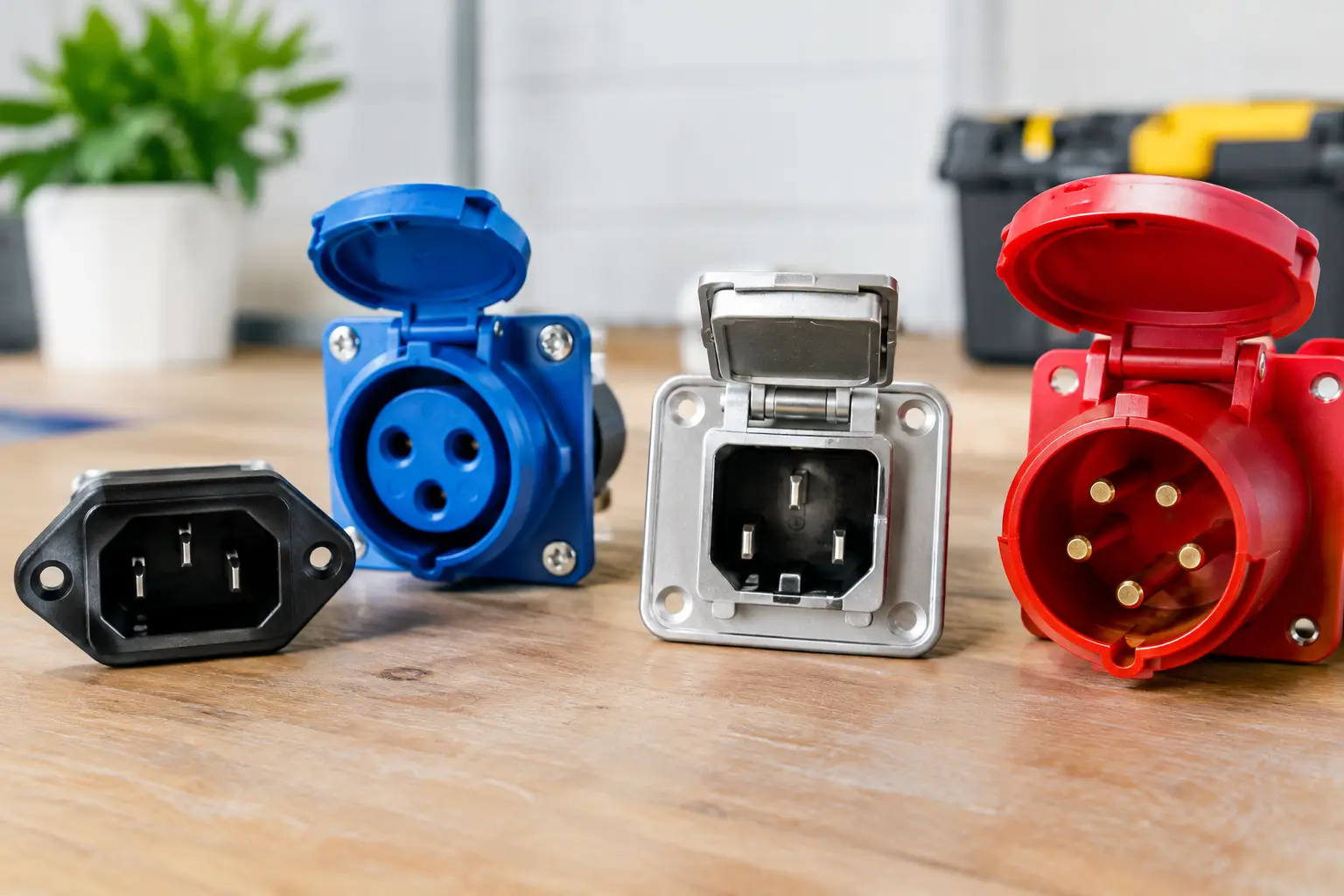
A power inlet is a recessed male electrical connector designed to receive electricity from an external power source. It is commonly mounted inside a weather-resistant enclosure on the outside of a house, RV, trailer, or other equipment.
When used with a portable generator, the connection typically follows this arrangement:
Generator outlet → Generator cord → Power inlet box → Transfer switch or approved interlock → Selected electrical circuits
The generator cord connects the generator’s outlet to the inlet. From there, the electrical wiring carries power to the transfer equipment and the circuits being supplied.
It’s important to understand the difference between a power inlet and a power outlet.
- Power inlet: Receives electricity from an external source.
- Power outlet or receptacle: Supplies electricity to a connected device or cord.
- Power inlet box: Houses and protects the inlet connector, usually outdoors.
- Transfer switch: Selects between utility power and generator power for designated circuits.
- Panel interlock: A listed, panel-compatible mechanical arrangement that prevents the utility main breaker and generator breaker from being on simultaneously.
A power inlet box does not automatically make a home’s electrical system safe for generator operation. The installation must include an appropriate transfer switch or approved interlock to prevent dangerous backfeeding into the utility lines.
Never connect a generator to a household receptacle to energize your home’s wiring. This practice, sometimes called backfeeding, can create a serious electrocution and fire hazard.
Choosing the Right Power Inlet by Amperage and Voltage
The first step is checking your generator’s actual electrical outlets and the equipment you plan to operate.
Don’t choose an inlet based only on the generator’s advertised starting watts or peak wattage. Look at the generator’s running output, available receptacles, voltage, and amperage.
Here is a general comparison of common power inlet ratings:
| Power inlet rating | Voltage | Approximate maximum capacity | Typical application | |—|—|—|—| | 15 amp | 120V | 1,800 watts | Small equipment | | 20 amp | 120V | 2,400 watts | Light-duty power | | 30 amp | 120/240V | 7,200 watts at 240V | Essential home circuits | | 50 amp | 120/240V | 12,000 watts at 240V | Larger backup systems |
These figures are theoretical calculations based on voltage multiplied by amperage. Actual usable power depends on the generator, its output rating, circuit protection, load distribution, and operating conditions.
Some manufacturers advertise 30-amp products as 7,500 watts and 50-amp products as 12,500 watts because they use 250 volts in their calculations. Always check the product’s actual electrical rating.
30-Amp 120/240-Volt Power Inlets
A 30-amp, 120/240-volt power inlet is one of the most common choices for portable generator home backup systems.
At 240 volts, a 30-amp connection provides a theoretical maximum of 7,200 watts:
30 amps × 240 volts = 7,200 watts.
Most residential 30-amp generator connections use the NEMA L14-30 configuration. This is a four-wire connection with:
- Two hot conductors
- One neutral conductor
- One equipment grounding conductor
This arrangement provides two 120-volt legs and supports compatible 120-volt and 240-volt circuits through properly designed transfer equipment.
A 30-amp inlet can be suitable for operating essential household equipment, including:
- Refrigerators and freezers
- Lighting circuits
- Internet equipment
- Gas furnace blowers
- Some well pumps
- Sump pumps
- Small kitchen appliances, when loads are managed carefully
However, a 30-amp inlet does not guarantee that your generator can operate all these appliances simultaneously.
Motors can draw considerably more current during startup than during normal operation. Refrigerators, pumps, and air-conditioning compressors are common examples.
If your generator has an L14-30 outlet, the generator cord and inlet should have the matching L14-30 configuration and appropriate electrical ratings.
For more information about this connection, see my guide to 30-amp, 4-prong generator cords.
50-Amp 120/240-Volt Power Inlets
A 50-amp power inlet is designed for larger portable generators and electrical systems requiring more capacity.
At 240 volts, its theoretical maximum capacity is:
50 amps × 240 volts = 12,000 watts.
A 50-amp, 125/250-volt product may also be advertised as 12,500 watts when calculated at 250 volts.
These connections are commonly found on higher-output portable generators, some RV installations, and larger backup-power systems.
Unlike a 30-amp L14-30 connection, 50-amp generator connections can use different connector configurations. Examples include NEMA SS2-50 and California Standard CS6365/CS6375 configurations.
These designations identify specific connector arrangements. Do not assume that two connectors are interchangeable simply because both are rated for 50 amps.
Check the exact NEMA or manufacturer designation on the generator, cord, and inlet before purchasing.
A 50-amp inlet can make sense when your generator has a matching 50-amp output and your transfer equipment and wiring are designed for that capacity.
It can also be installed as part of a planned upgrade, but a larger inlet does not increase the output of a smaller generator.
For example, connecting a 30-amp generator to a system with a 50-amp inlet does not give you 50 amps of available generator power. The actual output remains limited by the generator and the protective devices in the system.
Another consideration is cost. Fifty-amp generator cords are generally heavier, less flexible, and more expensive than comparable 30-amp cords.
See my guide to 50-amp generator extension cords for more information.
120-Volt Power Inlets: 15 Amp and 20 Amp
Not every generator application requires a 120/240-volt connection.
Smaller 120-volt inlets can be useful for sheds, compact inverter generators, trailers, battery-maintenance equipment, and other limited electrical applications.
Common configurations include:
- 15 amp, 120 volts: Up to 1,800 theoretical watts.
- 20 amp, 120 volts: Up to 2,400 theoretical watts.
- 30 amp, 120 volts: Up to 3,600 theoretical watts.
The NEMA L5-30 is a common locking connector for 30-amp, 120-volt applications. It is different from the L14-30, which provides 120/240-volt service.
This distinction is important when choosing generator cords and inlet boxes.
A 120-volt inlet cannot provide 240-volt power simply because the generator has enough total wattage. The voltage and connector configuration must support the intended application.
Match the Power Inlet Connector to Your Generator
Amperage is only one part of the selection process. Two connectors can have the same amp rating but different pin arrangements, voltage capabilities, and intended uses.
Before buying a power inlet box, check these four specifications:
- Voltage: Determine whether the generator connection is 120 volts or 120/240 volts.
- Amperage: Check whether the outlet is rated for 15, 20, 30, or 50 amps.
- Number of conductors: Confirm whether the connection requires three or four wires, including the grounding conductor.
- NEMA configuration: Look for the exact designation printed near the generator receptacle.
Here are some common configurations:
| Connector | Amperage | Voltage | Typical use | |—|—|—|—| | NEMA L5-30 | 30A | 120V | Generator connections | | NEMA L14-30 | 30A | 120/240V | Home generator backup | | NEMA TT-30 | 30A | 120V | RV shore power | | NEMA SS2-50 | 50A | 120/240V | Generator and marine-style connections | | NEMA 14-50 | 50A | 120/240V | RV and other high-capacity connections |
This table is a reference, not a list of interchangeable plugs and inlets. The connector’s gender, configuration, and application must also match.
For example, an L14-30 generator connection is not the same as an RV TT-30 connection, even though both are described as 30 amp.
Can You Use an Adapter Between Different Generator Connectors?
Adapters can be useful when connecting compatible equipment with different plug configurations.
For example, some RV owners use a properly rated adapter to connect a TT-30 RV cord to a compatible generator receptacle.
However, an adapter does not change the generator’s actual voltage or increase its available amperage.
It also does not automatically make an incompatible connection safe.
Always check the ratings of every component in the connection, including the generator outlet, adapter, cord, and inlet.
Avoid stacking several adapters to solve a connection mismatch. Every additional connection creates another potential point of wear, overheating, or incorrect use.
You can learn more about this subject in my guide to 30-amp 3-prong to 4-prong generator adapters.
How to Choose a Generator Power Inlet Box for Home Backup
If you’re installing a portable generator connection outside your house, the inlet box should be designed for outdoor electrical use.
It needs to protect the connection from weather while providing a suitable enclosure for the electrical components.
Here are some features worth checking before buying.
Weather Resistance and Enclosure Rating
Look for an inlet box with an appropriate outdoor enclosure rating.
NEMA 3R is a common rating for outdoor generator inlet boxes. It is intended to provide protection against rain, sleet, and external ice formation under its specified conditions.
However, a NEMA 3R rating does not mean the enclosure is completely waterproof or suitable for every environment.
If your installation is exposed to coastal salt air, frequent washdown, or other corrosive conditions, ask the manufacturer or electrician whether a more corrosion-resistant enclosure is appropriate.
Also check whether the inlet assembly has a cover that protects the connection when it is not being used.
Construction and Materials
Generator inlet boxes are commonly made from powder-coated steel or durable nonmetallic materials.
Both can be suitable for residential installations when properly rated and installed.
Consider the following:
- Corrosion resistance
- Quality of the enclosure and cover
- Space available for wiring connections
- Mounting options
- Weather protection while the inlet is not in use
- Compatibility with the generator cord
A well-designed enclosure should provide adequate space for the electrical connections without overcrowding the conductors.
UL and ETL Listings
Electrical safety certification is another important consideration.
Look for products that are UL Listed or carry an appropriate ETL certification for their intended use.
Do not assume that a product is certified simply because its packaging describes it as heavy-duty, waterproof, or weather-resistant.
Check the actual product markings and documentation.
Transfer Switch and Panel Interlock Compatibility
A generator inlet box must be connected to an appropriate electrical transfer arrangement when supplying a home’s wiring.
There are two common approaches:
Manual transfer switch: This device allows you to select specific household circuits that receive generator power instead of utility power.
Panel interlock: This is a mechanical device designed for a specific compatible electrical panel. It prevents the main utility breaker and generator breaker from being switched on simultaneously.
Neither arrangement should be selected based on appearance alone.
The transfer equipment must be compatible with the electrical panel, generator output, circuit protection, and neutral configuration.
Brands such as Reliance Controls offer portable-generator transfer equipment and power inlet boxes, but always verify the specific model’s compatibility before buying.
A qualified electrician should determine the appropriate conductor sizes, breaker ratings, grounding arrangement, and installation requirements.
Generator Cords Matter as Much as the Power Inlet
Even a properly rated power inlet can become a weak point if the generator cord is undersized or incompatible.
The cord must match the electrical rating and connector configuration of the system.
For a typical 30-amp L14-30 connection, use a compatible four-conductor generator cord rated for the intended 30-amp, 120/240-volt service.
For a 50-amp connection, use a cord specifically designed for the corresponding 50-amp connector configuration and electrical rating.
Choose the Correct Wire Gauge
Wire gauge affects how much current a cord can carry and how much voltage drop occurs along its length.
A longer cord generally produces more voltage drop than a shorter cord of the same wire gauge and carrying the same load.
When comparing generator cords, check:
- Rated amperage
- Conductor gauge
- Number of conductors
- Cord length
- Insulation and outdoor-use rating
- Connector quality
Do not select a cord based only on its physical thickness or the wattage printed in a product advertisement.
The appropriate conductor size depends on the actual electrical load, cord length, insulation type, temperature conditions, and applicable requirements.
For permanent wiring, conductor sizing must also account for the installation method and applicable electrical code.
How Long Should a Generator Cord Be?
The best cord length is the shortest one that allows you to place your generator in a safe location while reaching the inlet.
However, do not sacrifice generator safety just to reduce voltage drop.
Portable generators must operate outdoors, away from doors, windows, and ventilation openings, because carbon monoxide can enter a building and cause fatal poisoning.
Use a properly rated cord long enough to maintain that separation.
Inspect the cord before use. Replace it if you find damaged insulation, cracked connectors, exposed conductors, or signs of overheating.
Never run a generator cord through a closed window or door where it can be pinched or damaged.
Power Inlets for RVs
RV power inlets have different requirements from residential generator inlet boxes.
The correct connection depends on the electrical service installed in the recreational vehicle.
30-Amp RV Inlets
Many travel trailers use a NEMA TT-30, 30-amp, 120-volt connection.
Its theoretical maximum capacity is:
30 amps × 120 volts = 3,600 watts.
This is a single-voltage system, not a 120/240-volt connection.
That difference is particularly important when purchasing generator adapters and cords.
A TT-30 connection should not be confused with a 30-amp L14-30 generator connection.
50-Amp RV Inlets
Larger motorhomes and fifth wheels commonly use 50-amp, four-wire, 120/240-volt service.
This configuration provides two 120-volt legs, a neutral, and a grounding conductor.
Its theoretical maximum capacity at 240 volts is 12,000 watts.
When choosing a generator for a 50-amp RV, check whether the generator can actually supply the required electrical service. A generator with a 50-amp-rated receptacle is not necessarily capable of delivering the full theoretical capacity under all operating conditions.
Also consider the RV’s air conditioner, refrigerator, microwave, water heater, and other electrical loads.
A surge protector or electrical management system can provide additional protection and monitoring, depending on its features and compatibility.
Power Inlets for Well Pumps and Other Equipment
Some generator installations are designed around specific equipment rather than an entire house.
Well pumps are a good example.
A pump may have relatively modest running-watt requirements but demand substantially more power when its motor starts.
Before choosing a power inlet for a well pump, check:
- Motor voltage
- Full-load current
- Starting or locked-rotor current
- Motor horsepower
- Generator starting capacity
- Transfer equipment rating
A 240-volt well pump requires a compatible 240-volt supply and properly designed electrical connection.
A 120-volt generator inlet cannot operate a 240-volt pump simply by using an adapter.
The same planning applies to sump pumps, air compressors, and other motor-driven equipment.
Check the equipment manufacturer’s specifications rather than estimating the required generator capacity from running watts alone.
Power Inlets for Jobsites and Temporary Power
Construction sites and workshops may need a different type of power connection from a permanent residential installation.
In these environments, equipment can be moved frequently, cords may be exposed to rough handling, and electrical connections may encounter moisture, dust, or dirt.
A permanent power inlet box may be appropriate for a fixed installation, while a portable power distribution box may be more practical when workers need to move power between different areas.
When selecting equipment for these applications, consider:
- Connector locking capability
- Electrical rating
- Outdoor suitability
- GFCI protection where required
- Mechanical protection
- Cable routing
- Compatibility with portable distribution equipment
Keep electrical connectors away from standing water, mud, and vehicle traffic.
Follow applicable jobsite electrical safety requirements, including OSHA rules and the electrical code adopted for the installation.
Power Inlet Installation and Maintenance
Installing a power inlet box connected to a home’s electrical panel involves more than mounting an enclosure on an exterior wall.
The installation may require electrical panel work, conduit, correctly sized conductors, overcurrent protection, and compatible transfer equipment.
For residential generator connections, have a qualified electrician evaluate the installation and verify that it meets the locally adopted electrical code and permitting requirements.
The exact requirements can vary by jurisdiction.
What to Check Before Buying a Power Inlet
Before purchasing, use this checklist:
- Confirm the generator’s running watts and available outlet ratings.
- Check whether the connection is 120 volts or 120/240 volts.
- Verify the inlet’s amperage.
- Match the exact NEMA connector configuration.
- Confirm the generator cord has compatible connectors.
- Check the inlet box’s outdoor enclosure rating.
- Look for the appropriate UL or ETL certification.
- Verify compatibility with the transfer switch or panel interlock.
- Confirm that the electrical panel and protective devices support the planned installation.
- Consider future generator upgrades without assuming that a larger inlet increases present generator capacity.
Seasonal Inspection
Once installed, inspect the inlet and generator cord periodically, particularly before storm season or the time of year when power outages are more likely.
Look for:
- Cracked or damaged covers
- Corrosion around electrical connections
- Loose mounting hardware
- Discolored connectors
- Signs of overheating
- Damaged cord insulation
- Moisture or debris inside the enclosure
If you notice damaged components, have them evaluated and repaired before using the system.
It is also a good idea to test the complete backup-power arrangement before an emergency.
Follow the generator and transfer equipment manufacturers’ operating instructions. Start with the planned essential circuits, add loads gradually, and monitor the generator for overload warnings or abnormal operation.
Never operate a portable generator indoors, in a garage, or in another enclosed or partially enclosed space.
Final Thoughts: Which Power Inlet Should You Choose?
The right power inlet depends on your generator, electrical system, and intended application.
For many residential portable-generator installations, a 30-amp L14-30 inlet is a practical choice when the generator and transfer equipment are designed for 120/240-volt, 30-amp service.
If you have a larger generator with a compatible 50-amp output and need additional capacity, a 50-amp inlet may be more appropriate.
For smaller 120-volt applications, a 15-amp, 20-amp, or 30-amp inlet may be sufficient, depending on the equipment and connector configuration.
RV owners should pay particular attention to the difference between TT-30 and 50-amp RV service, while homeowners should prioritize transfer equipment compatibility and safe installation.
The most important rule is simple: match the inlet, generator outlet, cord, and electrical system by their actual voltage, amperage, and connector specifications.
A correctly selected power inlet makes generator connections more convenient, but the entire electrical system must be properly designed and installed for safe backup power.