As an Amazon Associate I earn from qualifying purchases.
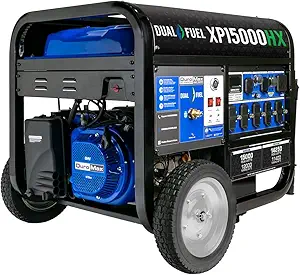
When a power outage lasts for hours or turns into a multi-day emergency, a high-output portable generator can keep essential parts of your home running without relying entirely on the utility grid.
The 15,000-watt generator class is especially useful for larger homes, workshops, RVs, jobsites, and households with demanding electrical loads. However, there is an important detail to understand before buying: a generator advertised as “15,000 watts” does not necessarily produce 15,000 watts continuously.
For example, the DuroMax XP15000HX produces 15,000 peak watts and 12,000 running watts, while the Westinghouse WGen14500TFc produces 18,000 peak watts and 14,500 running watts on gasoline.
That difference matters when you’re trying to run a central air conditioner, refrigerator, sump pump, well pump, electric water heater, or other high-demand equipment.
Below, you’ll find five high-output generators from the original list, followed by the specifications and buying considerations that matter most in 2026.
Quick Comparison: 15,000-Watt-Class Generators for 2026
| Generator | Fuel | Peak Watts | Running Watts | Best For |
|---|---|---|---|---|
| DuroMax XP15000HX | Gasoline / Propane | 15,000 | 12,000 | Large-home backup |
| Champion 15,000W Tri-Fuel | Gasoline / Propane / Natural Gas | Up to 15,000 | Up to 12,000 | Fuel flexibility |
| Westinghouse WGen14500TFc | Gasoline / Propane / Natural Gas | Up to 18,000 | Up to 14,500 | High-output home backup |
| DuroMax XP15000EH | Gasoline / Propane | 15,000 class | — | RVs, jobsites and backup |
| GENMAX GM15000ET | Gasoline / Propane / Natural Gas | 15,000 | 11,000 | Tri-fuel versatility |
Important: Always check the exact specification for the fuel you intend to use. Maximum and rated output can change when switching from gasoline to propane or natural gas.
What Can a 15,000-Watt Generator Run?
A generator in this class can provide substantial backup power, but the answer depends on the running wattage of the generator and the electrical loads in your home.
A typical high-output unit may be able to handle combinations of:
- Refrigerator and freezer
- Lighting
- TVs and internet equipment
- Sump pump
- Well pump
- Furnace blower
- Microwave
- Washing machine
- Garage-door opener
- Central air conditioning, depending on startup requirements
- Selected kitchen appliances
- Power tools
- RV air conditioning and other RV loads
A 15,000-watt-class generator does not automatically mean you can operate every electrical appliance in the house at the same time.
An all-electric home can consume a surprising amount of power when the electric range, dryer, water heater, heat pump, and air conditioning are running together. A gas-equipped home generally has more flexibility because heating, cooking, and water heating may not depend entirely on electricity.
The safest approach is to calculate your actual loads before choosing the generator.
Best 15,000-Watt-Class Generators for Home Backup in 2026
1. DuroMax XP15000HX Dual-Fuel Portable Generator
Check Amazon Price: Click Here
Key Specifications
- Fuel: Gasoline and propane
- Gasoline peak output: 15,000 watts
- Gasoline running output: 12,000 watts
- Engine: 713cc V-Twin OHV
- Start: Electric, recoil and remote start
- 120/240V: Yes
- 50A outlet: Yes
- Transfer-switch ready: Yes
- CO safety system: CO Alert
- Gasoline runtime: Up to 17.9 hours at 25% load
The DuroMax XP15000HX remains one of the most recognizable options in this power class. According to DuroMax, it produces 15,000 peak watts and 12,000 running watts on gasoline and can operate on either gasoline or propane. The manufacturer also lists remote start and a transfer-switch-ready 50A outlet.
Its dual-fuel design is useful during extended outages because homeowners are not limited to gasoline. Propane can also be stored for long periods when properly handled, which can make it a practical backup fuel.
The generator is particularly well suited to larger homes where the goal is to keep several major loads operating without moving up to a stationary standby generator.
Best For
Large homes that need substantial portable backup power with gasoline and propane flexibility.
2. Champion 15,000W Tri-Fuel Portable Generator
Check Amazon Price: Click Here
Key Specifications
- Fuel: Gasoline, propane and natural gas
- Power class: 15,000 watts
- Running output: Depends on fuel and exact model
- Voltage: 120/240V
- Start: Electric start
- CO protection: CO safety system
- Transfer connection: Designed for high-load applications
The major attraction of a Champion tri-fuel generator is fuel flexibility.
Instead of depending exclusively on gasoline, a tri-fuel generator can use gasoline, propane or natural gas, depending on the model and installation. That can be particularly useful during a long outage when gasoline availability becomes an issue.
Natural gas can be convenient for a home that already has an appropriate gas supply, while propane provides another option for households that maintain stored fuel.
Before purchasing, verify the exact Champion model number associated with the listing because Champion sells several generators with similar wattage descriptions. Rated output, outlets, runtime and included accessories can vary between models.
Best For
Homeowners who want multiple fuel options for extended emergency backup.
3. Westinghouse WGen14500TFc Tri-Fuel Generator
Check Amazon Price: Click Here
Key Specifications
- Fuel: Gasoline, propane and natural gas
- Gasoline peak: 18,000 watts
- Gasoline running: 14,500 watts
- Propane peak: 16,000 watts
- Propane running: 13,000 watts
- Natural gas peak: 14,400 watts
- Natural gas running: 11,600 watts
- Engine: 713cc V-Twin OHV
- Fuel tank: 10.5 gallons
- Gasoline runtime: Up to 16 hours at 25% load
- Start: Electric and remote
- CO sensor: Yes
- 50A outlet: Yes
- Transfer-switch/interlock ready: Yes
- THD: Less than 5%
The Westinghouse WGen14500TFc is worth highlighting because its name can be misleading if you only look at the “14,500” figure. The 14,500 watts are its rated running output on gasoline, while peak output reaches 18,000 watts. Propane and natural gas produce different output levels.
It also offers several features that are useful for home backup, including remote and electric start, a CO shutdown system, 50A and 30A connections, GFCI outlets and transfer-switch/interlock readiness. Westinghouse lists less than 5% THD and up to 16 hours of gasoline runtime at 25% load.
The combination of high running wattage and tri-fuel capability makes this model particularly interesting for larger homes with substantial electrical demand.
Best For
Homeowners who want very high continuous output and gasoline, propane and natural gas flexibility.
4. DuroMax XP15000EH Dual-Fuel Generator
Check Amazon Price: Click Here
The DuroMax XP15000EH is another high-output dual-fuel option from DuroMax.
Key Features
- Fuel: Gasoline and propane
- Power: 15,000-watt class
- Engine: Large-displacement V-Twin OHV
- Voltage: 120/240V
- 50A connection: Yes
- 30A connection: Yes
- Electric start: Yes
- Portable design: Yes
The XP15000EH is aimed at users who need a substantial amount of portable electricity rather than a small emergency generator.
Its 120/240V capability and high-amperage connections make it suitable for larger electrical loads, while the dual-fuel design gives users another option when gasoline is not the preferred fuel.
As with any generator in this category, the actual load should be calculated before connecting large appliances. A high peak-watt number does not mean every major appliance can run simultaneously.
Best For
Large homes, RVs, workshops and jobsites requiring high-output dual-fuel power.
5. GENMAX GM15000ET Tri-Fuel Portable Generator
Check Amazon Price: Click Here
Key Specifications
- Fuel: Gasoline, propane and natural gas
- Gasoline maximum: 15,000 watts
- Gasoline rated: 11,000 watts
- Propane maximum: 13,000 watts
- Propane rated: 10,000 watts
- Natural gas maximum: 12,000 watts
- Natural gas rated: 8,800 watts
- Engine: 520cc 4-stroke OHV
- Tank: Approximately 10.5 gallons
- Start: Electric, recoil and remote
- Voltage: 120/240V
- CO sensor: Yes
- Tri-fuel: Yes
The GENMAX GM15000ET is different from some of the other generators in this comparison because its 11,000 gasoline running watts are considerably lower than its 15,000-watt peak figure.
Its major advantage is flexibility. The GM15000ET can operate on gasoline, propane or natural gas, and its documentation lists different maximum and rated outputs for each fuel.
One specification deserves particular attention before using this generator with sensitive electronics: the available technical documentation lists 23% THD. That is substantially different from generators marketed specifically for low-THD output, so users should not assume that every high-wattage generator produces inverter-like power.
Best For
Users who prioritize tri-fuel capability and high peak output over low-THD electrical output.
15,000-Watt Generator Buying Guide for 2026
Choosing a generator based only on the number printed in the product title is a mistake. Here are the specifications that deserve the most attention.
1. Check Running Watts, Not Just Starting Watts
The most important number for continuous loads is running watts, sometimes called rated watts.
Starting or surge watts are temporary additional capacity used when equipment such as motors and compressors start.
For example, the DuroMax XP15000HX is rated at 15,000 peak watts but 12,000 running watts.
If your home requires 10,000 watts continuously, a generator advertised as “15,000 watts” with only 8,000 running watts would not be an appropriate match even though its marketing number sounds large.
2. Calculate Starting Wattage for Large Motors
Air conditioners, refrigerators, well pumps, sump pumps and other motor-driven equipment can require additional power during startup.
This is especially important if you want to run central AC during a blackout.
A generator may have enough continuous capacity but still struggle when several motors start at nearly the same time.
A load calculation should therefore consider:
Running watts + starting/surge requirements + other simultaneous loads
If you’re unsure about the startup requirements of a major appliance, check its nameplate or manufacturer’s specifications rather than guessing.
3. Gasoline, Propane or Natural Gas?
Gasoline
Gasoline is widely available and generally provides strong output, but it requires appropriate storage and regular fuel management.
Propane
Propane has a long storage life when properly stored and gives dual-fuel generators another option during an emergency.
Natural Gas
Natural gas can be convenient for a property that already has an appropriate gas connection. It can also reduce dependence on stored gasoline or propane during a prolonged outage.
However, natural gas output can be lower than gasoline output on the same generator. The Westinghouse WGen14500TFc is a good example: its gasoline rating is 14,500 running watts, compared with 13,000 on propane and 11,600 on natural gas.
4. Look for 120/240V Output
If you’re buying a large generator for home backup, 120/240V capability is an important specification.
Many major residential loads use 240V, including certain central air-conditioning systems, well pumps and other large equipment.
A generator with a 50A 120/240V connection can also make a professionally installed home connection more practical.
5. Transfer Switch vs. Interlock
A generator should never be connected to a home’s electrical panel by simply plugging it into an ordinary household outlet.
A properly installed transfer switch or approved interlock system is designed to prevent dangerous backfeeding into the utility system.
The Westinghouse WGen14500TFc, for example, is listed as transfer-switch and interlock-kit ready.
The exact connection method depends on the generator, electrical panel, local requirements and applicable electrical codes.
For permanent home connections, use a qualified electrician.
6. CO Detection Is Important, But It Does Not Make Indoor Operation Safe
Modern portable generators increasingly include carbon monoxide monitoring and automatic shutdown systems.
These features can provide an additional layer of protection, but they do not make a portable generator safe to operate indoors.
Never operate a gasoline, propane or natural-gas portable generator inside:
- A house
- Garage
- Basement
- Crawl space
- Enclosed porch
- Shed
- Other enclosed or partially enclosed structure
Carbon monoxide is odorless and potentially fatal.
Always follow the generator manufacturer’s placement and clearance requirements and local safety guidance.
7. Check THD if You Need to Power Sensitive Electronics
Total harmonic distortion, or THD, describes the quality of the generator’s electrical output.
Some generators in this class specify relatively low THD, while others may have considerably higher distortion.
For example, Westinghouse lists less than 5% THD for the WGen14500TFc.
By contrast, the available technical documentation for the GENMAX GM15000ET lists 23% THD.
If you plan to power computers, networking equipment, medical electronics or other sensitive devices, check the manufacturer’s electrical-output specifications rather than assuming that all portable generators produce the same quality of power.
8. Runtime Depends on Load
Manufacturers usually publish runtime at a specific percentage of load, often 25% or 50%.
That number should not be interpreted as the generator’s runtime under full household demand.
For example, DuroMax lists up to 17.9 hours at 25% load for the gasoline XP15000HX.
Westinghouse lists up to 16 hours at 25% load for the WGen14500TFc.
The more power you draw, the faster fuel consumption generally increases.
What Can a 15,000-Watt Generator Run During a Blackout?
The exact combination depends on the individual appliances, but a properly sized generator in this class can potentially support a substantial collection of household loads.
For example, a homeowner may prioritize:
- Refrigerator
- Freezer
- Wi-Fi router and modem
- Lighting
- Television
- Sump pump
- Well pump
- Furnace blower
- Microwave
- Washing machine
- Garage door opener
- Selected kitchen appliances
- Central air conditioning
The key is load management.
You may not want to operate a large electric dryer, electric water heater, electric range, central AC and several other high-demand appliances simultaneously.
This is why the generator’s running wattage and the home’s actual electrical load are more important than the product title.
Are 15,000-Watt Generators Good for Whole-House Backup?
They can be, but “whole-house backup” needs some qualification.
A 15,000-watt-class portable generator can provide substantial backup power to a large home, but whether it can support the entire house depends on:
- The home’s electrical demand
- Whether heating is electric or gas
- Whether the water heater is electric or gas
- The size and startup demand of the AC system
- Electric cooking equipment
- Electric dryer usage
- Well or sump pump requirements
- The generator’s running wattage
- The generator’s surge capacity
- How the generator is connected to the home’s electrical system
A smaller number of high-priority circuits may be a better strategy than attempting to operate every appliance at once.
Portable 15,000-Watt Generator vs. Standby Generator
A high-output portable generator and a permanently installed standby generator are not the same thing.
Portable Generator
Advantages:
- Lower initial equipment cost in many cases
- Can be moved
- Some models support multiple fuels
- Can be used away from home
- High power output is available without installing a permanent generator enclosure
Disadvantages:
- Requires manual setup
- Must be positioned outdoors during operation
- Requires fuel management
- May require manual connection
- Large models can be heavy
Standby Generator
Advantages:
- Permanently installed
- Designed for automatic backup operation
- Can work with an automatic transfer switch
- Convenient for frequent outages
Disadvantages:
- Higher installation cost
- Permanent installation
- Requires professional installation and maintenance
- Less portable
For occasional outages, a high-output portable generator can be a practical solution. For frequent outages where automatic operation is the priority, a permanently installed standby system may be more appropriate.
Best Uses for a 15,000-Watt Generator
These generators aren’t limited to residential emergencies.
Home Emergency Backup
Large portable generators can provide substantial backup capacity during hurricanes, winter storms, grid failures and other prolonged outages.
Construction Sites
The high output makes this class useful for simultaneously operating multiple tools and equipment.
RVs and Camping
Large RVs can benefit from 120/240V generators when they have substantial electrical demands, although the generator’s size and weight should be considered carefully.
Workshops
A high-output generator can provide power for tools and equipment when utility power isn’t available.
Remote Properties
Tri-fuel models can be especially useful for locations where fuel availability varies.
15,000-Watt Generator Safety Checklist
Before operating any large portable generator, make sure you:
- Operate it outdoors and away from doors, windows and vents.
- Never operate it inside a home or garage.
- Install and use CO detection according to the manufacturer’s instructions.
- Keep the generator dry and protected from direct exposure to rain as specified by the manufacturer.
- Never refuel a hot generator.
- Turn the generator off and allow it to cool before refueling.
- Use properly rated extension cords and connections.
- Never backfeed a home’s electrical system.
- Use a properly installed transfer switch or approved interlock when connecting to a panel.
- Follow the owner’s manual.
- Perform routine oil and air-filter maintenance.
- Store fuel according to applicable local requirements.
Safety features such as CO sensors are valuable, but they should be treated as an additional safeguard rather than permission to ignore safe operating procedures.
Final Thoughts: Choosing a 15,000-Watt Generator in 2026
The best 15,000-watt-class generator for your home depends on more than the largest number on the product box.
Start with your actual electrical requirements. Determine which appliances need to run continuously, identify the equipment with high starting loads, and decide whether gasoline, propane or natural gas makes the most sense for your situation.
The DuroMax XP15000HX offers 15,000 peak and 12,000 running watts with dual-fuel capability and a transfer-switch-ready 50A connection.
The Westinghouse WGen14500TFc stands out on paper for its 14,500 gasoline running watts, tri-fuel capability, remote start, CO shutdown and low-THD output.
The GENMAX GM15000ET provides tri-fuel flexibility, but its 11,000 gasoline running watts and documented THD specification make it important to evaluate based on your actual application rather than its 15,000-watt peak figure.
The most important lesson is simple: shop by running watts, fuel availability, electrical connections, startup capacity and safety features—not just by the advertised peak wattage.
For a large home facing extended outages, taking the time to calculate your actual electrical load before buying can prevent an expensive generator from being undersized for the equipment you need to keep running.