As an Amazon Associate I earn from qualifying purchases.
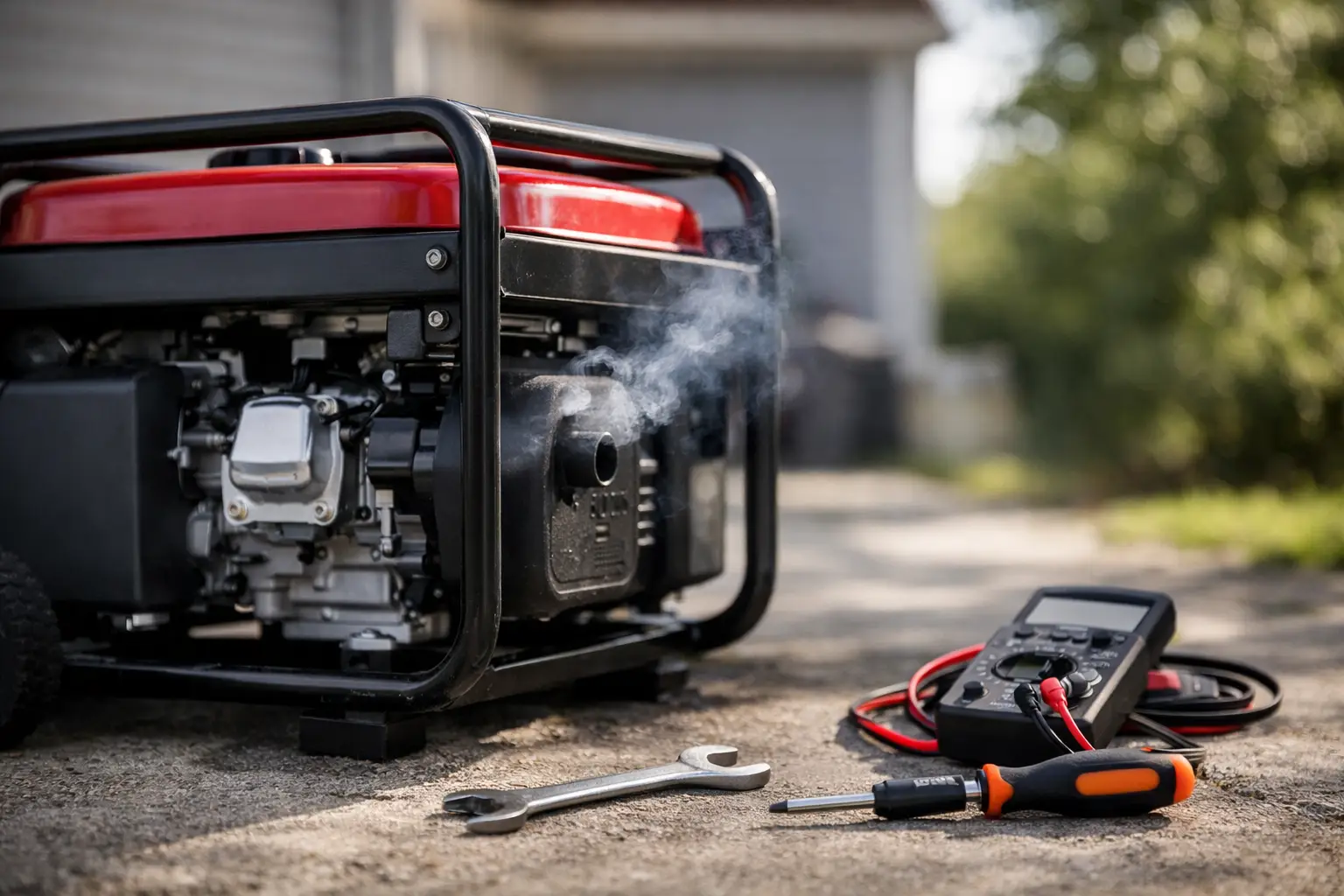
If your generator starts but keeps stalling, the problem is usually related to fuel delivery, airflow, ignition, low-oil protection, overheating, or an electrical load that exceeds the generator’s available power. The fastest way to find the cause is to pay attention to when the engine dies: does it stall with nothing connected, after several minutes of running, or immediately after you plug in an appliance?
The best fix is not to replace parts at random. Start by noticing exactly when the engine dies. A generator that stalls with nothing plugged in points to a different problem than one that bogs down the instant a well pump or circular saw starts.
Quick Diagnosis: When Does Your Generator Stall?
What happens Most likely causes Starts and dies within seconds Choke, carburetor, stale fuel, low oil Runs for 10–20 minutes, then stops Fuel-cap vent, fuel restriction, overheating Runs normally with no load but stalls when an appliance starts Overload, high starting watts, voltage drop Runs rough before shutting down Dirty carburetor, restricted air filter, spark plug Shuts down when hot and restarts after cooling Overheating or ignition-related issue Shuts down with a low-oil warning Low oil level, uneven surface, sensor or wiring issue
First, Find Out Why the Generator Is Stalling
A generator that stalls immediately after starting often has a choke, carburetor, fuel-flow, or low-oil issue. If it runs normally for several minutes before quitting, look more closely at fuel-tank venting, overheating, or a restriction that worsens as the engine runs.
The timing of the shutdown is one of the most useful clues. If the engine dies almost immediately, start with fuel, choke, oil level, and ignition. If it runs for several minutes before stopping, investigate fuel-tank venting, fuel restrictions, and overheating. If it only stalls when you connect an appliance, focus on starting watts, total load, and extension-cord voltage drop.
A unit that stalls only after connecting appliances is usually overloaded or dealing with a high-starting-watt motor. This distinction matters because adding fuel treatment will not solve an overload, and buying a larger generator will not correct contaminated gasoline.
Before troubleshooting, move the generator outdoors to a dry, open area well away from doors, windows, and vents. Never run a portable generator in a garage, shed, basement, RV compartment, or other enclosed or partially enclosed space because carbon monoxide can build up rapidly. Shut the engine off, allow hot components to cool, and disconnect appliance cords before inspecting the unit. Follow the safety instructions in your owner’s manual before servicing any component.
Why a Generator Keeps Stalling With No Load
Old fuel or a dirty carburetor
Old or contaminated gasoline is one of the first things worth checking when a portable generator starts but will not stay running. Fuel can degrade surprisingly quickly, especially ethanol-blended gasoline stored through a season. As it ages, it can leave varnish in the carburetor’s tiny jets. The engine may start on choke but stall when the choke is opened because the carburetor cannot deliver enough fuel for normal operation.
Drain stale fuel from the tank and carburetor bowl according to the owner’s manual. Refill with fresh fuel of the recommended type. If the generator has a fuel shutoff valve, close it before storage and run the engine until the carburetor is empty. A quality fuel stabilizer helps for stored fuel, but it cannot reliably restore fuel that has already gone bad.
Fuel stabilizer is primarily a preventive measure. It does not turn badly degraded gasoline back into fresh fuel, and it will not remove varnish that has already restricted a carburetor jet.
A carburetor cleaning may be necessary if fresh fuel does not help. On many portable inverter generators and open-frame models, cleaning the main jet and bowl is a manageable maintenance task for a confident DIY owner. If you are not comfortable removing fuel-system parts, a small-engine service shop can prevent a minor issue from becoming a damaged gasket or stripped screw.
Fuel cap vent or fuel-line restriction
The fuel tank must admit air as fuel leaves it. If the cap vent is blocked, a vacuum forms in the tank and gradually stops fuel flow. A useful clue is a generator that runs for 10 to 20 minutes, then stalls, but restarts after sitting for a while.
This is a classic pattern behind a generator that runs for a few minutes and then dies. The longer the engine runs, the more noticeable a restricted fuel supply can become.
With the engine cool and off, inspect the cap vent if your model has one. Check the fuel line for cracks, kinks, loose clamps, or a clogged inline filter. Do not test for a tank vacuum by opening the cap beside a hot or running engine.
Choke left on or an air-filter problem
The choke enriches the fuel mixture for cold starts. Once the engine has warmed for a short time, it normally needs to move to the run position. Leaving it partially or fully closed can make the engine run rough, smoke, foul the spark plug, and stall.
If your generator starts on choke but dies as soon as you move the choke to RUN, suspect a fuel-delivery problem before assuming the ignition system has failed. A restricted carburetor jet is a common possibility because the engine needs a proper fuel-air mixture once the choke is opened.
Airflow matters just as much. A foam or paper air filter packed with dust, grass, or oil restricts air and makes the engine run too rich. Inspect it regularly, especially after dry camping, storm cleanup, or jobsite use. Replace a damaged paper filter rather than trying to wash it.
Low-oil shutdown and incorrect oil level
Most modern portable generators have a low-oil sensor that shuts the engine down to prevent internal damage. On some generators, a low-oil protection system can shut the engine down if the oil level is too low or if the unit is not positioned as specified by the manufacturer. Oil that is overfilled can also cause running problems.
Place the generator on level ground, wait a few minutes after shutdown, and check the oil exactly as the manual instructs. Some dipsticks are checked without threading them in, while others are not. Use the recommended oil viscosity for expected temperatures. If the oil level is correct but the low-oil light stays on or the engine repeatedly dies, the sensor or wiring may need professional diagnosis.
Spark plug, ignition, or overheating issues
A worn, carbon-fouled, or incorrectly gapped spark plug can fire well enough to start the engine but misfire once it warms up. Inspect the plug for heavy deposits, cracked porcelain, or a wet fuel smell. Replace it with the specified plug type if it is questionable.
Overheating can also trigger a shutdown on some inverter generators. Clear debris from cooling vents and confirm the unit has the required clearance around it. Avoid placing it in tall grass, against a wall, or under a cover that traps heat. A purpose-built generator tent may provide rain protection, but only if it is designed to maintain safe ventilation and exhaust clearance.
If the generator consistently shuts off after it reaches operating temperature and then starts again after cooling down, do not keep restarting it repeatedly. Check the cooling system, ventilation, oil level, and maintenance requirements in the owner’s manual. Persistent hot-start or shutdown problems may require ignition or engine diagnosis.
Why Does My Generator Stall When I Plug Something In?
If the generator sounds healthy until you connect equipment, treat the issue as a power-demand problem first. Turn off the generator, unplug everything, restart it with no load, and add appliances one at a time.
The key is starting watts, not only running watts. Refrigerators, window air conditioners, pressure washers, air compressors, and well pumps draw a brief but substantial surge as their motors start. A 1/2-horsepower well pump, for example, can require substantially more power during startup than it uses once it is running. The actual requirement depends on the pump and motor design, so check the manufacturer’s specifications whenever possible. A generator sized only for the pump’s running watts can bog down, trip its breaker, or stall.
Running watts are the power an appliance normally consumes after it is operating. Starting watts are the temporary surge required by equipment with motors or compressors when they start. That initial surge can be several times higher than the appliance’s normal running demand, depending on the equipment.
Check the generator’s rated running watts and surge watts against the actual appliance requirements. Also consider what is already running. A [4,500-watt generator may be sufficient for a refrigerator, lights, and a few outlets, yet still struggle if a sump pump starts while a microwave or portable heater is operating.
Inverter generators with an economy mode can sometimes hesitate under a sudden heavy motor load. Try starting the motor-driven appliance with economy mode off. This is not a cure for an undersized generator, but it can improve response when the generator otherwise has enough surge capacity.
Do not overlook cords and adapters. An undersized, damaged, or excessively long extension cord can create voltage drop and heat. Use a heavy-duty outdoor-rated cord with the correct wire gauge for the load and distance. For a home backup setup, the inlet box,
generator cord, and transfer equipment must match the generator outlet and be installed for the intended amperage. A loose 30-amp connection, a worn plug, or an improvised adapter can create heat and unreliable operation.
Never use a household extension cord that is not rated for the generator’s output and intended outdoor use. If a cord, plug, inlet, or adapter becomes unusually hot, stop using it and investigate the connection before continuing.
A Safe Troubleshooting Order
Generator Starts Then Dies: What to Check First
If your generator starts but dies within a few seconds, check these items in order:
Oil level: Confirm the generator is on level ground and the oil level matches the owner’s manual. Choke position: Use the choke only for starting a cold engine, then gradually move it to RUN as specified by the manufacturer. Fuel quality: If the gasoline has been sitting for a long period, drain and replace it according to the manufacturer’s instructions. Fuel flow: Check the fuel valve, fuel line, filter, and tank vent for restrictions. Air filter: Inspect for excessive dirt, oil contamination, or damage. Spark plug: Check the plug condition and gap against the manufacturer’s specification. Overheating: If the generator runs normally when cold but shuts down after warming up, inspect cooling airflow and ventilation. Electrical load: If it only dies when equipment is connected, calculate the total running and starting wattage before replacing engine components.
Work through these checks before ordering parts or assuming the generator has failed:
Step 1 — Remove the load
Step 2 — Check oil
Step 3 — Check fuel
Step 4 — Check choke and air filter
Step 5 — Inspect spark plug
Step 6 — Check cooling
Step 7 — Add appliances one at a time
If the engine stalls with no load after these checks, carburetor service, ignition testing, valve adjustment, or low-oil sensor diagnosis may be next. Those repairs are often worthwhile on a quality generator that has otherwise been maintained well. On an older low-cost unit with repeated fuel-system failures, compare the repair estimate against replacement – especially if your current power needs have grown.
FAQ
Why does my generator start and then die?
A generator that starts but quickly dies often has a fuel-delivery problem, a clogged carburetor, stale gasoline, a restricted fuel filter, or a blocked fuel cap vent. It can also happen when the choke is left in the wrong position or the engine is not receiving enough fuel. If it starts normally but dies after a few seconds, check the fuel system first.
Why does my generator keep stalling under load?
If your generator stalls when you connect appliances, it may be overloaded or struggling to produce enough power. Check the generator’s running and starting wattage and compare them with the total demand of the connected devices. A dirty air filter, weak spark plug, fuel restriction, or carburetor problem can also cause stalling under load.
Why does my generator run for a few minutes and then stop?
When a generator runs for several minutes and then shuts off, common causes include a blocked fuel cap vent, restricted fuel flow, overheating, low engine oil, or a dirty carburetor. A clogged vent can create a vacuum inside the fuel tank and gradually stop fuel from reaching the engine. If it restarts after sitting for a while, fuel or overheating problems are worth checking first.
Why does my generator die when I turn off the choke?
If the engine dies as soon as you move the choke to the OFF position, it usually means the engine is not getting enough fuel or is receiving too much air. A partially clogged carburetor or restricted fuel passage is a common cause. The choke temporarily enriches the fuel mixture, allowing the engine to keep running despite an underlying fuel-delivery problem.
Can bad gas cause a generator to stall?
Yes. Old, contaminated, or water-contaminated gasoline can cause a generator to start, run poorly, or stall unexpectedly. Gasoline that has been sitting for a long time can also leave deposits in the carburetor and restrict fuel passages. If the generator has been stored for months, draining the old fuel and using fresh gasoline may solve the problem.
Can an overloaded generator shut off?
Yes. Connecting appliances that require more power than the generator can safely provide may trip the overload protection or cause the engine to stall. Large appliances such as air conditioners, refrigerators, pumps, and power tools can have high starting-wattage requirements. Disconnect some loads and restart the generator, then reconnect appliances gradually while staying within its rated capacity.
Why does my generator shut off when it gets hot?
A generator that stops after becoming hot may be experiencing overheating, low oil, poor ventilation, or excessive engine load. Some generators have automatic protection systems that shut the engine down when operating conditions become unsafe. Make sure the generator is outdoors in a well-ventilated area, the cooling openings are clear, and the oil level is correct before running it again.
| Symptom | Start here | | —————————- | ——————————- | | Starts and immediately dies | Choke, fuel, oil | | Starts only with choke | Carburetor/fuel delivery | | Runs 10–20 minutes then dies | Tank vent/fuel restriction/heat | | Dies when AC starts | Starting watts/load | | Dies when hot | Cooling/ignition | | Dies with low-oil light | Oil level/sensor | | Runs rough before stopping | Fuel/air/spark |
When a Generator Needs Professional Service
Stop troubleshooting and seek professional service if you find damaged wiring, burned electrical connections, fuel leaks, repeated low-oil shutdowns despite a correct oil level, persistent overheating, or an engine that continues to stall after basic fuel and airflow checks.
Do not bypass a low-oil sensor, thermal protection device, circuit breaker, or other safety system simply to keep the generator running. Those systems are designed to protect the engine, generator, or operator from potentially serious problems.
Prevent the Next Stall Before an Outage
Generators are most dependable when they are exercised before an emergency. Run the unit monthly or on the schedule in its manual, connect a modest load, and confirm that it transitions off choke and carries power normally. This also gives you a chance to inspect the generator cord, inlet box cover, RV adapter, and any critical equipment such as a sump or well pump.
For homeowners, the right generator size and connection method are part of reliability. For RV owners and campers, clean fuel, correct adapters, and realistic
air-conditioner starting requirements matter just as much. A generator that runs perfectly on a bare outlet may still be the wrong match for the equipment it is expected to support.
Final Takeaway
When a generator keeps stalling, don’t start by replacing the carburetor, spark plug, or other parts at random. First identify the pattern: whether it dies immediately, shuts down after several minutes, or stalls only when an appliance starts.
That single observation can narrow the problem considerably. Check fuel, oil, airflow, cooling, ignition, and electrical load in that order. If the generator still stalls with no load after the basic checks, professional diagnosis is usually a better next step than continuing to replace parts.
For emergency backup power, reliability starts before the outage. Fresh fuel, scheduled maintenance, correct generator sizing, and properly rated cords and connections can prevent a small maintenance issue from becoming a complete loss of power when you need the generator most.