If you own a large RV, fifth wheel, or Class A motorhome, having the right power equipment can make a big difference when you’re camping away from reliable shore power. A 50 amp RV generator can provide the electricity needed for air conditioners, refrigerators, microwaves, battery chargers, and other appliances, while a properly sized 50 amp RV extension cord can give you the extra reach needed to connect your RV or generator safely.
But these products are not interchangeable.
A generator produces the electricity. The power cord carries that electricity between the generator, RV, inlet box, or other compatible connection point. Choosing the wrong connector, cable size, or generator capacity can leave you with a setup that doesn’t work as expected.
For 2026, I’ve focused this guide on the practical details that matter most: power output, 50 amp compatibility, NEMA connector types, cable gauge, length, construction, portability, and the type of setup each product is designed for.
Whether you’re looking for a portable generator for a 50 amp RV or a heavy-duty cord to complete an existing setup, the following options are worth considering.
Quick Comparison: 50 Amp RV Generators and Extension Cords
| Product | Type | Length / Output | Connector or Fuel | Best Use |
|---|---|---|---|---|
| PlugSaf 50 Amp Generator Cord | Generator/RV cord | 25 ft | 14-50P to SS2-50R | Generator-to-RV or inlet connections |
| AIVOLT 8000W Dual Fuel Inverter Generator | Inverter generator | 8,000W peak / 6,100W running on gas | Gasoline/propane | Portable RV and backup power |
| YOMILINK 50 FT 50 Amp Cord | Generator/RV cord | 50 ft | 14-50P to SS2-50R | Long-distance connections |
| CircleCord 50 FT 50 Amp Cord | Generator/RV cord | 50 ft | 14-50P to SS2-50R | Heavy-duty RV and generator use |
| POWGRN 50 Amp Extension Cord | RV/EV extension cord | 25 ft | 14-50P to 14-50R | Extending a standard 50A connection |
What Does 50 Amp RV Power Actually Mean?
Before buying a generator or extension cord, it’s important to understand what “50 amp” means in an RV.
A typical 50 amp RV connection uses a four-wire configuration: two hot legs, one neutral, and one ground. Each hot leg supplies approximately 120 volts, while the two hot legs together provide 240 volts between them.
That is why you’ll often see 50 amp RV cords described as 125/250V.
A 50 amp RV electrical service can theoretically provide up to approximately 12,500 watts at 250 volts, although the actual usable power depends on how the RV distributes and uses the two hot legs.
This distinction matters when shopping for a generator.
An 8,000-watt generator, for example, does not provide the same amount of available power as a generator capable of producing 12,500 watts. The generator needs to be evaluated according to its actual running output, starting output, voltage configuration, and the loads you intend to operate.
The same principle applies to extension cords. A 50 amp cord isn’t automatically compatible with every 50 amp connection. The connector configuration has to match.
The 5 Best 50 Amp RV Generators and Heavy-Duty Cords for 2026
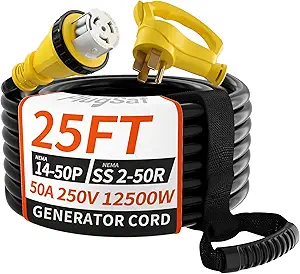
1. PlugSaf 50 Amp Generator Cord – 25 FT Heavy-Duty RV and Generator Cord
If you need a dedicated cable for connecting a generator to a compatible 50 amp RV inlet or generator inlet box, the PlugSaf 50 Amp Generator Cord is one of the most practical options in this group.
Check Amazon Price Click Here!
This cord uses a NEMA 14-50P male plug and SS2-50R locking female connection, making it different from a conventional 14-50P-to-14-50R extension cord.
That distinction is important.
The SS2-50R connection uses a locking mechanism that can help prevent the connection from coming loose during normal movement or vibration. Product information for this PlugSaf model also identifies a heavy-duty STW construction and 50 amp, 250V/12,500W rating.
The 25-foot length is a useful middle ground. It’s long enough for many RV or generator installations without becoming as difficult to store as a 50- or 75-foot cable.
Key Specifications
- Length: 25 feet
- Amperage: 50 amps
- Voltage: Up to 250V
- Connector: NEMA 14-50P to SS2-50R
- Cable Type: Heavy-duty STW
- Design: Twist-lock female connection
- Primary Uses: RVs, portable generators, generator inlet boxes
What I Like
The biggest advantage is the locking connection. If your generator or inlet uses an SS2-50R configuration, this is much more appropriate than buying a standard 14-50R extension cord simply because both products are labeled “50 amp.”
The 25-foot length is also easier to manage than a very long generator cable.
What to Consider
Make sure your equipment actually accepts an SS2-50R connection before ordering. Connector compatibility is more important than simply matching the amp rating.
2. AIVOLT 8000-Watt Dual Fuel Inverter Generator – Portable Power for RVs
For RV owners who need a portable power source rather than just an extension cord, the AIVOLT 8000W Dual Fuel Inverter Generator is the generator option in this guide.
Check Amazon Price Click Here!
The current AIVOLT specifications list 8,000 watts of starting/surge power and 6,100 watts of running power on gasoline, with 7,200 watts of surge and 5,500 watts running on LPG/propane. It uses gasoline or LPG and has a 120/240V capability with a 50 amp outlet.
That makes it considerably more useful for a large RV than a small 2,000- or 3,000-watt inverter generator.
However, there is an important point that shouldn’t be overlooked:
An 8,000-watt generator does not mean your RV can use the full theoretical 12,500 watts available from a 50 amp shore-power connection.
If your RV has two air conditioners, an electric water heater, microwave, refrigerator, battery charger, and other large loads operating at the same time, you may exceed the generator’s running capacity.
The better approach is to calculate the loads you actually need.
Key Specifications
- Peak Output: Up to 8,000W
- Running Output: Up to 6,100W on gasoline
- Fuel: Gasoline and LPG/propane
- Engine: 4-stroke
- Generator Type: Inverter
- 50 Amp Capability: Yes
- Voltage: 120/240V capability
- Weight: About 130.7 pounds
- Use: RVs, camping, emergency and backup power
AIVOLT also lists a CO monitoring system, low-oil shutdown, electric start, and parallel capability among the generator’s features.
Why It Makes Sense for RV Use
The biggest benefit is fuel flexibility.
If gasoline isn’t convenient, propane can provide another way to operate the generator. The inverter design is also useful when you need cleaner electrical output for modern electronics.
The downside is size and weight. At more than 100 pounds, this isn’t the type of generator you’ll casually lift into an RV storage compartment.
For that reason, it makes more sense for larger RVs, trailers, campsites, or backup-power situations where you can move it using its wheels and handle.
Important Limitation
Don’t buy an 8,000-watt generator simply because your RV has a 50 amp electrical connection.
Instead, determine how many watts your largest appliances require, including their startup demands. An air conditioner, for example, can require substantially more power when its compressor starts than when it is already running.
3. YOMILINK 50 FT 50 Amp RV/Generator Cord – Heavy-Duty Long-Reach Option
When 25 feet isn’t enough, a 50-foot cable can make a major difference.
The YOMILINK 50 FT 50 Amp Cord is designed for situations where you need additional distance between the power source and the RV or inlet.
Check Amazon Price Click Here!
This model uses a NEMA 14-50P male connector and SS2-50R twist-lock female connector, along with heavy-duty 6/3 + 8/1 AWG STW wiring according to available product specifications.
The 90-degree grip design is particularly useful because thick 50 amp cables can put considerable leverage on a connection when they hang straight down.
Key Specifications
- Length: 50 feet
- Amperage: 50 amps
- Voltage: 125/250V
- Power Rating: Up to 6,250W at 125V / 12,500W at 250V
- Wire: 6/3 + 8/1 AWG STW
- Connector: NEMA 14-50P to SS2-50R
- Design: Twist-lock
- Use: RVs, generators and compatible inlet systems
Why the 50-Foot Length Matters
Longer isn’t always better.
A 50-foot cord takes up substantially more storage space and is heavier than a 25-foot cable. But it can be extremely useful when the generator needs to remain farther from the RV.
This can be especially helpful when you’re trying to position a portable generator away from occupied areas while still maintaining a practical connection.
The Main Trade-Off
The extra length comes with extra weight.
If your normal campground setup only requires 20 or 25 feet, carrying 50 feet of heavy 50 amp cable may be unnecessary.
But if you regularly camp at locations where the power source is inconveniently positioned, the additional reach can be worth the storage space.
4. CircleCord 50 FT 50 Amp RV/Generator Cord – Heavy-Duty Locking Connection
The CircleCord 50 FT 50 Amp RV/Generator Cord is another long-reach option designed around a locking connection.
Check Amazon Price Click Here!
Available specifications identify a 14-50P male plug and SS2-50R twist-locking female connection, with 6/3 + 8/1 STW construction and pure copper conductors. The cable is also marketed as UL listed, with a heavy-duty jacket designed for outdoor exposure.
One of the more useful design features is the 90-degree connector, which can reduce the amount of downward force placed on the connection point.
Key Specifications
- Length: 50 feet
- Amperage: 50 amps
- Voltage: 125/250V
- Maximum Rating: 6,250W at 125V / 12,500W at 250V
- Wire: 6/3 + 8/1 AWG STW
- Connector: NEMA 14-50P to SS2-50R
- Construction: Pure copper conductors with heavy-duty jacket
- Certification: UL listed according to product specifications
Where This Cord Fits Best
CircleCord makes the most sense when you specifically need a 50-foot 50 amp cable with a locking female connector.
It’s suitable for compatible RV hookups and generator-to-inlet applications.
It’s also worth considering for home backup installations where the generator has to be positioned some distance from the inlet.
One Important Consideration
A 50-foot 50 amp cable is not a lightweight accessory.
The larger conductors required for this type of electrical service make these cords considerably heavier than ordinary household extension cords. Storage and handling should be part of the buying decision.
5. POWGRN 50 Amp RV/EV Extension Cord – 25 FT Standard 14-50 Connection
The POWGRN 50 Amp Extension Cord takes a different approach from the locking cords above.
Check Amazon Price Click Here!
Instead of using an SS2-50R twist-locking female connector, the 25-foot POWGRN model uses a NEMA 14-50P male plug and NEMA 14-50R female receptacle.
That makes it a better fit for applications where both the power source and the equipment use the standard 14-50 connection.
POWGRN lists this model as a 50 amp, 125/250V extension cord with a 6,250/12,500-watt rating and STW construction. The manufacturer also lists an ergonomic grip handle and weather-resistant construction.
Key Specifications
- Length: 25 feet
- Amperage: 50 amps
- Voltage: 125/250V
- Power Rating: 6,250/12,500W
- Connector: NEMA 14-50P to NEMA 14-50R
- Cable: STW
- Use: RVs and compatible EV charging equipment
- Listing: ETL listed according to product information
Why the Connector Matters
This is probably the most important thing to understand about this product.
A 14-50P-to-14-50R cord is not automatically interchangeable with a 14-50P-to-SS2-50R generator cord.
The connectors look similar in terms of their four-conductor configuration, but they are designed for different connection arrangements.
If your RV inlet accepts a standard 14-50R connection, a cord like POWGRN can be appropriate.
If your equipment requires an SS2-50R twist-lock connector, you need a different cable.
50 Amp RV Generator vs. 50 Amp Extension Cord: What’s the Difference?
This distinction is easy to overlook when shopping online.
A generator creates electricity.
An extension cord transports electricity from one compatible connection point to another.
For example, a portable generator might have a 50 amp outlet. You could then use an appropriate generator cord to connect that outlet to an RV inlet or properly installed transfer/inlet equipment.
The generator’s output determines how much power is available.
The cable’s rating determines whether the cable is appropriate for carrying that electrical load.
You need both parts to be compatible.
Buying a 50 amp cord doesn’t turn a 6,000-watt generator into a 12,500-watt power source.
How Much Power Does a 50 Amp RV Need?
A 50 amp RV electrical system can theoretically support substantially more power than a 30 amp RV.
A simplified calculation is:
50 amps × 250 volts = 12,500 watts
That’s why 50 amp RV service is common on larger motorhomes and fifth wheels with multiple high-demand appliances.
However, that doesn’t mean every RV continuously uses 12,500 watts.
Actual consumption depends on the appliances running at a given time.
Common high-demand loads include:
- Roof air conditioners
- Electric water heaters
- Microwaves
- Residential refrigerators
- Induction cooktops
- Coffee makers
- Battery chargers
- Electric space heaters
- Hair dryers
- Other high-wattage appliances
The starting demand of motors and compressors also matters.
This is particularly important when pairing a 50 amp RV with a portable generator.
How to Choose the Right 50 Amp RV Generator
1. Check Running Watts First
Don’t focus only on the generator’s headline peak wattage.
Running watts tell you more about how much equipment the generator can continuously power.
For example, the AIVOLT 8000W has a listed 8,000W surge output but 6,100W running output on gasoline.
That’s the number you should compare with your expected continuous load.
2. Add Startup Loads
Some appliances require more electricity during startup.
Air conditioner compressors, refrigerators, pumps, and other motor-driven equipment can briefly draw additional power.
If your calculated running load is already close to the generator’s maximum, startup demand could cause an overload.
3. Look for 120/240V Capability
If your RV or installation requires a 120/240V generator connection, verify that the generator actually provides the required configuration.
Don’t assume that every generator advertised as “50 amp” provides the same output arrangement.
4. Consider Fuel Type
A dual-fuel generator can operate on gasoline or propane.
That’s useful for emergency preparedness because you have another fuel option when gasoline isn’t convenient.
Gasoline generally provides higher output on many dual-fuel generators, so check the manufacturer’s specifications instead of assuming both fuels provide identical performance.
5. Check Generator Weight
An 8,000-watt generator can be a substantial piece of equipment.
If you travel frequently, consider how you’ll move it from your storage area to the campsite.
Wheels and handles are helpful, but they don’t make a 100-plus-pound generator lightweight.
How to Choose the Right 50 Amp RV Extension Cord
1. Match the Connector First
Before comparing brands, identify the connector your RV or generator uses.
Common configurations include:
- NEMA 14-50P to NEMA 14-50R
- NEMA 14-50P to SS2-50R
- Other manufacturer-specific or installation-specific configurations
A cord can have the correct amp rating and still be the wrong product if the connectors don’t match.
2. Pay Attention to Wire Gauge
Many heavy-duty 50 amp cords use 6/3 + 8/1 AWG construction.
This designation generally means three 6-gauge conductors for the two hot legs and neutral, plus an 8-gauge ground conductor.
It’s a common configuration among heavy-duty 50 amp RV and generator cables.
Don’t judge a cable simply by how thick the outside jacket looks. Check the actual conductor specification.
3. Choose the Shortest Practical Length
A longer cord gives you more flexibility, but it also means:
- More weight
- More storage space
- More cable to coil
- More handling effort
- Potentially greater voltage drop over long distances
If 25 feet is enough for your normal setup, there may be little reason to carry 50 feet.
If your generator or pedestal regularly sits far away, the longer cable can be worthwhile.
4. Look at the Jacket
Outdoor RV cables need insulation and jackets designed for their intended environment.
Look for a cable specifically rated for outdoor or RV/generator use rather than assuming any large extension cord will work.
5. Check the Listing or Certification
UL and ETL listings can provide useful information about product compliance with applicable safety standards.
However, certification should not be the only factor you consider.
The connector configuration, conductor size, amp rating, construction and intended application still need to match your setup.
25-Foot vs. 50-Foot 50 Amp RV Cord
The choice between 25 and 50 feet is largely about your campsite layout.
| Feature | 25-Foot Cord | 50-Foot Cord |
|---|---|---|
| Storage | Easier | More difficult |
| Weight | Lower | Higher |
| Setup | Faster | More cable to manage |
| Reach | Limited | Excellent |
| Typical Use | Close pedestal/generator | Distant pedestal/generator |
| Best For | Frequent travel | Fixed or awkward layouts |
For most RV owners, the best length is the shortest cable that reliably reaches the connection point.
There’s no advantage to carrying another 25 feet of heavy copper cable if you’ll rarely use it.
14-50R vs. SS2-50R: Which Connection Do You Need?
This is one of the most important buying decisions in the entire category.
NEMA 14-50R
A standard 14-50R receptacle is a common four-prong configuration used for 50 amp RV and other high-current applications.
The POWGRN cable in this guide is an example of a 14-50P-to-14-50R extension cord.
SS2-50R Twist Lock
An SS2-50R uses a locking connection.
Models such as PlugSaf, YOMILINK, and CircleCord in this guide use the 14-50P-to-SS2-50R arrangement.
The locking design can be useful for generator connections where preventing accidental separation is important.
Don’t Buy Based on “50 Amp” Alone
The phrase “50 amp” describes the electrical capacity, not the physical connector.
Always verify both ends before ordering.
Can You Use a 50 Amp RV Cord With a Portable Generator?
Yes, provided the generator has the appropriate 50 amp outlet and the cord matches the generator and RV/inlet configuration.
For example, a generator with a compatible 14-50 outlet can use a properly rated 14-50P cord.
However, the generator still determines how much power is actually available.
This is where the AIVOLT 8000W illustrates an important point. Its 50 amp capability doesn’t mean it produces the full theoretical 12,500 watts associated with 50 amp RV service. Its published running output is lower.
You should therefore plan your appliance usage around the generator’s actual continuous and surge capacity.
Can a 50 Amp RV Cord Be Used for Home Backup Power?
Some of these cords can be part of a generator-to-home backup system, but the installation must be designed correctly.
A portable generator should never be connected to a home’s electrical system through an improvised connection or by backfeeding a household receptacle.
A proper installation may involve:
- A generator inlet box
- A correctly sized circuit
- A transfer switch or approved interlock arrangement
- Proper grounding and bonding according to the equipment and installation requirements
- A cord with compatible connectors and adequate ratings
The cord is only one component of the system.
If you’re setting up a generator to supply selected household circuits, have the electrical installation performed according to applicable local requirements and the generator manufacturer’s instructions.
Safety Tips for 50 Amp RV Generators and Cords
High-amperage equipment deserves more attention than an ordinary household extension cord.
Keep the Generator Outdoors
Never operate a gasoline or propane generator inside an RV, garage, basement, shed, or other enclosed or partially enclosed area.
Carbon monoxide can accumulate quickly.
Keep the generator away from doors, windows, vents and other openings according to the manufacturer’s instructions.
Inspect the Cord Before Every Use
Look for:
- Cuts
- Cracked insulation
- Burn marks
- Damaged plugs
- Loose connections
- Bent or damaged blades
- Signs of overheating
Don’t use a damaged 50 amp cable.
Fully Uncoil the Cable
A heavy-duty extension cord should generally be fully uncoiled during high-load operation rather than left tightly bundled.
This helps prevent excessive heat buildup.
Keep Connections Dry
Outdoor-rated equipment still needs to be installed and used according to its rating.
Don’t leave connections sitting in standing water or exposed to conditions outside the manufacturer’s specifications.
Don’t Exceed the Generator’s Capacity
If the generator starts shutting down or its overload protection activates, reduce the electrical load.
Don’t repeatedly reset an overloaded generator without finding the cause.
Use the Correct Inlet Equipment
If you’re connecting a portable generator to an RV or home inlet, use equipment specifically designed for that application.
Never improvise electrical connections just to make two incompatible plugs fit.
Which 50 Amp RV Power Option Makes the Most Sense?
The right choice depends more on your setup than on the product name.
For a 25-Foot Locking Generator Connection
The PlugSaf 50 Amp Generator Cord is the logical choice when you need a 25-foot cable with a locking SS2-50R connection.
For Portable Generator Power
The AIVOLT 8000W Dual Fuel Inverter Generator provides substantially more power than compact RV generators and adds gasoline/propane flexibility. Just remember that its 6,100W gasoline running output is below the theoretical maximum of a full 50 amp RV shore-power connection.
For Long-Reach Generator or RV Connections
The YOMILINK 50 FT 50 Amp Cord is designed for users who need the additional reach of a 50-foot cable while retaining the 14-50P-to-SS2-50R configuration.
For Another Heavy-Duty 50-Foot Locking Cable
The CircleCord 50 FT 50 Amp Cord offers similar 50-foot reach and a locking SS2-50R connection, along with 6/3 + 8/1 construction according to available product information.
For a Standard 14-50 Extension
The POWGRN 50 Amp Extension Cord is the better match when you specifically need a 14-50P-to-14-50R connection rather than a twist-locking female end.
Final Thoughts
Choosing the right 50 amp RV generator and extension cord isn’t simply about finding the product with the highest number on the package.
Start with your RV’s electrical service and determine how much power you actually need. Then check the generator’s continuous wattage, startup capacity, voltage configuration and fuel options.
For the cable, identify the connector first. A 14-50P-to-14-50R extension cord serves a different purpose from a 14-50P-to-SS2-50R locking generator cord.
Length is the next consideration. A 25-foot cord is easier to store and handle, while a 50-foot model can solve a real problem when the generator or campground pedestal is farther away.
Among the products covered here, PlugSaf is aimed at 25-foot locking connections, YOMILINK and CircleCord provide longer 50-foot options, and POWGRN is designed around the standard 14-50P-to-14-50R configuration. The AIVOLT 8000W fills a different role as the portable power source rather than the cable connecting that power to your RV.
The most important thing is to build the system around your actual electrical requirements instead of assuming that every product labeled “50 amp” is interchangeable.
For RV owners who regularly travel, camp without shore power, or maintain a portable backup-power setup, choosing the correct generator, connector and cable length can make hookups easier and help avoid unnecessary electrical problems.