As an Amazon Associate I earn from qualifying purchases.
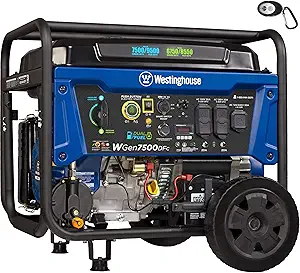
The Westinghouse WGen7500DFc is a 7,500-watt dual-fuel portable generator designed for home backup, jobsite power, and other situations where a larger portable generator makes more sense than a small inverter model. It produces 7,500 running watts and 9,500 peak watts on gasoline, or 6,750 running watts and 8,550 peak watts on propane. It also includes electric start, a wireless remote, recoil backup starting, 120/240V output, and a built-in carbon monoxide sensor with automatic shutdown.
The biggest reason to consider this model is its combination of high continuous output and dual-fuel flexibility. Gasoline provides the generator’s highest rated output, while propane gives homeowners another fuel option for backup power. The WGen7500DFc also has a 6.6-gallon fuel tank, a VFT digital display, GFCI protection, automatic low-oil shutdown, and a transfer-switch-ready 120/240V outlet.
There are, however, a few things to understand before buying. The WGen7500DFc is a conventional open-frame generator, not an inverter generator, it is relatively heavy at about 202 pounds, and it is not RV-ready with a factory TT-30R outlet. Its total harmonic distortion is also listed at up to 23%, so buyers should consider that specification when deciding which electronics and appliances to connect.
Westinghouse WGen7500DFc Specifications
| Feature | Westinghouse WGen7500DFc |
|---|---|
| Model | WGen7500DFc |
| Generator Type | Portable, open-frame, conventional |
| Fuel Type | Gasoline or propane |
| Running Watts, Gasoline | 7,500 watts |
| Peak Watts, Gasoline | 9,500 watts |
| Running Watts, Propane | 6,750 watts |
| Peak Watts, Propane | 8,550 watts |
| Engine | 420cc Westinghouse OHV 4-stroke |
| Fuel Tank | 6.6 gallons |
| Starting System | Electric, remote, and recoil |
| Voltage | 120/240V |
| Frequency | 60 Hz |
| Outlets | 2 × 120V 5-20R GFCI, 1 × 120/240V L14-30R |
| USB Ports | 2 |
| Transfer Switch Ready | Yes |
| ST Switch Ready | Yes |
| RV Ready | No |
| CO Sensor | Yes, automatic shutdown |
| Low-Oil Shutdown | Yes |
| Overload Protection | Yes |
| Digital Display | VFT data center |
| Noise Level | Approximately 72 dBA |
| Dry Weight | Approximately 202.1 lb. |
| Dimensions | Approximately 27.2 × 26.1 × 26 inches |
| Residential Warranty | 3-year limited warranty |
| Commercial Warranty | 1-year limited warranty |
Specifications can vary by documentation or production listing, so buyers should verify the current product documentation before purchase.
How Much Power Does the WGen7500DFc Produce?
The WGen7500DFc produces 7,500 running watts and 9,500 peak watts on gasoline. When operating on propane, output drops to 6,750 running watts and 8,550 peak watts.
The distinction between running watts and peak watts matters. Running watts represent the amount of power the generator can continuously provide, while peak watts are intended to handle temporary startup demands from equipment with electric motors or compressors.
For example, a refrigerator, freezer, sump pump, well pump, furnace blower, or air-conditioning equipment can require additional power when its motor starts. That means you should not simply add the running wattage of your appliances and assume the generator will automatically handle every combination.
For a home backup installation, calculate both the continuous load and expected starting surge. If you want to operate a central air-conditioning system, check the electrical requirements on the actual equipment rather than assuming that 7,500 running watts will be sufficient.
The generator’s 120/240V output also makes it more suitable for certain home backup applications than a portable generator limited to 120V.
Gasoline vs. Propane Performance
One of the most useful features of the WGen7500DFc is its dual-fuel system.
On gasoline, the generator provides its highest output:
- 7,500 running watts
- 9,500 peak watts
On propane, the output is:
- 6,750 running watts
- 8,550 peak watts
That difference is worth remembering when planning a backup-power setup. If your household load is close to the generator’s maximum capacity, gasoline provides more available power.
Propane can still be attractive for emergency preparedness because many homeowners prefer keeping propane available for backup use rather than storing large quantities of gasoline.
Westinghouse also states that the generator can switch between gasoline and propane without shutting the unit off, which adds convenience when managing fuel during an extended outage.
Fuel Tank and Runtime
The WGen7500DFc uses a 6.6-gallon gasoline tank with a built-in fuel gauge.
Runtime depends heavily on electrical load, so the advertised maximum should not be interpreted as a fixed number of hours under every condition. Westinghouse lists up to 11 hours of gasoline runtime under its specified test condition, while propane runtime is listed at up to 8 hours with a 20-pound propane tank under the corresponding test condition.
Actual runtime can change depending on:
- Total electrical load
- Fuel quality
- Ambient temperature
- Maintenance condition
- Fuel type
- How frequently connected appliances cycle on and off
For an outage lasting several days, the dual-fuel design can be particularly useful because it gives you another fuel option when gasoline availability becomes inconvenient.
Electric Start, Remote Start, and Recoil Backup
The WGen7500DFc offers three starting methods: electric start, wireless remote start, and recoil start.
The electric start is useful for normal operation, while the remote key fob adds convenience when the generator is positioned outside the home. The recoil starter provides a manual backup if the electric starting system or battery is unavailable.
The generator also includes a battery, and Westinghouse provides a battery float charger with the unit.
The remote starter is especially useful during bad weather because you do not necessarily have to stand beside the generator every time you want to start or stop it. Actual wireless range can vary depending on walls, interference, and other conditions, so it is better to treat the remote as a convenience feature rather than rely on a specific maximum distance.
VFT Digital Display
One of the practical features that is easy to overlook is the VFT Data Center.
The display provides real-time information including:
- Voltage output
- Frequency
- Lifetime operating hours
That information can be useful when monitoring the generator during an outage and when keeping track of maintenance.
Instead of relying only on an approximate schedule, the hour information gives you a better reference for tracking how much the generator has actually been used.
Outlet Configuration
The WGen7500DFc has a useful selection of outlets for household and general-purpose applications.
The current configuration includes:
- Two 120V 5-20R GFCI duplex outlets
- One 120/240V L14-30R twist-lock outlet
- Two USB ports
The L14-30R outlet is particularly important for home backup because it is transfer-switch ready.
One correction worth making clear is that the WGen7500DFc does not have a built-in TT-30R RV outlet. Westinghouse currently lists the model as not RV-ready. If RV use is your primary reason for buying a generator, check the receptacle configuration carefully before purchasing.
Is the WGen7500DFc an Inverter Generator?
No.
The WGen7500DFc is a conventional open-frame generator with automatic voltage regulation, not an inverter generator.
Westinghouse lists total harmonic distortion at up to 23%. That makes the model different from many modern inverter generators that are specifically designed to provide cleaner power for sensitive electronics.
For basic household loads, power tools, pumps, refrigerators, lighting, and similar equipment, the WGen7500DFc’s conventional design can make sense. However, if your priority is powering sensitive electronics directly from a generator, look closely at the electrical specifications of both the generator and your equipment.
A transfer switch or appropriate power-management equipment can also change how you distribute generator power through a home.
Transfer-Switch Ready for Home Backup
The WGen7500DFc is designed with a 120/240V L14-30R outlet that is transfer-switch ready.
That makes it more appropriate for homeowners who want a more organized backup-power setup rather than running multiple extension cords throughout the house.
A portable generator should never be connected directly to a home’s electrical system through an improvised connection. A properly installed transfer switch or other approved connection method is important to prevent dangerous backfeeding.
If you are planning whole-home or selected-circuit backup, have the electrical installation evaluated by a qualified electrician and make sure the transfer equipment is compatible with the generator and the circuits you intend to power.
Carbon Monoxide Sensor and Safety Features
The WGen7500DFc includes a carbon monoxide sensor with automatic shutdown.
Other built-in safety features include:
- Automatic low-oil shutdown
- Overload protection
- GFCI outlets
- Covered outlets
- Automatic voltage regulation
- Bonded-neutral grounding system
The CO sensor is an important additional safety feature, but it should never be treated as permission to operate the generator in an unsafe location.
The U.S. Consumer Product Safety Commission recommends operating portable generators outside and at least 20 feet from the home, with exhaust directed away from doors, windows, and vents.
Never operate this generator inside a home, garage, basement, crawlspace, shed, or another enclosed area. Opening a door or window does not make indoor generator operation safe.
The CO shutdown system is an extra layer of protection. It does not replace proper generator placement, ventilation, maintenance, or the safety instructions in the owner’s manual.
Weight and Portability
At approximately 202.1 pounds dry, the WGen7500DFc is not a lightweight portable generator.
Its wheels and folding handle make it considerably easier to move across a driveway, garage floor, or other reasonably level surface, but moving a 200-pound generator still requires planning.
This is one of the tradeoffs of choosing a 7,500-watt conventional generator. You get substantially more output than a small portable inverter generator, but you also get a larger frame, larger engine, and significantly more weight.
If you expect to move the generator frequently by yourself, its size should be part of your buying decision.
Noise Level
Westinghouse lists the WGen7500DFc at approximately 72 dBA.
That is within the range expected from a large open-frame generator, but it is not a quiet inverter generator.
For residential use, placement matters. The generator should be positioned outdoors in accordance with safety requirements, with the exhaust directed away from the home and occupied areas. Do not attempt to solve noise concerns by placing the generator closer to the house or inside an enclosed structure.
If low noise is a major priority, an inverter generator may be a better category to investigate.
Maintenance and Ownership
Like other gasoline-powered portable generators, the WGen7500DFc needs regular maintenance even if you rarely experience outages.
Important maintenance items include:
- Engine oil changes
- Air-filter inspection and cleaning or replacement
- Spark-plug inspection
- Battery maintenance
- Fuel-system care
- Periodic test runs
- Inspection of electrical connections and outlets
The built-in hour meter helps track operating time, but maintenance intervals should be based on the current owner’s manual rather than a generic schedule.
It is also worth remembering that a generator that sits unused for months can be less useful during an emergency if it has not been tested. Periodically checking the starting system and confirming that the generator operates correctly is part of being prepared.
Westinghouse lists a 3-year limited residential warranty and a 1-year limited commercial warranty for the model.
Who Is the WGen7500DFc Best Suited For?
The WGen7500DFc makes the most sense for buyers who need substantial portable output and want the flexibility of two fuels.
Potential applications include:
- Home backup power for essential circuits
- Refrigerators and freezers
- Sump and well pumps
- Lighting and household appliances
- Selected HVAC equipment, when the starting and running requirements are compatible
- Construction and jobsite equipment
- Cabins and other properties without reliable utility power
- Emergency preparedness
- Outdoor events where a large conventional generator is appropriate
The 120/240V output and transfer-switch-ready connection make it particularly relevant to homeowners planning a more permanent portable-generator backup setup.
However, buyers who specifically need an RV-ready generator, a lightweight unit, very quiet operation, or inverter-style power characteristics should look at other generator categories before deciding.
What I Like About the WGen7500DFc
The strongest points are practical rather than flashy.
7,500 running watts gives the generator enough continuous capacity for a substantial number of household and jobsite loads. The dual-fuel system gives you a choice between gasoline and propane, while the electric, remote, and recoil starting options provide useful flexibility.
The 120/240V L14-30R outlet, CO sensor, GFCI protection, VFT display, fuel gauge, and low-oil shutdown also make the generator more useful as a serious backup-power machine rather than simply a high-output portable power source.
The main tradeoffs are its 202.1-pound weight, open-frame design, conventional rather than inverter power system, and lack of a factory RV-ready TT-30R outlet.
Those limitations are important because they help determine whether this particular generator fits your situation.
Final Verdict on the Westinghouse WGen7500DFc
The Westinghouse WGen7500DFc is a high-output dual-fuel portable generator built around a straightforward idea: provide substantial backup power while giving the owner a choice between gasoline and propane.
Its 7,500 running watts on gasoline, 6,750 running watts on propane, 120/240V output, electric and remote start, recoil backup, CO sensor, GFCI protection, and transfer-switch-ready L14-30R outlet make it well suited to homeowners who need more power than a compact generator can provide.
At the same time, this is not a small or especially quiet machine. At roughly 202 pounds, it is a serious piece of equipment. It is also not an inverter generator and is not factory RV-ready, so those requirements should be checked before purchase.
For emergency preparedness, the most important step is to match the generator’s running and starting wattage to the actual appliances and circuits you intend to use. If you plan to connect it to your home’s electrical system, use properly installed transfer equipment rather than attempting an improvised connection.
For buyers who need a substantial open-frame generator with gasoline/propane flexibility, the WGen7500DFc is worth examining as part of the 2026 portable-generator market.